Formik: Custom onBlur on Field overrides default behavior
Bug, Feature, or Question?
Bug/Feature
Current Behavior
a Field with a custom onBlur removes the default validation/touched behavior
<Field name="fname" onBlur={() => console.log("custom")} />
https://codesandbox.io/s/yk9mmj1kwx
Desired Behavior
custom onBlur prop will be chained to the internal handleBlur
Suggested Solutions
in handleBlur
if (this.props.onBlur) this.props.onBlur()
- Formik Version: 0.11.11
- React Version: 16.2
- CodeSandbox Link: https://codesandbox.io/s/yk9mmj1kwx
 elado
elado
All 9 comments
Hrmmm. Need to think about this one
 jaredpalmer
on 29 Mar 2018
jaredpalmer
on 29 Mar 2018
This is why I didn't want to make a PR first ;)
If it's too breaking, how about another preserveBlurBehavior boolean?
elado
on 29 Mar 2018
Hola! So here's the deal, between open source and my day job and life and what not, I have a lot to manage, so I use a GitHub bot to automate a few things here and there. This particular GitHub bot is going to mark this as stale because it has not had recent activity for a while. It will be closed if no further activity occurs in a few days. Do not take this personally--seriously--this is a completely automated action. If this is a mistake, just make a comment, DM me, send a carrier pidgeon, or a smoke signal.
![stale[bot] picture](https://avatars3.githubusercontent.com/in/1724?v=4&s=40) stale[bot]
on 15 Aug 2018
stale[bot]
on 15 Aug 2018
ProBot automatically closed this due to inactivity. Holler if this is a mistake, and we'll re-open it.
stale[bot]
on 22 Aug 2018
This would be nice - I'd like to prefill another field based on the content of another, after onBlur.
 charlax
on 21 Jan 2019
charlax
on 21 Jan 2019
Here's my solution with the Formik's field.onBlur prop. Wrapped Formik's onBlur handler with my own. Had to resort to a setTimeout as it seems field.touched and field.errors aren't immediately available after formik's onBlur event is called:
...
<Field name={name} id={name} component={CustomInputText} />
...
class CustomInputText extends React.PureComponent {
handleBlur = e => {
const {
field: { name, onBlur },
} = this.props;
onBlur(e);
// The latest touched and errors aren't available until after the
// formik's onBlur handler has been called. Setting a timeout allows us
// to access the proper touched and errors after onBlur event has
// occurred.
setTimeout(() => {
const {
form: { touched, errors },
} = this.props;
const isError = touched[name] && errors[name];
const isSuccess = touched[name] && !errors[name];
if (isError) {
console.log('validation error');
}
if (isSuccess) {
console.log('validation success');
}
}, 0);
};
render() {
const { field, ...otherProps } = this.props;
return (
<input
className="floating-field"
type="text"
{...field}
{...otherProps}
onBlur={this.handleBlur}
/>
);
}
}
 vai0
on 25 Feb 2019
vai0
on 25 Feb 2019
How about this?
function formikOnBlur(evt) {
  // formiks default handler
}

function getFieldProps(props) {
  return {
    ...props,
    onBlur: (...args) => {
      formikOnBlur(...args);
      props.onBlur && props.onBlur(...args);
    },
    // ... other props
  };
}

<Field name="email">
  {field => (
    <input
      {...field.getFieldProps({
        onBlur: () => console.log('blur'),
      })}
    />
  )}
</Field>
props getter would chain "overrides" props while still keeps Formik work.
 Andreyco
on 26 Feb 2019
Andreyco
on 26 Feb 2019
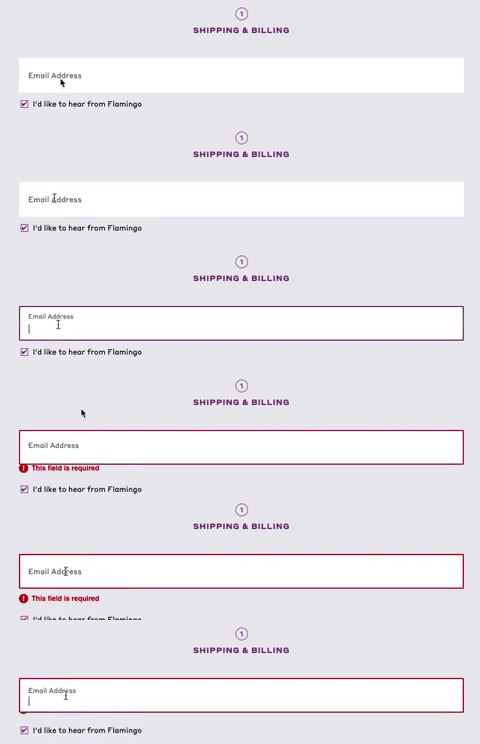
This would be a really helpful feature for interactions like this one.
 maecapozzi
on 26 Mar 2019
maecapozzi
on 26 Mar 2019
I'm a big fan of the approach outlined by @Andreyco. This would follow the 'prop getters' pattern as is outlined here: https://kentcdodds.com/blog/how-to-give-rendering-control-to-users-with-prop-getters
It's used to great effect in https://github.com/downshift-js/downshift
 seanders
on 4 Apr 2019
seanders
on 4 Apr 2019
Related issues
 dearcodes
·
3Comments
dearcodes
·
3Comments
 sibelius
·
3Comments
sibelius
·
3Comments
 jeffbski
·
3Comments
jaredpalmer
·
3Comments
jeffbski
·
3Comments
jaredpalmer
·
3Comments
 najisawas
·
3Comments
najisawas
·
3Comments
Most helpful comment
How about this?
propsgetter would chain "overrides" props while still keeps Formik work.