Fontbakery: Render Markdown on the text terminal output
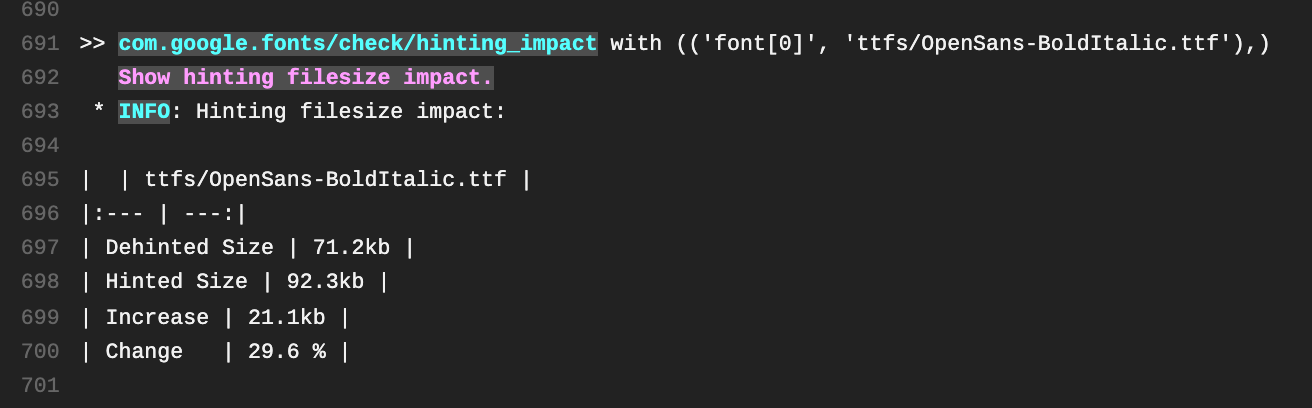
it would be nice to use Markdown syntax for everything and then render it into something more beautiful than what we get now in cases like this:
 felipesanches
All 12 comments
For the specific case of rendering tables, we could use box-drawing characteres as was often used on MS-DOS programs like this:
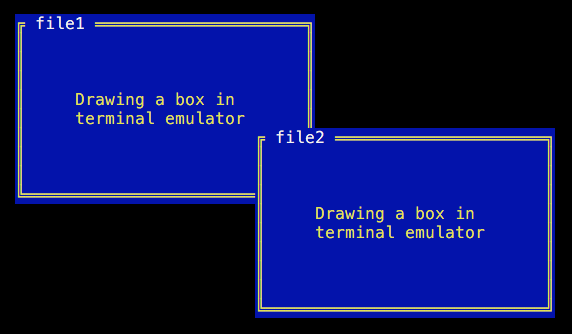
Maybe with some python code equivalent to this:
https://github.com/piotrmurach/tty-box
felipesanches
on 21 Jun 2019
+1 for fontbakery reminding me of Rogue
 laerm0
on 21 Jun 2019
laerm0
on 21 Jun 2019
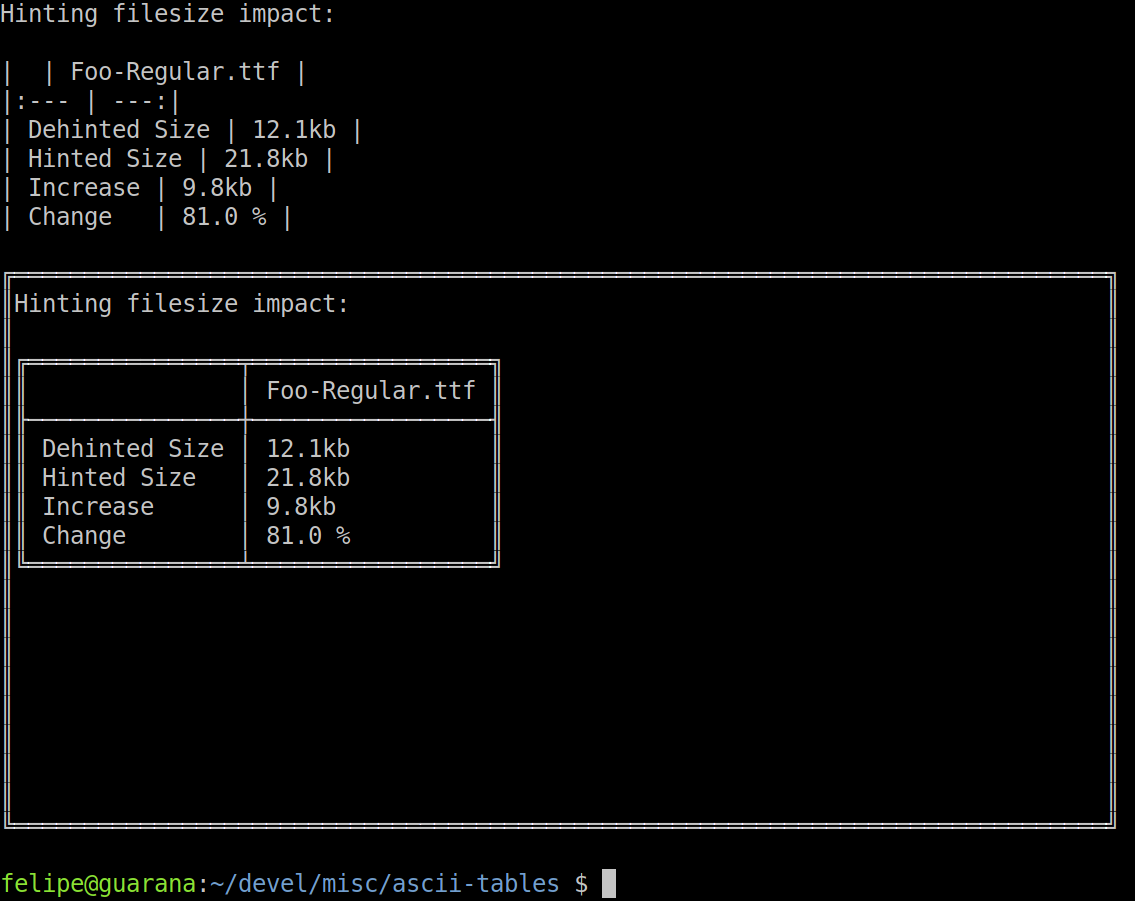
I took some free time this weekend to experiment with this funny idea. I got the following markdown table from our hinting_impact check and drafted some python routines to render them as ascii-art tables:
|  | Foo-Regular.ttf |
|:--- | ---:|
| Dehinted Size | 12.1kb |
| Hinted Size | 21.8kb |
| Increase | 9.8kb |
| Change   | 81.0 % |
| | Foo-Regular.ttf |
|:--- | ---:|
| Dehinted Size | 12.1kb |
| Hinted Size | 21.8kb |
| Increase | 9.8kb |
| Change | 81.0 % |
felipesanches
on 23 Jun 2019
How do you access this hinting impact check Felipe?
 chrissimpkins
on 23 Jun 2019
chrissimpkins
on 23 Jun 2019
Em dom, 23 de jun de 2019 13:44, Chris Simpkins notifications@github.com
escreveu:
How do you access this hinting impact check Felipe?
—
You are receiving this because you authored the thread.
Reply to this email directly, view it on GitHub
https://github.com/googlefonts/fontbakery/issues/2559?email_source=notifications&email_token=AABUFLDF7VRXPF6UTKGCMODP36R65A5CNFSM4H2TVEPKYY3PNVWWK3TUL52HS4DFVREXG43VMVBW63LNMVXHJKTDN5WW2ZLOORPWSZGODYLCN2Q#issuecomment-504768234,
or mute the thread
https://github.com/notifications/unsubscribe-auth/AABUFLE4FZMVX75PWXEOKITP36R65ANCNFSM4H2TVEPA
.
felipesanches
on 23 Jun 2019
@aurium, here's the issue describing the markdown table parsing/rendering task
I'll look for the table drawing routines in my hard-drive and post them here soon
felipesanches
on 13 Mar 2021
here's an early prototype. Feel free to reuse this code in a pull request:
def hinting_impact(font, ttfautohint_stats):
  """Show hinting filesize impact.

     Current implementation simply logs useful info
     but there's no fail scenario for this checker."""

  hinted = ttfautohint_stats["hinted_size"]
  dehinted = ttfautohint_stats["dehinted_size"]
  increase = hinted - dehinted
  change = (float(hinted)/dehinted - 1) * 100

  def filesize_formatting(s):
    if s < 1024:
      return f"{s} bytes"
    elif s < 1024*1024:
      return "{:.1f}kb".format(s/1024)
    else:
      return "{:.1f}Mb".format(s/(1024*1024))

  hinted_size = filesize_formatting(hinted)
  dehinted_size = filesize_formatting(dehinted)
  increase = filesize_formatting(increase)

  results_table = "Hinting filesize impact:\n\n"
  results_table += f"|  | {font} |\n"
  results_table += "|:--- | ---:|\n"
  results_table += f"| Dehinted Size | {dehinted_size} |\n"
  results_table += f"| Hinted Size | {hinted_size} |\n"
  results_table += f"| Increase | {increase} |\n"
  results_table += f"| Change   | {change:.1f} % |\n"
  return results_table


def add_border(buf, width, height):
  #top border
  newbuf = u"\u2554" + (width-2)*u"\u2550" + u"\u2557\n"

  #content
  for line in buf.split('\n'):
    newbuf += u"\u2551" + line + " "*max(0, width - len(line) - 2) + u"\u2551\n"

  #whitespace
  for i in range(max(0, height - len(buf.split('\n')) -2)):
    newbuf += u"\u2551" + " "*(width-2) + u"\u2551\n"

  #bottom border
  newbuf += u"\u255A" + (width-2)*u"\u2550" + u"\u255D\n"

  return newbuf

def padded(widths, cells):
  padded_cells = []
  for i, cell in enumerate(cells):
    padded_cells.append(cell + " "*max(0, widths[i]-len(cell)))
  return padded_cells


def render_table(lines):
  table = []
  widths = []
  for line in lines:
    cells = line.split("|")
    cells.pop(0)
    cells.pop(-1)
    table.append(cells)
    for i, cell in enumerate(cells):
      if i >= len(widths):
        widths.append(len(cell))
      else:
        widths[i] = max(widths[i], len(cell))

  # compute total table width:
  width = len(widths) + 1
  for w in widths:
   width += w

  #top border
  newbuf = u"\u2554" + u"\u2564".join([w*u"\u2550" for w in widths]) + u"\u2557\n"

  #header
  newbuf += u"\u2551" + u"\u2502".join(padded(widths, table[0])) + u"\u2551\n"

  #header separator
  newbuf += u"\u255F" + u"\u253C".join([w*u"\u2500" for w in widths]) + u"\u2562\n"

  #table body
  for i in range(2,len(table)):
    newbuf += u"\u2551" + u"\u2502".join(padded(widths, table[i])) + u"\u2551\n"

  #bottom border
  newbuf += u"\u255A" + u"\u2567".join([w*u"\u2550" for w in widths]) + u"\u255D\n"

  return newbuf

def render_markdown(buf):
  new_buf=""
  table_lines = []
  for line in buf.split('\n'):
    if '|' in line:
      table_lines.append(line)
    else:
      if table_lines:
        new_buf += render_table(table_lines)
        table_lines = []
      new_buf += line + "\n"
  return new_buf

stats = {
  'hinted_size': 22345,
  'dehinted_size': 12345,
}

input_str = hinting_impact("Foo-Regular.ttf", stats)
output = render_markdown(input_str)

print (input_str)

print (add_border(output, 80, 20))
Hi folks,
I'm working on this, and i think makes sense to parse status messages as MD and rich.markdown will help a lot. Unluckily that lib does not recognizes MD tables.
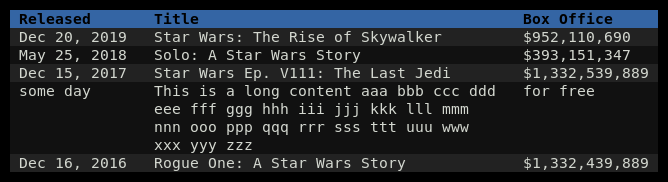
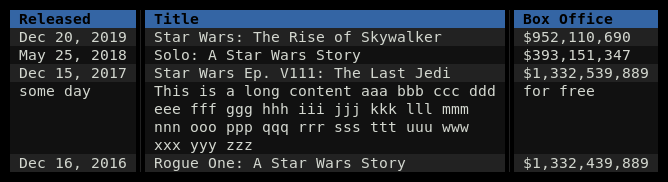
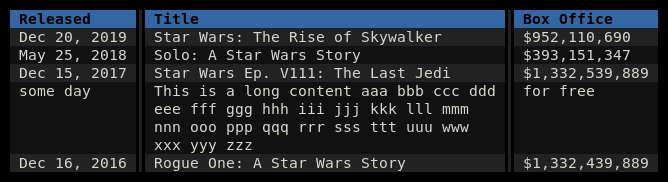
I just make a MD Table parser to work with rich and The table itself can be printed with rich.table. I have my beliefs about how a table must to be printed on a console. I'm against borders and horizontal lines that will only steal space. We can understand the table using zebra background and a special bg to headers.
However, I will be happy to know what kind of vertical separator you prefer.
I'm putting 3 options below and you can vote with :+1: or :-1: emoji reaction on the comment top-right corner.
_(Hey, sure, you can comment against my beliefs if you disagree. I'm open to listen.)_
 aurium
on 18 Mar 2021
aurium
on 18 Mar 2021
No explicit separator (there is enough margin)
aurium
on 18 Mar 2021
Light separator
aurium
on 18 Mar 2021
Hard (or bold) separator
aurium
on 18 Mar 2021

aurium
on 10 Apr 2021
Related issues
 arialcrime
·
9Comments
felipesanches
·
9Comments
arialcrime
·
9Comments
felipesanches
·
9Comments
 m4rc1e
·
8Comments
felipesanches
·
5Comments
felipesanches
·
6Comments
m4rc1e
·
8Comments
felipesanches
·
5Comments
felipesanches
·
6Comments
Most helpful comment