Fmt: Allow specifying named arguments as brace initializer lists
It would be extremely convenient if we could write
fmt::format("{foo} {bar}", {"foo", 123}, {"bar", "..."});
Please consider it.
 rokups
All 11 comments
Interesting idea. Does this API have any advantage over the currently supported UDL-based one?
fmt::format("{foo} {bar}", "foo"_a=123, "bar"_a="...");
 vitaut
on 28 Feb 2018
vitaut
on 28 Feb 2018
I would argue it is more self-explanatory and intuitive.
rokups
on 28 Feb 2018
The thing about UDLs is that you generally have to write at least one using somewhere, which might be something that you may not want to do when having a single call to fmt::format in the middle of a function.
 Morwenn
on 1 Mar 2018
Morwenn
on 1 Mar 2018
Seems reasonable. PRs are welcome =).
vitaut
on 1 Mar 2018
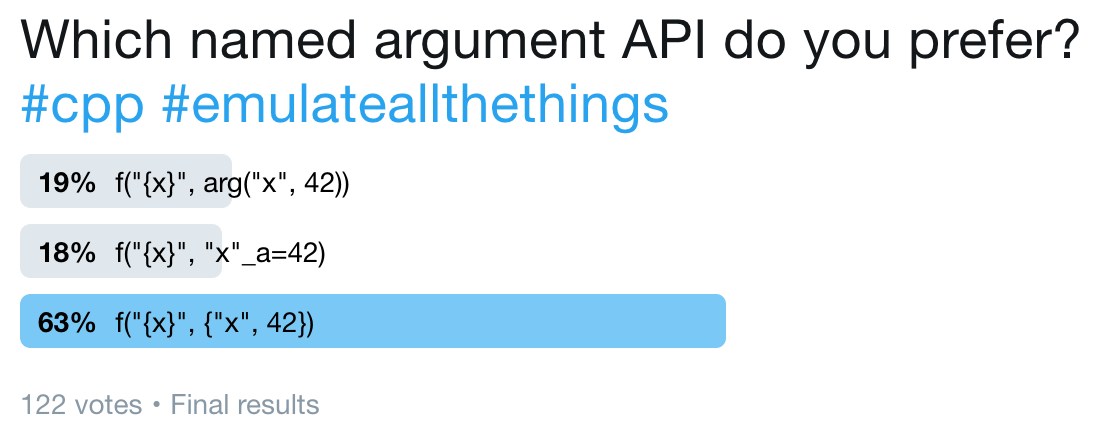
@rokups, the Twitter crowd prefers your proposed API (https://twitter.com/vzverovich/status/970309902374617090):
vitaut
on 7 Mar 2018
One small concern I have with this API is that it can be a bit confusing when the arguments are strings (i.e. it'd be harder to tell from a glance in {"foo", "bar"} what is the name and what is the arg, especially if there is also {'bar", "foo"}), but it's nothing critical (it's not hard to remember the order once you've used it).
 danilaml
on 9 Apr 2018
danilaml
on 9 Apr 2018
How is it hard? Pairs are always defined as {"key", "value"}. Maybe it is hard for one that does not know the language, but then again in such case everything is hard in c++.
rokups
on 9 Apr 2018
You can use fmt::arg:
fmt::format("{foo} {bar}", fmt::arg("foo", 123), fmt::arg("bar", "..."));
 khalilfazal
on 10 Apr 2018
khalilfazal
on 10 Apr 2018
This problem(enhancement) is actually harder than it seems.
The templated arg function (in core.h) takes in a string view and a templated variable, and constructs a class called named_arg.
The problem is that initializer lists need to construct an object, but the object, like the arg function, also need to be templated, and it seems like you can’t deduce templates in function parameters, so you need to construct the object before passing it to the function, which is not optimal.
basically
template<typename T>
struct obj {
    string_view view;
    T val;
    obj(const string_view& _view, const T& _val) : view(_view), val(_val) {}
    auto make_arg(){/*make named arg*/}
};

template<typename String>
print(String str, const obj& ...args) {
// obj needs to be templated, but the template cannot be deduced from a function parameter
// there is also (I think) no way of having an array of different data types without destroying the type
}

fmt::print("{name}", {"name", "val"});
 DimmyJing
on 11 Apr 2018
DimmyJing
on 11 Apr 2018
I'm fairly sure that this is impossible, I worked very hard trying to do something similar for a logging framework I was involved in and it just didn't work. Initializer lists can't be forwarded, so variadics (which generally depend on forwarding) and initializer lists don't mix. I tried to pull the variadic template as a template parameter in, but that didn't work for reasons that are unclear to me: http://coliru.stacked-crooked.com/a/6561625a609d82b9. Anyhow, I mostly commented so I can be on this thread, so that if someone succeeds I can learn something :-).
 quicknir
on 11 Apr 2018
quicknir
on 11 Apr 2018
It looks like this is impossible unfortunately, so closing for now.
vitaut
on 14 May 2018
Related issues
 beojan
·
5Comments
beojan
·
5Comments
 wkenyon
·
3Comments
wkenyon
·
3Comments
 stryku
·
4Comments
stryku
·
4Comments
 dalle
·
3Comments
dalle
·
3Comments
 ugenehan
·
3Comments
ugenehan
·
3Comments
Most helpful comment
@rokups, the Twitter crowd prefers your proposed API (https://twitter.com/vzverovich/status/970309902374617090):