Proposal
It would be useful for library definitions to have a new utility type $Not<A>, to create a type that accepts any type except type A.
Use case
For example in flow-typed ramda definition we have something like:
declare type $npm$ramda$Placeholder = { "@@functional/placeholder": true, ... };

declare type __CurriedFunction1<A, R, AA: A> = (...r: [AA]) => R;
declare type CurriedFunction1<A, R> = __CurriedFunction1<A, R, *>;

declare type __CurriedFunction2<A, B, R, AA: A, BB: B> = (
    ((...r: [AA]) => CurriedFunction1<BB, R>) &
    ((...r: [$npm$ramda$Placeholder, BB]) => CurriedFunction1<AA, R>) &
    ((...r: [AA, BB]) => R)
);
declare type CurriedFunction2<A, B, R> = __CurriedFunction2<A, B, R, *, *>;
This cause FlowJs to hit recursion limit more often , I guess we could help flowJs with $Not utility type such as:
declare type __CurriedFunction2<
  A: $Not<$npm$ramda$Placeholder>,
  B: $Not<$npm$ramda$Placeholder>,
  R,
  AA: A,
  BB: B
> = (
    ((...r: [AA]) => CurriedFunction1<BB, R>) &
    ((...r: [$npm$ramda$Placeholder, BB]) => CurriedFunction1<AA, R>) &
    ((...r: [AA, BB]) => R)
);
I'd also like to implement this feature, but I'm having serious trouble to understand the codebase. But I'm decided to give it a try
 moroine
All 23 comments
@moroine what's trouble?
 goodmind
on 18 Aug 2019
goodmind
on 18 Aug 2019
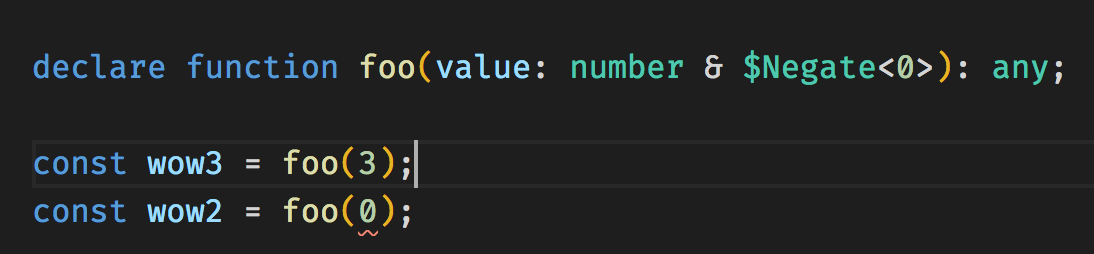
I'll try to implement, if you still want to dive into codebase just ask me in Flow discord
goodmind
on 18 Aug 2019
@moroine
goodmind
on 18 Aug 2019
Can you make full example, so I can test if it works for your case?
goodmind
on 18 Aug 2019
That's amazing!
I've created a test case below.
https://flow.org/try/#0CYUwxgNghgTiAEAXAngBwQEgHaoLYZil2CgwAVowQALAewlBngF54BveAIgAFuAzAK5YwiAJa0sUCAHpUlGvUacAXEhgCQAGngA6PfAC+AbgBQJ0JFgJBwsRPi4QMAOYgAPAEFtAIQB8ACi94bwBKVQ49HQwAUQAPKBFPX21ImPjEv0NTC2g4eBsRcSwHJ1dPHwCPMOCWX3ZdPTSExCSUxrjmt0zjE2lpeByrfKFC+0cXd17++HgPVQwAORBnKER3bDwCIhJyeToGJ2SpmeD5pZW1tw38QmJSCgSFA5hfY8rq71r61I7Ej2SGlFfi1utlwLlrCM7MVxmUgn5-Nctnddo99owfNUPF8Iu10i1-m0gfiunUeiYwBIAM6IeAAfTp8xwN229z2iicLHqPH4UKKUlk7OeKjUGiyZkpWBp8BgAEZwvAoKosAJcAAjJzaNWqGkwURYZyGLmwkD+DhK+CywzaDja+AAcjV9sMIVMJv8DJtitUVoMITN8DtjudftMZjMfWCAlpokQ9qp8AA7rQYABrfWGxOx6iK4DAczgoYFaG54D+FXqzXwCsamDVGtOMGWPLFoql8uq2v1zuc5h1BswJsQ4a2NtQPOI5nInYPKjoqsD7uVph96s9wdmcdlz2W-0AJldQA
moroine
on 19 Aug 2019
Doesn't work :\
goodmind
on 19 Aug 2019
Did you push your work somewhere, I'd like to have a look and maybe trying to help
moroine
on 19 Aug 2019
No, wait, I'll push
goodmind
on 19 Aug 2019
goodmind
on 19 Aug 2019
I'd like to be able to use $Negated to model n-ary operations that take at least 2 operands, e.g.
type AtLeastTwo<T> = T[] & $Negated<[] | [T]>;
type Expr = {
   kind: "add",
   args: AtLeastTwo<number>,
} | {
   kind: "mul",
   args: AtLeastTwo<number>,
} | ...

({kind: "add", args: []}: Expr); // error
({kind: "add", args: [1]}: Expr); // error
({kind: "add", args: [1, 2]}: Expr); // okay
@goodmind would what I wrote work with the $Negated you implemented?
 kevinbarabash
on 19 Aug 2019
kevinbarabash
on 19 Aug 2019
It's not easy to jump into Ocaml... I've read the Ocaml doc, but this codebase is too complex for me 😞
I'll try to follow & understand, but there is no way I can be useful on this one except writing documentation.
moroine
on 19 Aug 2019
@moroine did you manage to build it?
you can learn ReasonML first, then OCaml
goodmind
on 20 Aug 2019
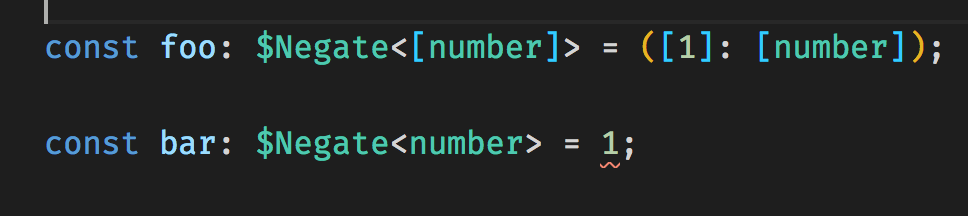
@kevinbarabash I don't think it does, maybe quick_subtype doesn't support tuples
goodmind
on 20 Aug 2019
Nah, quick_subtype is useless, doesn't work with most types
goodmind
on 20 Aug 2019
That's too bad. Thanks for checking.
kevinbarabash
on 20 Aug 2019
Instead of adding $Not to Flow (which I'm not convinced is necessary nor desirable), let's take a closer look at the libdef to see if it can be simplified.
declare type $npm$ramda$Placeholder = { "@@functional/placeholder": true, ... };

declare type __CurriedFunction1<A, R, AA: A> = (...r: [AA]) => R;
declare type CurriedFunction1<A, R> = __CurriedFunction1<A, R, *>;

declare type __CurriedFunction2<A, B, R, AA: A, BB: B> = (
    ((...r: [AA]) => CurriedFunction1<BB, R>) &
    ((...r: [$npm$ramda$Placeholder, BB]) => CurriedFunction1<AA, R>) &
    ((...r: [AA, BB]) => R)
);
declare type CurriedFunction2<A, B, R> = __CurriedFunction2<A, B, R, *, *>;
A few things don't make sense to me here:
- _CurriedFunction1 doesn't use
Ain it's type. Why is the type param necessary? Same with A and B in _CurriedFunction2 *is deprecated but used everywhere. This could also be contributing to the stack overflows (which is very deep, btw. you have to make Flow recurse 10k times into a single type for that to happen, which means it might actually be in an infinite loop). I don't think this libdef would need*at all if it cut down on the amount of type params it has.- Why do you need $Not? Couldn't you just put the rambda placeholder first in the overload?
  ((...r: [$npm$ramda$Placeholder, BB]) => CurriedFunction1<AA, R>) &
  ((...r: [AA]) => CurriedFunction1<BB, R>) &
  ((...r: [AA, BB]) => R)
 jbrown215
on 21 Aug 2019
jbrown215
on 21 Aug 2019
Somewhat related, but I would love to be able to specify a non-callable object type. As far as I can tell that is currently impossible with Flow. Also related, but being able to specify object types that don't have certain properties with some kind of sigil, perhaps ! prefixing the key would also be great:
type FooBar = {| foo: string, bar: number |};
type JustBar = {| ...FooBar, !foo: any |}; // equivalent to {| bar: number |}
type NonCallableObject = { ![[call]]: any };
 jcready
on 22 Aug 2019
jcready
on 22 Aug 2019
@jbrown215 thanks for taking the time to have a look at the ticket
- _CurriedFunction1 doesn't use
Ain it's type. Why is the type param necessary? Same with A and B in _CurriedFunction2
After some investigations, I found out the reason. A lot of ramda function are defined using var instead of function which errors when using your proposal. Try flow
This will make impossible to use CurriedFunction helper, as it needs to be done at each level. Do you have any suggestion on how to type this?
2.
*is deprecated but used everywhere. This could also be contributing to the stack overflows (which is very deep, btw. you have to make Flow recurse 10k times into a single type for that to happen, which means it might actually be in an infinite loop). I don't think this libdef would need*at all if it cut down on the amount of type params it has.
👍
3. Why do you need $Not? Couldn't you just put the rambda placeholder first in the overload?
  ((...r: [$npm$ramda$Placeholder, BB]) => CurriedFunction1<AA, R>) &
  ((...r: [AA]) => CurriedFunction1<BB, R>) &
  ((...r: [AA, BB]) => R)
It indeed fixes the error, but I feel it unnatural that the order matter that much. & is not supposed to be commutative?
moroine
on 23 Aug 2019
After some investigations, I found out the reason. A lot of ramda function are defined using var instead of function which errors when using your proposal.
Are all of the rest arguments necessary? They have tuple types, so the arity of the function is known statically.
Everything works as expected when I get rid of them.
& is not supposed to be commutative?
We use the order of types in function intersections as an "overloaded" function. We try each case in the intersection one by one until we find a match and we use that function.
jbrown215
on 23 Aug 2019
Are all of the rest arguments necessary? They have tuple types, so the arity of the function is known statically.
I think that's a way to define different functions depending on the number of parameters. As the returned type will be completely different. I don't think there is a way to make the number of parameters exact in a function declaration
moroine
on 23 Aug 2019
I think that's a way to define different functions depending on the number of parameters. As the returned type will be completely different.
But the rest parameter is constrained by a tuple, which means that you can't have more arguments than there are elements in the tuple. Right?
jbrown215
on 23 Aug 2019
Yeah, tuple is used to discriminate branches from the number of arguments. Without rest, we have errors with currying such as Try
moroine
on 24 Aug 2019
@jbrown215 I think one of the issues is that function is that we need kindof "exact function", i.e. having exact number of parameters.
When I use the following definition, it seems to work properly Try
declare type CurriedFunction1<A, R> = (A, ...noRest: []) => R;
declare type CurriedFunction2<A, B, R> = (
   (($npm$ramda$Placeholder, B, ...noRest: []) => CurriedFunction1<A, R>) &
   ((A, ...noRest: []) => CurriedFunction1<B, R>) &
   ((A, B, ...noRest: []) => R)
);
After digging in, it was indeed related to function overloading. But I'd prefer to use rest params as being typed as empty tuple as it's easier to maintain
moroine
on 25 Aug 2019
Related issues
 Beingbook
·
3Comments
Beingbook
·
3Comments
 mjj2000
·
3Comments
mjj2000
·
3Comments
 bennoleslie
·
3Comments
bennoleslie
·
3Comments
 jamiebuilds
·
3Comments
jamiebuilds
·
3Comments
 tp
·
3Comments
tp
·
3Comments