Flow: Repurpose indexer for exact objects as computed keys
Proposal
Given that this code
type S = {|[key: string]: string|}
doesn't make sense with exact objects, why disallow indexers and not reuse this syntax for computed keys?
type SingleStringKey = {| [key: "a"]: string |} // {|a: string|}
type TwoStringKeys = {| [key: "a" | "b"]: string |} // {|a: string, b: string|}

type Hello<A, B, C> = {|
   ...{|[A]: string|},
   ...{|[B]: string|},
   ...{|[C]: string|}
|}

declare var test: Hello<"foo", "bar", "baz"> // {| foo: string, bar: string, baz: string |}

type SingleAnyStringKey = {| [key: string]: string |} // {|[key: string]: string|}

const hello: SingleAnyStringKey = {a: ''} // ok
const foo: SingleAnyStringKey = {b: ''} // ok
const baz: SingleAnyStringKey = {b: '', c: ''} // error

// singleton strings work like regular exact objects
Use case
This would enable computed keys (at least string literals) in types, also with spreads this would be very powerful feature
 goodmind
All 10 comments
/cc @jbrown215
goodmind
on 28 Jun 2019
We discussed doing something like this internally, but we wanted to mirror Typescript's syntax. They did a really good job with mapped types. Fortunately, most of the functionality in Mapped Types can already be encoded in Flow, but we don't have any equivalent of the in syntax they use to generate object types like you specify above from enums.
 jbrown215
on 1 Jul 2019
jbrown215
on 1 Jul 2019
@jbrown215 maybe check this for alternative for in syntax #7849, or do you want it to be syntax?
goodmind
on 1 Jul 2019
If we're going to go with this kind of feature I'd like it to also clean up the syntax. The $ syntax used to denote experimental features, but it has sort taken on a life of its own. Our object type destructors are hard to call experimental at this point, so I'd like to see the syntax cleaned up at some point.
I think the amount of work in this project would be significant, too
jbrown215
on 1 Jul 2019
I'm all for mirroring TypeScript syntax tho!
goodmind
on 1 Jul 2019
If this is something you are interested in taking on, then I can put together a project plan for what I had in mind to make sure we're on the same page. I'd also want to make sure we have the resources to support you here, since this project would probably be more than just a few PRs. I'd want to make sure you have dedicated reviewers and that the team is on board with the direction.
jbrown215
on 1 Jul 2019
It's performance review season right now, so I won't be able to put all of this together until early next week.
jbrown215
on 1 Jul 2019
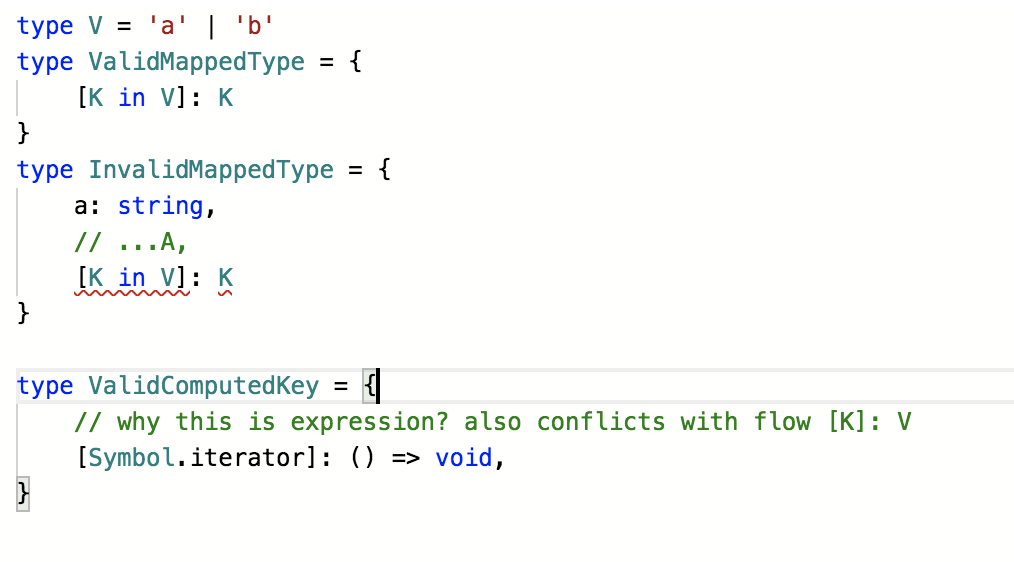
Yeah, how would this syntax interact with spreads and another things? TypeScript disallows any properties in mapped types
Also it's strange that it accepts expression instead of type
goodmind
on 1 Jul 2019
Related #5276
goodmind
on 2 Jul 2019
I owe you a full answer here, but to explain how we could use them to interact with other things: we do this in the new type spread implementation by reading things as spreads. For example, type A = {...B, foo: number, ...C, bar: number} is basically type A = {...B, ...{| foo: number |}, ...C, ...{| bar: number |}}. We can do the same thing here.
jbrown215
on 9 Jul 2019
Related issues
 mjj2000
·
3Comments
mjj2000
·
3Comments
 ctrlplusb
·
3Comments
ctrlplusb
·
3Comments
 ghost
·
3Comments
ghost
·
3Comments
 funtaps
·
3Comments
funtaps
·
3Comments
 cubika
·
3Comments
cubika
·
3Comments
Most helpful comment
I'm all for mirroring TypeScript syntax tho!