Flow: Object spread not handling booleans correctly
Using booleans to spread into objects does not work correctly:
Input:
const a = false;
const b = {
  ...(a && {}),
};
Output:
2: const b = {
             ^ boolean [1] is not an object.
References:
1: const a = false;
             ^ [1]
Expected Output:
No errors!
https://flow.org/try/#0MYewdgzgLgBAhjAvDAZnANhApgbgFCiSwBGSMA3njDAHR0AUCAZExQL4CUANHmzkA
Spreading false into an object does nothing, and if a was true, we would not spread a boolean, because we would move along the && to the object. So this should be permitted.
In Chrome:

Background: This pattern is used often when composing styles in CSS-in-JS libraries.
 suchipi
All 10 comments
@TrySound, @danwang Why the downvotes? It took me a while, but this actually seems to be about something factual. Whatever you think about that expression, it does not result in a boolean as claimed by Flow. I would understand if Flow complains with __an__ error (Flow is opinionated after all and does not accept something just because it is possible in JS), but I don't understand the actual error.
PS: Here's the spec for object spread, in my current state I'm not capable of deciphering from this what is supposed to happen when there's a boolean instead of an object. Code generated by Babel works just fine though. I think item 1 under headline 2.3 applies (spec).
(OP) Of course, if there already is a boolean there are plenty of ways to achieve the desired outcome in other ways. Extreme brevity is not a goal when you use Flow.
 lll000111
on 13 Mar 2018
lll000111
on 13 Mar 2018
@lll000111 this should probably have different message, but spreading boolean to object doesn't feel right. Though I can understand spreading null which has type object.
 TrySound
on 13 Mar 2018
TrySound
on 13 Mar 2018
For reference, here's what the relevant pattern looks like:
const style = {
display: "flex",
justifyContent: "center",
alignItems: "center",
...(disabled && {
color: "#888",
cursor: "auto",
}),
};
There is some congruity with React.Node being a supertype of falsy values:
const a = false
return (
<div>
{a}
</div>
);
I believe this is the best pattern to conditionally include a key during object declaration, and I would love to see this implemented in flow.
For the people that think this isn't legal js, tc39 explicitly confirmed that it is valid.
For anyone interested in a workaround while this isn't 'fixed', I'm currently using:
Instead of:
const condition = false
const myobj = {
  akey: 'a value',
  ...(condition && { key: 'value' }),
}
I'm going with:
const condition = false
const myobj = {
  akey: 'a value',
  ...(condition ? { key: 'value' } : {}),
}
Even though it works with small objects, it gets funny when dealing with objects that span multiple lines, since the colon gets pushed down the code:
const condition = false
const myobj = {
  akey: 'a value',
  ...(condition ? {
    key: 'value',
    color: 'red',
    background: '1px solid black',
  } : {}),
}
I usually avoid using long ternaries.
 Yurickh
on 30 Jul 2018
Yurickh
on 30 Jul 2018
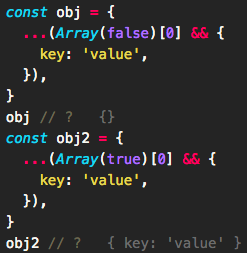
I also have another workaround solution too. 🤣
{...Array(condition)[0] && yourObject}
 Cerberus
on 13 Sep 2018
Cerberus
on 13 Sep 2018
Does the project no longer maintain?
 lehainam-dev
on 28 Jan 2019
lehainam-dev
on 28 Jan 2019
@lehainam125 Do you see it's not maintained?
https://github.com/facebook/flow/commits/master
TrySound
on 28 Jan 2019
What's the status on this?
 aalises
on 26 Mar 2019
aalises
on 26 Mar 2019
I don't think it is right to typecast false to {} like spread does.
Object.assign also disallows it
1: Object.assign({}, false)   ^ boolean [1] is not an object.
References:
1: Object.assign({}, false)
                     ^ [1]
TypeScript also doesn't support this
 goodmind
on 26 Mar 2019
goodmind
on 26 Mar 2019
Related issues
 mmollaverdi
·
3Comments
mmollaverdi
·
3Comments
 Beingbook
·
3Comments
Beingbook
·
3Comments
 tp
·
3Comments
tp
·
3Comments
 mjj2000
·
3Comments
mjj2000
·
3Comments
 iamchenxin
·
3Comments
iamchenxin
·
3Comments
Most helpful comment
I believe this is the best pattern to conditionally include a key during object declaration, and I would love to see this implemented in flow.
For the people that think this isn't legal js, tc39 explicitly confirmed that it is valid.
For anyone interested in a workaround while this isn't 'fixed', I'm currently using:
Even though it works with small objects, it gets funny when dealing with objects that span multiple lines, since the colon gets pushed down the code:
I usually avoid using long ternaries.