Flatbuffers: [Swift] Optimize the implementation
All 12 comments
first PR to address this is #5835
 mustiikhalil
on 1 Apr 2020
mustiikhalil
on 1 Apr 2020
second PR to address this is #5888
mustiikhalil
on 6 May 2020
current:
writing 500_000 objects is 123 ms
----------------------------------
improve reallocation function:
writing 500_000 objects is 112 ms
----------------------------------
If we remove Generics from the swift implementation we get a speed up that would reach to 95ms instead of the current 110ms
mustiikhalil
on 10 Jun 2020
@aardappel, @mzaks I've been doing a lot of tests for swift implementation of FlatBuffers. regarding how swift uses generics and how it performs without it.
As you can see in the first screenshot, the generics would be calling FlatBuffersBuilder.add in 795ms

however in the following screenshot we can see that FlatBuffersBuilder.add is called in 583ms
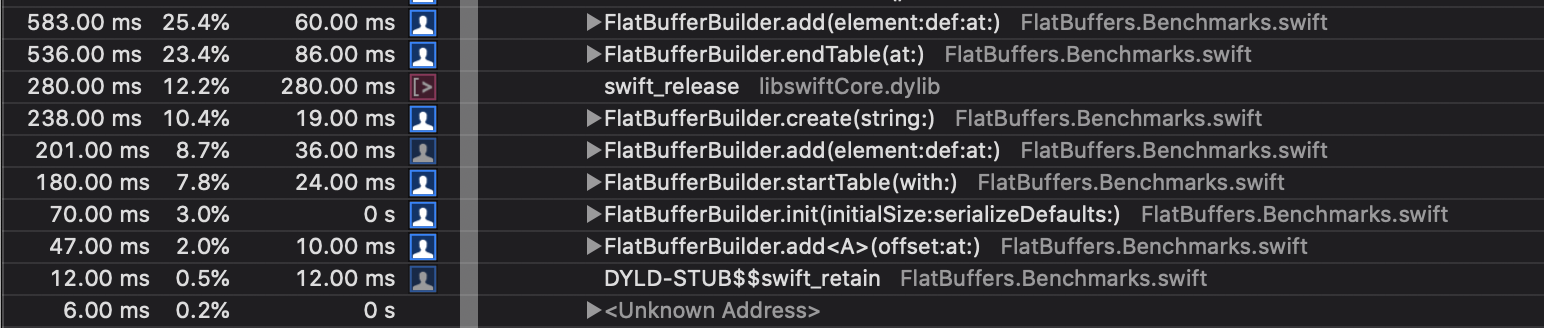
Knowing that swift compilation would eventually create them by itself, but still would make a request to the witness table thus the 10ms increase. So the question now is. should we remove generic functions like:
func add<T: Scaler>(v: T, def: T, off: VOffsets>{}
in favor of the following
func add(v: UInt32, def: UInt32, off: VOffsets> {}
func add(v: Int32, def: Int32, off: VOffsets> {}
fyi, cpp runs with the same benchmark for 64ms with heavy optimization
mustiikhalil
on 11 Jun 2020
I'd say if that's code you have to write just once, and the codebloat is not too crazy, yes. Many language implementations have these functions duplicated.
But wow, 10x slower than C++? That's surprising to me for a language that also goes thru LLVM.
 aardappel
on 11 Jun 2020
aardappel
on 11 Jun 2020
@aardappel
I mean the code is going to be a bit bloated since the function add contains the following code
mutating public func add(element: Int, def: Int, at position: VOffset) {
if element == def {
track(offset: 0, at: position)
return
}
let off = push(element: element)
track(offset: off, at: position)
}
we can also write the if statement in one line but that's not swift standards, so I would like to avoid it.
but other than that, it would be an add function for each scaler we have:
mutating public func add(element: Int64, def: Int64, at position: VOffset) {
if element == def { track(offset: 0, at: position); return }
track(offset: push(element: element), at: position)
}
mutating public func add(element: Int32, def: Int32, at position: VOffset) {
if element == def { track(offset: 0, at: position); return }
track(offset: push(element: element), at: position)
}
I think swift would improve to be around 95ms, which if I remember correctly is similar to csharp if not a bit better. however it might never reach the cpp performance that runs the same benchmark with 64ms. Plus swift has automatic garbage collection which might be the reason swift is 10x slower than cpp
mustiikhalil
on 11 Jun 2020
track(offset: element == def ? 0 : push(element: element), at: position)
or whatever the Swift equivalent syntax is :)
Why does it still need to call track btw? in C++ and many other languages its just if (element == def) return.
aardappel
on 11 Jun 2020
Yep, that was still based on the csharp implementation where we had to fill in an array
mustiikhalil
on 12 Jun 2020
@aardappel I just downloaded Xcode 12, and was following WWDC, and thought of re-benchmarking the swift library again without changes. the results were quite surprising tbh.
current compiled with swift 5.2:
average of 95 ms which was compared to go/CSharp
current compiled with swift 5.3
average of 77 ms which makes it lay between cpp and the other languages
Ooh, nice.. that's some progress :)
aardappel
on 29 Jun 2020
when the following #6326 lands for swift the implementation will be faster in terms of struct. which was reduced from 1.8 seconds to 0.72 seconds serializing 3 million tables with a vector of 5 structs in each one of them.
|   Name        |   Scores      |
-----------------------------------------
|   500_000     |   0.070299s   |
-----------------------------------------
|   10 str      |   0.000212s   |
-----------------------------------------
|   3M strc     |   0.729939s   |
-----------------------------------------
|   100 str     |   0.000256s   |
-----------------------------------------
Related issues
 dakom
·
8Comments
dakom
·
8Comments
 dleslie
·
9Comments
dleslie
·
9Comments
 rw
·
3Comments
rw
·
3Comments
 NN---
·
6Comments
NN---
·
6Comments
 tymcauley
·
3Comments
tymcauley
·
3Comments
Most helpful comment
when the following #6326 lands for swift the implementation will be faster in terms of struct. which was reduced from
1.8 secondsto0.72 secondsserializing 3 million tables with a vector of 5 structs in each one of them.