Hi~
I found several bad epochs(like bad epochs 3) when browsing the training log. I‘m confused about the meaning of the bad epochs.’
One more question, if we want to use the bert-lstm-crf whose lstm layer is not bidirectional( I set the bidirectional = False in Sequence_tagger.py), but it seems to be more modified?(the error proves that dimension does not match)
Hope to get your reply, Thanks.
 aslicedbread
All 21 comments
Hi, bad epoch means your metrics does not improve on validation set for this epoch
 gccome
on 15 Mar 2019
gccome
on 15 Mar 2019
Hi, bad epoch means your metrics does not improve on validation set for this epoch
@gccome
Hi,
What does the 3 mean? Does it mean that 3 epochs have not been improved on the verification set?
aslicedbread
on 15 Mar 2019
That’s correct.
gccome
on 15 Mar 2019
That’s correct.
@gccome
Thank you.
And how does flair define the best model?
I mean that the highest F1 on the verification set throughout the training process is 0.735, but the F1 on the best model is 0.71. (the verification set and the testing set are the same. ) I'm also confused about this.
aslicedbread
on 15 Mar 2019
@aslicedbread by reviewing the code, the best model is saved when you have best F1 on validation set. At the end, the best model will be applied on test data. In my experiments, those two numbers match. Can I see you training log file?
gccome
on 15 Mar 2019
@aslicedbread by reviewing the code, the best model is saved when you have best F1 on validation set. At the end, the best model will be applied on test data. In my experiments, those two numbers match. Can I see you training log file?
@gccome
of course. Here is the url: https://share.weiyun.com/5U1NBWR
I'm not sure whether this web drive is available in your country.
aslicedbread
on 15 Mar 2019
@aslicedbread unfortunately I was not able to open it:(
gccome
on 15 Mar 2019
@aslicedbread by reviewing the code, the best model is saved when you have best F1 on validation set. At the end, the best model will be applied on test data. In my experiments, those two numbers match. Can I see you training log file?
@gccome
of course. Here is the url: https://share.weiyun.com/5U1NBWR
I'm not sure whether this web drive is available in your country.
Unfortunately no.
 gatarelib
on 15 Mar 2019
gatarelib
on 15 Mar 2019
@aslicedbread unfortunately I was not able to open it:(
@gccome
sorry to hear that.
I have uploaded to the google drive.
Here is the url:
https://drive.google.com/file/d/1dnlOaIrFqO4hVWyqNRl-C7PDPF1L59t3/view?usp=sharing
aslicedbread
on 15 Mar 2019
@aslicedbread it seems you were not evaluating against validation set. Could you please share your training code snippet? Did you set anneal_against_train_loss to be False? By observing the log, seems like you were training against training loss.
gccome
on 15 Mar 2019
@aslicedbread it seems you were not evaluating against validation set. Could you please share your training code snippet? Did you set
anneal_against_train_lossto be False? By observing the log, seems like you were training against training loss.
@gccome
of course.
Here is the url:
https://drive.google.com/open?id=1niO_26tdOtV_tjdKdRA0bBSW1CXJtD3P
By the way, what does the anneal_against_train_loss mean?
aslicedbread
on 15 Mar 2019
@aslicedbread Yes you were training against training loss, not validation set. If you look at ModelTrainer.train function, you will see that the default value for anneal_against_train_loss is True, meaning the best model is saved when you hit lowest training loss. You are not training against validation set unless you set this parameter to be False
gccome
on 15 Mar 2019
@aslicedbread Yes you were training against training loss, not validation set. If you look at
ModelTrainer.trainfunction, you will see that the default value foranneal_against_train_lossisTrue, meaning the best model is saved when you hit lowest training loss. You are not training against validation set unless you set this parameter to beFalse
@gccome
Thanks a lot. I get it.
In addition, what should I set if we want to use the bert-lstm-crf model (not the bidirectional lstm)?
aslicedbread
on 15 Mar 2019
@aslicedbread what do you mean by bert-lstm-crf? In flair you can use Bert embedding + lstm + crf for sequence tagging. Did you mean fine tuning BERT?
gccome
on 15 Mar 2019
@aslicedbread what do you mean by bert-lstm-crf? In flair you can use Bert embedding + lstm + crf for sequence tagging. Did you mean fine tuning BERT?
@gccome
No. I mean that we use the bert-bidirectional lstm-crf by default. If we want to use the bert-lstm(single direction)-crf, what should we set? ( I set the bidirectional = False in Sequence_tagger.py, but it seems that it's not enough. )
aslicedbread
on 16 Mar 2019
@aslicedbread I think set bidirectional=False should do. Why do you think it is not enough?
gccome
on 28 Mar 2019
Closing due to inactivity, but feel free to reopen if there are more questions!
 alanakbik
on 27 May 2019
alanakbik
on 27 May 2019
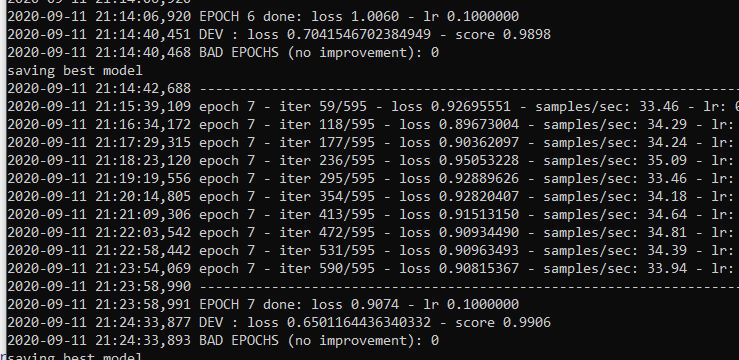
Could someone kindly explain why it's BAD EPOCHS despite that the loss reduced and score increase on the validation set?
 oluwayetty
on 11 Sep 2020
oluwayetty
on 11 Sep 2020
It is the bad epoch if the number is greater than 0.
 djstrong
on 11 Sep 2020
djstrong
on 11 Sep 2020
Thanks @djstrong If I understand you correctly, do you mean this doesn't mean Bad epochs? It's only bad if it's something like BAD EPOCHS (no improvement): 1 or any number above zero?
oluwayetty
on 11 Sep 2020
Yes, it is a counter of bad epochs.
djstrong
on 11 Sep 2020
Related issues
 ChessMateK
·
3Comments
ChessMateK
·
3Comments
 jannenev
·
3Comments
jannenev
·
3Comments
 aschmu
·
3Comments
aschmu
·
3Comments
 Y4rd13
·
3Comments
Y4rd13
·
3Comments
 davidsbatista
·
3Comments
davidsbatista
·
3Comments