Firacode: Ligature requests: .< and >. and .~ and !.
In MetaOCaml, .< e >. is used to encode the quasi-quoting of expression e, whereas .~e is to unquote / escape. These are beautifully encoded in the paper and documentation, but look horrific in actual source-code. Compare:
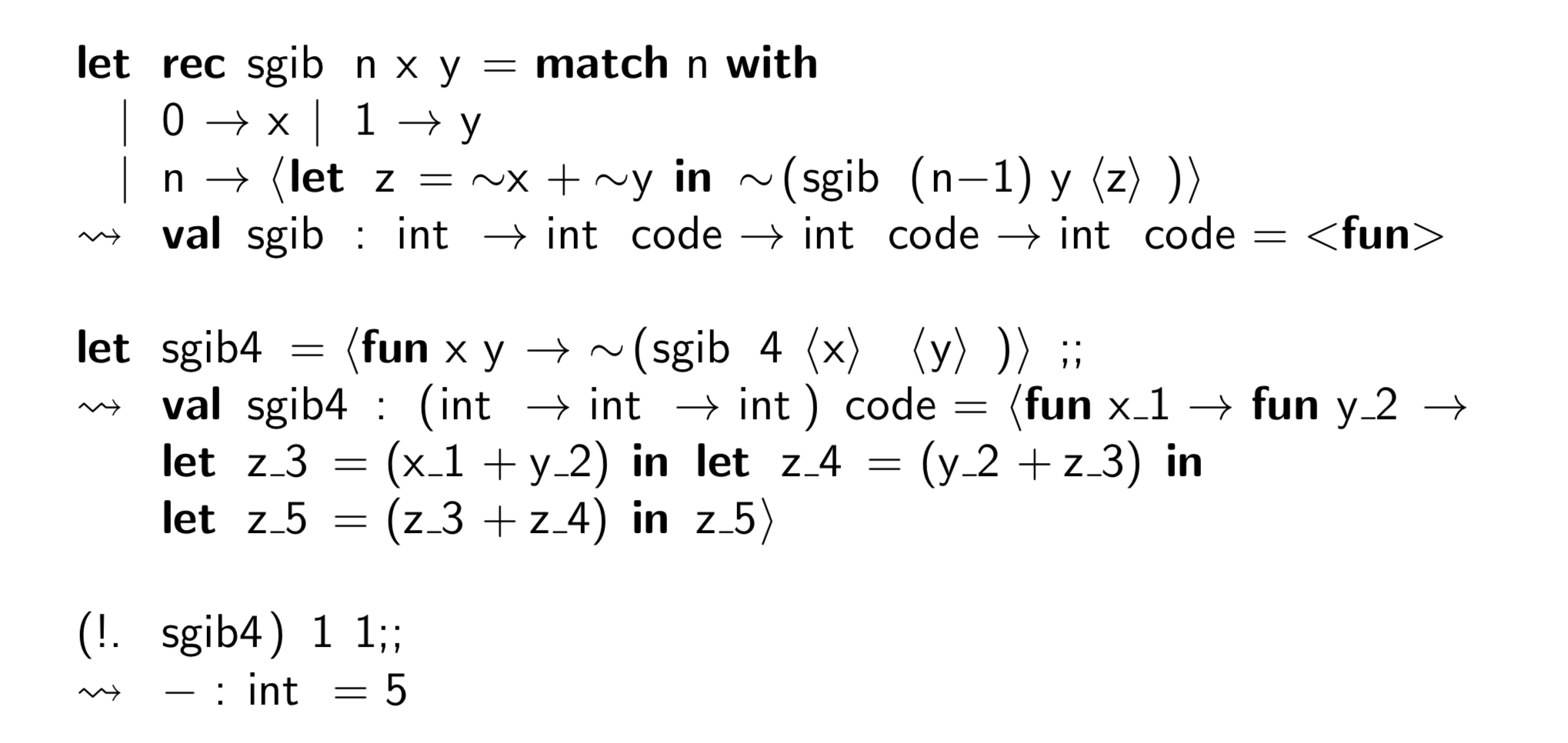
vs.

Typographic ligatures could go a long way towards improving the usability of MetaOCaml; I'd really love to see these supported by Fira Code. (=
(Also see #317 and, especially, #380.)
 ELLIOTTCABLE
All 7 comments
What exactly does the paper do with .<, >., and .~? I’m having a hard time finding them in the text.
 j-f1
on 12 Dec 2017
j-f1
on 12 Dec 2017
Metaprogramming, basically.
I’m on my phone, but they’re very similar to Lisp’s quasi-quoting — the purpose overall being runtime code-generation, and specifically (compile-time) typed code-generation.
(I’m speaking a little out of my ass, let’s be clear — I’m new to all this, too!)
ELLIOTTCABLE
on 12 Dec 2017
Oh and in the picture paper, the Unicode tall-angle-bracket has the meaning that is encoded in dot-lessthan in ASCII, I just belatedly realized that may be what you’re asking 🤣
ELLIOTTCABLE
on 12 Dec 2017
Showing them the way they are in the paper doesn’t work when the symbols are used in other languages. They don’t make it clear what the component symbols are, and they make ligatures of things that are logically separate. For example:
if (x>.85) {        // Comparison against 0.85
    obj.~Class;     // Explicitly call destructor in C++
} else if (3.<x) {  // Compare against 3.0
    // ...
}
And in something that uses ! for shell escapes, !. can start !./my_program.
 dhouck
on 13 Dec 2017
dhouck
on 13 Dec 2017
See my comment on #380 — I wasn’t suggesting they be converted to another glyph (other software already does that), but that they be beautified and kerned a lá the other Fira ligatures!
ELLIOTTCABLE
on 13 Dec 2017
I’d want to be careful even there; in the examples I gave it would be incorrect to kern them as though they were a single token as they are in OCaml. Maybe it would work if you required whitespace (or another of these ligatures) to be on the other side of the .?
dhouck
on 13 Dec 2017
That makes a lot of sense to me — it'd be really messy to kern 0.<=1 or similar, in languages that denote floats that way.
:+1:!
ELLIOTTCABLE
on 10 Jan 2018
Related issues
 tomByrer
·
4Comments
tomByrer
·
4Comments
 pamu
·
3Comments
pamu
·
3Comments
 ulope
·
4Comments
ulope
·
4Comments
 Jhonyrod
·
4Comments
Jhonyrod
·
4Comments
 mlajtos
·
4Comments
mlajtos
·
4Comments
Most helpful comment
What exactly does the paper do with
.<,>., and.~? I’m having a hard time finding them in the text.