Feathers-vuex: How to use $regexp and $iRegexp in a query
I'm trying to search an ltree column in postgresql, and followed this advice https://github.com/sequelize/sequelize/issues/11629
Steps to reproduce
I've whitelisted $regex and $iRegex in feathers-client.js
const {
  makeServicePlugin, makeAuthPlugin, BaseModel, models, clients, FeathersVuex,
} = feathersVuex(feathersClient, {
  idField: 'id',
  whitelist: ['$regexp', '$iRegexp', '$options']
});
I also tried $regex and iRegex
I used the following query in the component
computed: {
    findQuery() {
      return {
        $sort: {
          id: 1
        },
        $limit: 100,
        path: {
          $regexp: 'root.*'
        }
      }
    }
  },

  methods: {
    ...mapActions('data', {
      findItems: 'find',
    })
  },

  created: async function() {
    await this.findItems({
      query: this.findQuery,
    })
  }
I've also tried setting operator aliases in sequelize.js, although I understand that's not a good idea
const Sequelize = require('sequelize');
const Op = Sequelize.Op;

module.exports = function(app) {
  const connectionString = app.get('postgres_data');
  const sequelize_data = new Sequelize(connectionString, {
    dialect: 'postgres',
    operatorsAliases: {
      $regexp: Op.regexp,
      $iRegexp: Op.iRegexp
    }
Expected behavior
To be able to query with $regexp and $iRegexp
Actual behavior
I get a error
type: "FeathersError",
className: "bad-request"
code: 400
data: Object { "$regexp": "root.*" }
errors: Object {  }
hook: Object { type: "before", method: "find", path: "data", … }
System configuration
Tell us about the applicable parts of your setup.
Postgresql 12
Module versions (especially the part that's not working):
"@feathersjs/feathers": "^4.4.3",
"@feathersjs/socketio-client": "^4.4.3",
"feathers-vuex": "^3.2.0",
"socket.io-client": "^2.3.0",
"vue": "^2.6.11",
"vuex": "^3.1.2",
"vuex-router-sync": "^5.0.0"
NodeJS version:
v13.3.0
 Adam-0-Moore
All 17 comments
Is this error coming across the websocket?
 marshallswain
on 24 Dec 2019
marshallswain
on 24 Dec 2019
Sorry, I'm really new at this, but I believe so. I see the error in the console of the devtools.
Adam-0-Moore
on 24 Dec 2019
To see if it's coming across the websocket, you need to open the Network pane and filter down to WS (which is the websocket filter). You'll see your connection in the list. Click on it and you'll see the request messages on the right. Look through the responses to verify if it's coming across the Websocket connection. That will give me a much more direct way of figuring out how to help you.
marshallswain
on 24 Dec 2019
Yes, it does look like it's coming across the websocket.
This is sent:
421["find","category",{"$sort":{"id":1},"$limit":100,"path":{"$regexp":"root.*"}}]
and this is received:
431[{"name":"BadRequest","message":"Invalid query parameter $regexp","code":400,"className":"bad-request","data":{"$regexp":"root.*"},"errors":{}}]
Adam-0-Moore
on 24 Dec 2019
Ok. This might mean that you need to add the custom query params to the whitelist for the service on the client: https://github.com/feathersjs-ecosystem/feathers-sequelize#api
Usually, the "invalid query parameter" means that those params aren't added to the whitelist.
marshallswain
on 24 Dec 2019
Oh, I'm sorry, I think I'm not following - is this different from adding whitelist: ['$regexp', '$iRegexp', '$options'] to feathers-client.jp
Adam-0-Moore
on 24 Dec 2019
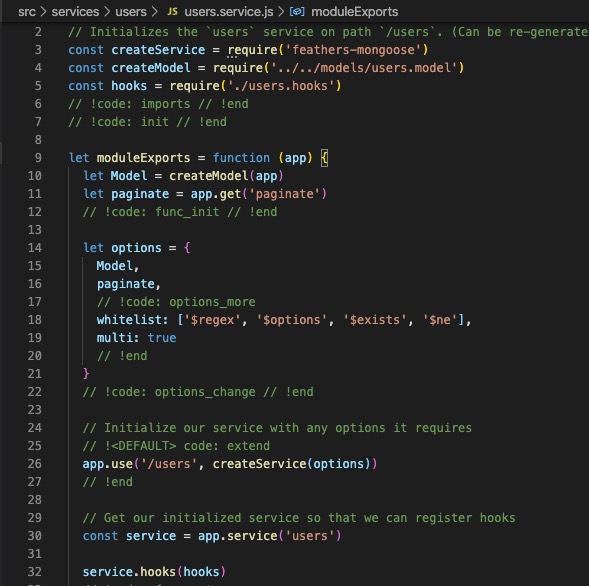
It is different. You need to specify the whitelist on the client AND on the API server. Each service on the server has a whitelist option that works exactly the same way as it does on the client. When you whitelist on the server, it will probably work. Here's an example of one of my server-side services. Notice that I have to manually enable $regex for that service.
marshallswain
on 24 Dec 2019
I missed that! Thanks!
I get a new error - I wonder if I'm writing the query wrong...
431[{"stack":"Error: Invalid value { path: { '$regexp': 'root.*' } }\n at Object.escape (/Users/adam/Documents/Projects/test/backend/portal/server/node_modules/sequelize/lib/sql-string.js:65:11)\n at PostgresQueryGenerator.escape (/Users/adam/Documents/Projects/test/backend/portal/server/node_modules/sequelize/lib/dialects/abstract/query-generator.js:986:22)\n at PostgresQueryGenerator._whereParseSingleValueObject (/Users/adam/Documents/Projects/test/backend/portal/server/node_modules/sequelize/lib/dialects/abstract/query-generator.js:2556:41)\n at PostgresQueryGenerator.whereItemQuery (/Users/adam/Documents/Projects/test/backend/portal/server/node_modules/sequelize/lib/dialects/abstract/query-generator.js:2274:19)\n at /Users/adam/Documents/Projects/test/backend/portal/server/node_modules/sequelize/lib/dialects/abstract/query-generator.js:2173:25\n at Array.forEach (<anonymous>)\n at PostgresQueryGenerator.whereItemsQuery (/Users/adam/Documents/Projects/test/backend/portal/server/node_modules/sequelize/lib/dialects/abstract/query-generator.js:2171:35)\n at PostgresQueryGenerator.getWhereConditions (/Users/adam/Documents/Projects/test/backend/portal/server/node_modules/sequelize/lib/dialects/abstract/query-generator.js:2583:19)\n at PostgresQueryGenerator.selectQuery (/Users/adam/Documents/Projects/test/backend/portal/server/node_modules/sequelize/lib/dialects/abstract/query-generator.js:1315:28)\n at QueryInterface.rawSelect (/Users/adam/Documents/Projects/test/backend/portal/server/node_modules/sequelize/lib/query-interface.js:1157:37)\n at Function.aggregate (/Users/adam/Documents/Projects/test/backend/portal/server/node_modules/sequelize/lib/model.js:1993:32)\n at /Users/adam/Documents/Projects/test/backend/portal/server/node_modules/sequelize/lib/model.js:2045:19\n at tryCatcher (/Users/adam/Documents/Projects/test/backend/portal/server/node_modules/bluebird/js/release/util.js:16:23)\n at Promise._settlePromiseFromHandler (/Users/adam/Documents/Projects/test/backend/portal/server/node_modules/bluebird/js/release/promise.js:547:31)\n at Promise._settlePromise (/Users/adam/Documents/Projects/test/backend/portal/server/node_modules/bluebird/js/release/promise.js:604:18)\n at Promise._settlePromise0 (/Users/adam/Documents/Projects/test/backend/portal/server/node_modules/bluebird/js/release/promise.js:649:10)\n at Promise._settlePromises (/Users/adam/Documents/Projects/test/backend/portal/server/node_modules/bluebird/js/release/promise.js:729:18)\n at _drainQueueStep (/Users/adam/Documents/Projects/test/backend/portal/server/node_modules/bluebird/js/release/async.js:93:12)\n at _drainQueue (/Users/adam/Documents/Projects/test/backend/portal/server/node_modules/bluebird/js/release/async.js:86:9)\n at Async._drainQueues (/Users/adam/Documents/Projects/test/backend/portal/server/node_modules/bluebird/js/release/async.js:102:5)\n at Immediate.Async.drainQueues [as _onImmediate] (/Users/adam/Documents/Projects/test/backend/portal/server/node_modules/bluebird/js/release/async.js:15:14)\n at processImmediate (internal/timers.js:445:21)","message":"Invalid value { path: { '$regexp': 'root.*' } }"}]
Adam-0-Moore
on 24 Dec 2019
I'm not a Sequelize user, but you might start by reading the Operators security section here: https://sequelize.org/master/manual/querying.html
marshallswain
on 24 Dec 2019
Ok, Thank you - I'll do that :)
Adam-0-Moore
on 24 Dec 2019
I'm curious, are you not an SQL user, or do you use SQL with something other than Sequelize?
Adam-0-Moore
on 24 Dec 2019
I used to do absolutely everything in SQL, since my PHP days 18 years ago. Postgres is really great, now, too. These days I really prefer building apps with MongoDB.
marshallswain
on 24 Dec 2019
If I were starting a new app, though, I would probably use feathers-objection, based on what long-time feathers-sequelize users have said in the Slack channel in the last month or so.
marshallswain
on 24 Dec 2019
Thank you - Since I'm just starting I'll have a look at that!
Adam-0-Moore
on 24 Dec 2019
I finally figured out Objection, and querying ltree columns with regex just works.
I wanted to write back with a solution for sequelize, but I never could figure it out.
Thanks for recommending feathers-objection :)
Adam-0-Moore
on 30 Dec 2019
I hade a similar problem and I got a working solution for it.
The solution steps:
- Firstly, I imported the
Op(Operators) from thesequelizelibrary. _[example-model.js]_ - Then, I modified the
operatorsandwhitelistproperties of the model. _[example-model.js]_ - Lastly, I used the new operator in my hook file. _[example-hook.js]_
I hope, it helps.
example-model.js
const { Players } = require('./players.class');
const createModel = require('../../models/players.model');
const hooks = require('./players.hooks');
const Sequelize = require('sequelize');

module.exports = function (app) {
  const options = {
    Model: createModel(app),
    paginate: app.get('paginate'),
    operators: {
      '$iRegexp': Sequelize.Op.iRegexp
    },
    whitelist: ['$iRegexp']
  };

  app.use('/players', new Players(options, app));

  const service = app.service('players');

  service.hooks(hooks);
};
example-hook.js
const { params, service } = context;
if (params.query['search']) {
  params.sequelize = {
    where: {
      'name': {
        [service.options.operators.$iRegexp]: params.query.search
      }
    },
    raw: false
  };
}
 okaracalik
on 1 Jan 2020
okaracalik
on 1 Jan 2020
Thanks @okaracalik for sharing your clean solution with Sequelize. I'm going to go ahead and close this issue, since there's not really anything more to be done in feathers-vuex. It will always be available to others in the Issue search.
marshallswain
on 30 Apr 2020
Related issues
 ontoneio
·
7Comments
ontoneio
·
7Comments
 daenuprobst
·
5Comments
daenuprobst
·
5Comments
 samburgers
·
7Comments
samburgers
·
7Comments
 kshitizshankar
·
7Comments
kshitizshankar
·
7Comments
 Heartnett
·
4Comments
Heartnett
·
4Comments
Most helpful comment
I hade a similar problem and I got a working solution for it.
The solution steps:
Op(Operators) from thesequelizelibrary. _[example-model.js]_operatorsandwhitelistproperties of the model. _[example-model.js]_I hope, it helps.