Fastapi: Impossible to set examples for enums?
Example
Here's a self-contained, minimal, reproducible, example with my use case:
from enum import Enum

from fastapi import FastAPI, Query

app = FastAPI()


class SomeValue(str, Enum):
    a = 'a'
    b = 'b'


@app.get("/")
def read_root(query_value: SomeValue = Query(..., example='b')):
    # Doesnt matter what happens here
    return {"Hello": "World"}
Description
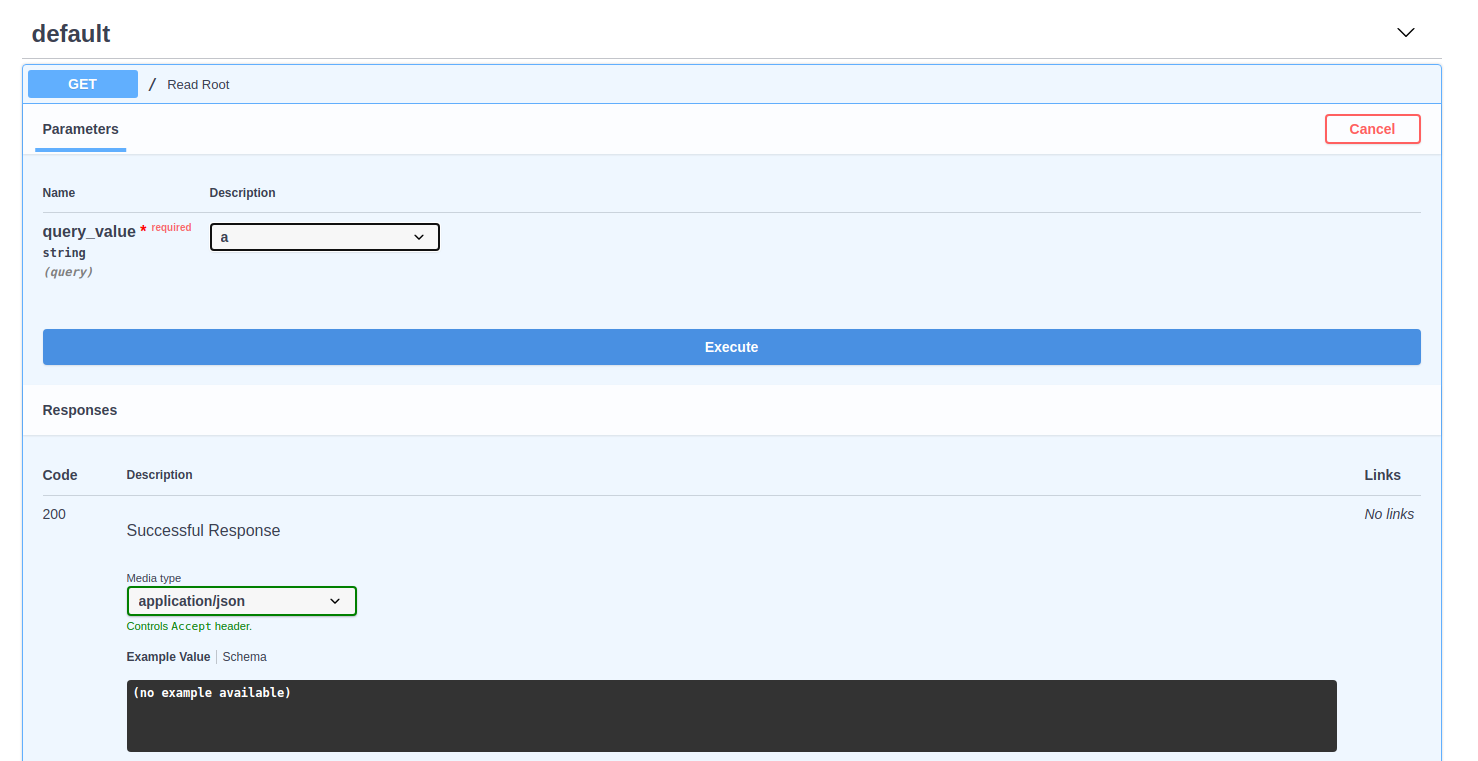
I set an example for query_value but in the openapi-schema this example is ignored and doesn't appear.
Is that intended or a bug? I need to set a specific example for every parameter (as required by our testsuite) and I don't see why it shouldn't be allowed to set one for enums.
Environment
- OS: Windows 10
FastAPI Version 0.60.1
Python version: 3.8
 jeremyschiemann
All 4 comments
There are imports missing on the minimal example :sleeping:
Only the body example appears in the possible responses field. You already have the possible values in the query field, so I don't understand exactly the reason why you need it for your testsuit. Do you mind explaining?
 Kludex
on 31 Jul 2020
Kludex
on 31 Jul 2020
I'm sorry for the missing imports, I edited it.
We have a guideline that every parameters needs an example and our testsuit has a test where it explicitly tests each endpoint with its examples (which it gets from the created /openapi.json).
This is because we need to provide an example endpoint call that 100% works, otherwise the ui designers are complaining.
I understand that for enums all possible values are already present but I don't understand why examples for enums are removed.
Before we where using connexion where you have to write the openapi spec yourself in a yaml, where setting an example for a enum was no problem.
see also the first example for 'Parameter Examples' in 'Adding Examples' of the swagger docu: https://swagger.io/docs/specification/adding-examples/#Parameter_Examples
jeremyschiemann
on 31 Jul 2020
found a workaround
from enum import Enum

from fastapi import FastAPI, Query

app = FastAPI()


class SomeValue(str, Enum):
    a = 'a'
    b = 'b'

    @classmethod
    def __modify_schema__(cls, field_schema):
        # __modify_schema__ should mutate the dict it receives in place,
        # the returned value will be ignored
        field_schema.update(
            example='b',
        )


@app.get("/")
def read_root(query_value: SomeValue):
    # Doesnt matter what happens here
    return {"Hello": "World"}
Thanks for the help here @Kludex ! :clap: :bow:
Thanks for reporting back and closing the issue :+1:
 tiangolo
on 9 Dec 2020
tiangolo
on 9 Dec 2020
Related issues
 RogerioDosSantos
·
3Comments
RogerioDosSantos
·
3Comments
 kkinder
·
3Comments
kkinder
·
3Comments
 RenanAlonkin
·
3Comments
RenanAlonkin
·
3Comments
 scheung38
·
3Comments
scheung38
·
3Comments
 mr-bjerre
·
3Comments
mr-bjerre
·
3Comments
Most helpful comment
found a workaround