Faker.js: faker.date.past(N) always return random date
So, I look the documentation and it said:
Past faker.date.past(years, refDate) Returns a date from a reference date to N years ago.
When I try to execute it, it's always getting random
const faker = require('faker')

const N = 10;
console.log(faker.date.past(N)); // return 2016-02-28T04:46:00.384Z
console.log(faker.date.past(N)) // return 2013-08-02T03:41:39.812Z

console.log(faker.date.past(N, new Date()) //return 2015-02-07T14:40:15.780Z
console.log(faker.date.past(N, new Date()) //return 2014-03-29T01:59:31.280Z
Should it return to N years ago?
 fauzanelka
All 4 comments
I think you misunderstand, but I'm not sure I understand what you expect it to return. faker.date.past(years, refDate) will return a randomly generated Date objects up to years years before refDate, which defaults to new Date().
So for example, to get a random date up to 1 year in the past:
> faker.date.past(1)
2018-06-02T20:24:32.338Z
Or to get a random date up to 10 years before January 1, 2001:
> faker.date.past(10, new Date(2001, 0, 1))
1995-06-13T23:44:41.043Z
 denizdogan
on 1 Feb 2019
denizdogan
on 1 Feb 2019
Thanks for the response.
That's why I'm asking why it return N random years ago, tested just now
Faker 4.1.0
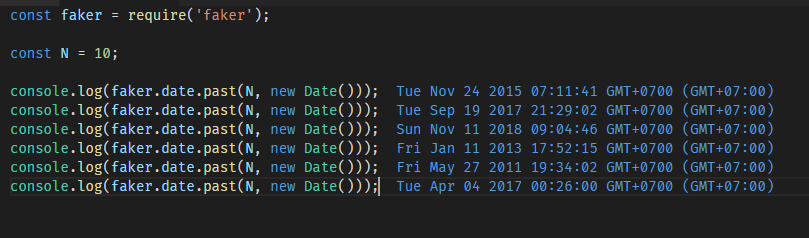
fauzanelka
on 1 Feb 2019
Oh, I think I got the point.
I think the documentation should write
Returns a date between a reference date and N years ago
instead
Returns a date from a reference date to N years ago
fauzanelka
on 1 Feb 2019
I think I will close this issue
fauzanelka
on 1 Feb 2019
Related issues
 clarmso
·
3Comments
clarmso
·
3Comments
 aadamsx
·
6Comments
aadamsx
·
6Comments
 Aleyasen
·
6Comments
Aleyasen
·
6Comments
 adoyle-h
·
3Comments
adoyle-h
·
3Comments
 kevinburke
·
5Comments
kevinburke
·
5Comments
Most helpful comment
I think you misunderstand, but I'm not sure I understand what you expect it to return.
faker.date.past(years, refDate)will return a randomly generatedDateobjects up toyearsyears beforerefDate, which defaults tonew Date().So for example, to get a random date up to 1 year in the past:
Or to get a random date up to 10 years before January 1, 2001: