Fairseq: CUDA out of Memory when fine-tuning mBART pre-trained CC25 model
❓ Questions and Help
While fine-tuning mBART pre-trained CC25 model on preprocessed data with the given sentencepiece model, was always running into out of memory problems.
Please help to resolve this -
denom = exp_avg_sq.sqrt().add_(group['eps'])
RuntimeError: CUDA out of memory. Tried to allocate 978.00 MiB (GPU 0; 10.76 GiB total capacity; 8.73 GiB already allocated; 659.12 MiB free; 9.26 GiB reserved in total by PyTorch)
Command -
python train.py $DEST_DIR --encoder-normalize-before --decoder-normalize-before --arch mbart_large --task translation_from_pretrained_bart --source-lang $SRC --target-lang $TGT --criterion label_smoothed_cross_entropy --label-smoothing 0.2 --dataset-impl mmap --optimizer adam --adam-eps 1e-06 --adam-betas '(0.9, 0.98)' --lr-scheduler polynomial_decay --lr 3e-05 --min-lr -1 --warmup-updates 2500 --total-num-update 40000 --dropout 0.3 --attention-dropout 0.1 --weight-decay 0.0 --max-tokens 128 --update-freq 2 --save-interval 1 --save-interval-updates 5000 --keep-interval-updates 10 --no-epoch-checkpoints --seed 222 --log-format simple --log-interval 2 --reset-optimizer --reset-meters --reset-dataloader --reset-lr-scheduler --restore-file $PRETRAIN --langs $langs --layernorm-embedding --ddp-backend no_c10d --memory-efficient-fp16
Tried -
1) Lowered no of max-tokens
2) memory-efficient-fp16
3) --empty-cache-freq
4) combinations of above on a single and multiple GPUs
Relating issue :
https://github.com/pytorch/fairseq/issues/1841
Reference :
https://github.com/pytorch/fairseq/tree/master/examples/mbart#download-model
Environment
- fairseq Version (e.g., 1.0 or master):
master - PyTorch Version (e.g., 1.0):
1.4.0 - OS (e.g., Linux):
Ubuntu 18.04.4 - How you installed fairseq (
pip, source):pip - Build command you used (if compiling from source):
pip install --editable . - Python version:
3.7.7 - GPU models and configuration: Geforce RTX 2080ti
- Any other relevant information:
 gvskalyan
All 8 comments
Tried the above in a P100 GPU in Google Colab.
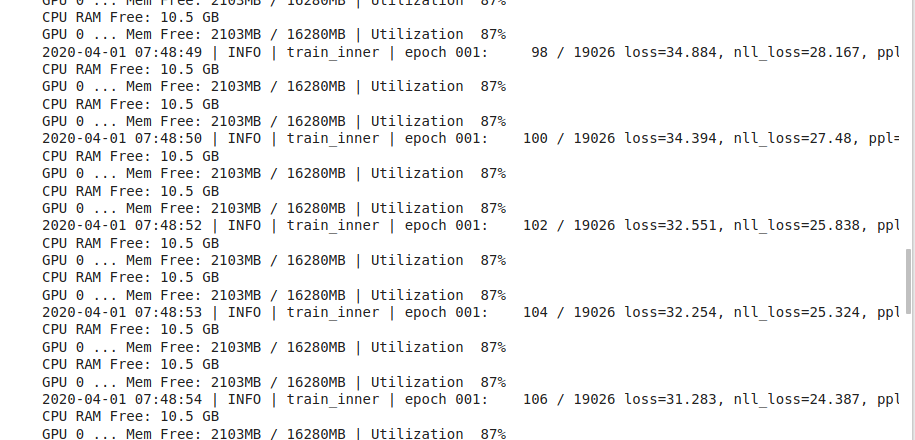
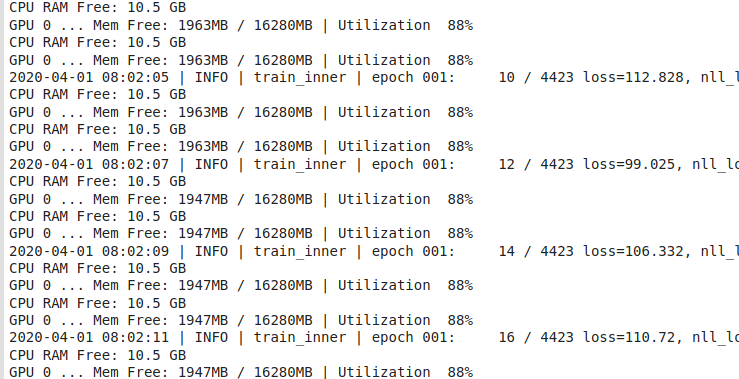
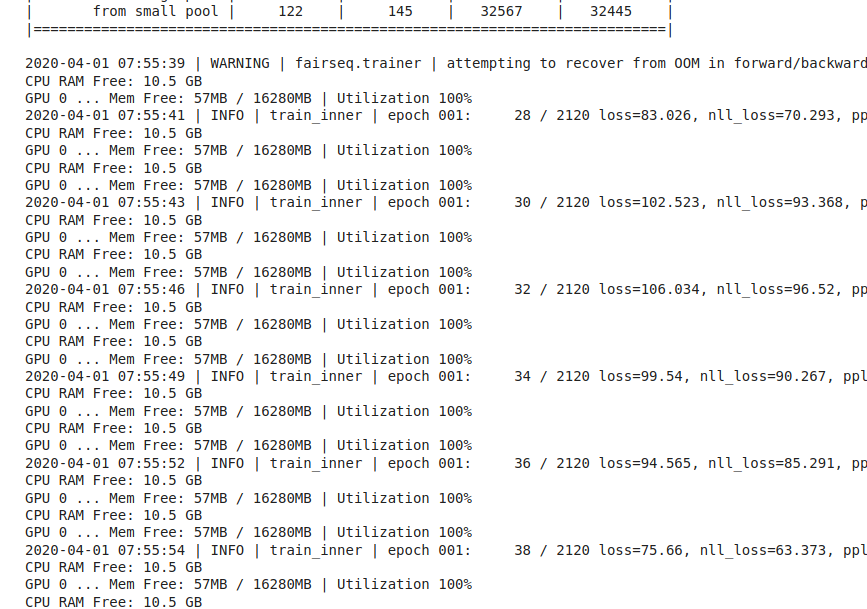
used the following snippet to print current GPU memory before calling train_step in train.py
```import os,sys,humanize,psutil,GPUtil
Define function
def mem_report():
print("CPU RAM Free: " + humanize.naturalsize( psutil.virtual_memory().available ))
GPUs = GPUtil.getGPUs()
for i, gpu in enumerate(GPUs):
print('GPU {:d} ... Mem Free: {:.0f}MB / {:.0f}MB | Utilization {:3.0f}%'.format(i, gpu.memoryFree, gpu.memoryTotal, gpu.memoryUtil*100))
Execute function
mem_report()
```
--max-tokens 128
--max-tokens 256
--max-tokens 1024
gvskalyan
on 1 Apr 2020
@yinhanliu @myleott can you consider releasing mbart base model which uses bart_base architecture
gvskalyan
on 10 Apr 2020
@ngoyal2707
 huihuifan
on 13 Apr 2020
huihuifan
on 13 Apr 2020
@gvskalyan We are not planning to release mbart.base model as previous work has shown that bigger model size help to deal with the issue of interference when training on multiple languages.
To deal with the GPU OOM, I'd recommend looking into gradient checkpointing: https://pytorch.org/docs/stable/checkpoint.html
Which allows to trade compute for memory.
We don't have yet implemented it in fairseq as it has some generalization issues with fairseq abstraction, we will look into getting that in fairseq in future. But for now, I'd recommend trying to get gradient checkpointing working for fitting the model in GPU memory.
 ngoyal2707
on 13 Apr 2020
ngoyal2707
on 13 Apr 2020
Having a smaller mBART available would be very helpful for quicker development and debugging on weaker devices, even if it performs poorly.
 lukovnikov
on 22 Apr 2020
lukovnikov
on 22 Apr 2020
@gvskalyan We are not planning to release
mbart.basemodel as previous work has shown that bigger model size help to deal with the issue of interference when training on multiple languages.To deal with the GPU OOM, I'd recommend looking into gradient checkpointing: https://pytorch.org/docs/stable/checkpoint.html
Which allows to trade compute for memory.
We don't have yet implemented it in fairseq as it has some generalization issues with fairseq abstraction, we will look into getting that in fairseq in future. But for now, I'd recommend trying to get gradient checkpointing working for fitting the model in GPU memory.
Can you give us some suggestion to limit GPU usage ? And if we need to use torch.utils.checkpoint on fine-tune mbart , do you have examples for us?
 Daisy-123
on 22 May 2020
Daisy-123
on 22 May 2020
I also got out of memory error even with a very small batch size of 8, num_beams = 1.
But I don't have such an error when I'm using the original BART-large. Not sure what happened
 allanj
on 7 Oct 2020
allanj
on 7 Oct 2020
mBART is much larger than bart-large because of a much larger embeddings table.
 sshleifer
on 7 Oct 2020
sshleifer
on 7 Oct 2020
Related issues
 gaopengcuhk
·
3Comments
gaopengcuhk
·
3Comments
 zqs01
·
3Comments
zqs01
·
3Comments
 ashim95
·
3Comments
ashim95
·
3Comments
 yilegu
·
3Comments
yilegu
·
3Comments
 mali-nuist
·
3Comments
mali-nuist
·
3Comments
Most helpful comment
@gvskalyan We are not planning to release
mbart.basemodel as previous work has shown that bigger model size help to deal with the issue of interference when training on multiple languages.To deal with the GPU OOM, I'd recommend looking into gradient checkpointing: https://pytorch.org/docs/stable/checkpoint.html
Which allows to trade compute for memory.
We don't have yet implemented it in fairseq as it has some generalization issues with fairseq abstraction, we will look into getting that in fairseq in future. But for now, I'd recommend trying to get gradient checkpointing working for fitting the model in GPU memory.