Facenet: A question about how to make a face verification?
Hello, now I have a new question: if I have an array of one people's face embeddings, how can I use these embeddings to make face verification?
I mean if I need do train these embeddings with a model and then give a new embeddings to verify, maybe there is a threshold, if the probability is greater than the threshold they are the same person, or they are two people.
How I choose the model?(Apparently the SVM model cant be used under the circumstances )
Looking forward your replying sincerely
Thanks @davidsandberg
 xvdehao
All 4 comments
Hey @xvdehao ,
For example of face verification you can take a look at compare.py.
If you want to use something like SVM it is classification. There is also an example of classification: classifier.py.
I hope this answers your questions.
 MaartenBloemen
on 22 Nov 2017
MaartenBloemen
on 22 Nov 2017
So thankful of your answer @MaartenBloemen Thats realy helpful to me
And now I use the compare.py to verify two pictures,the result is here
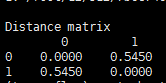
Whats the meaning of this result? And thejudgment criteria is the same as SVM model used in classify.py?
@MaartenBloemen @davidsandberg
Any answer is very helpful to me Thank you
xvdehao
on 23 Nov 2017
@xvdehao The output is the euclidean distance, this is always a number between 0 and 2 where 0 is 100% the same and 2 is 0% the same, if you want the output as a percentage you can use confidence = (2 - dist) * 50, so in your case it would mean the confidence is 72.75%.
For SVM the output is different, here the output is a percentage as a decimal number. If you need an explanation on how to train an SVM classifier have a look on the wiki.
MaartenBloemen
on 23 Nov 2017
Got it, this answer is really useful and distinct.
Thank you so much
xvdehao
on 23 Nov 2017
Related issues
 RaviRaaja
·
3Comments
RaviRaaja
·
3Comments
 allahbaksh
·
3Comments
allahbaksh
·
3Comments
 arunxz98
·
3Comments
arunxz98
·
3Comments
 Leedonggeon
·
3Comments
Leedonggeon
·
3Comments
 helloyide
·
4Comments
helloyide
·
4Comments
Most helpful comment
@xvdehao The output is the euclidean distance, this is always a number between 0 and 2 where 0 is 100% the same and 2 is 0% the same, if you want the output as a percentage you can use
confidence = (2 - dist) * 50, so in your case it would mean the confidence is 72.75%.For SVM the output is different, here the output is a percentage as a decimal number. If you need an explanation on how to train an SVM classifier have a look on the wiki.