Fable: Q: What is | 0 doing in compiled js?
I'm always seeing | 0 in compiled sources in REPL:
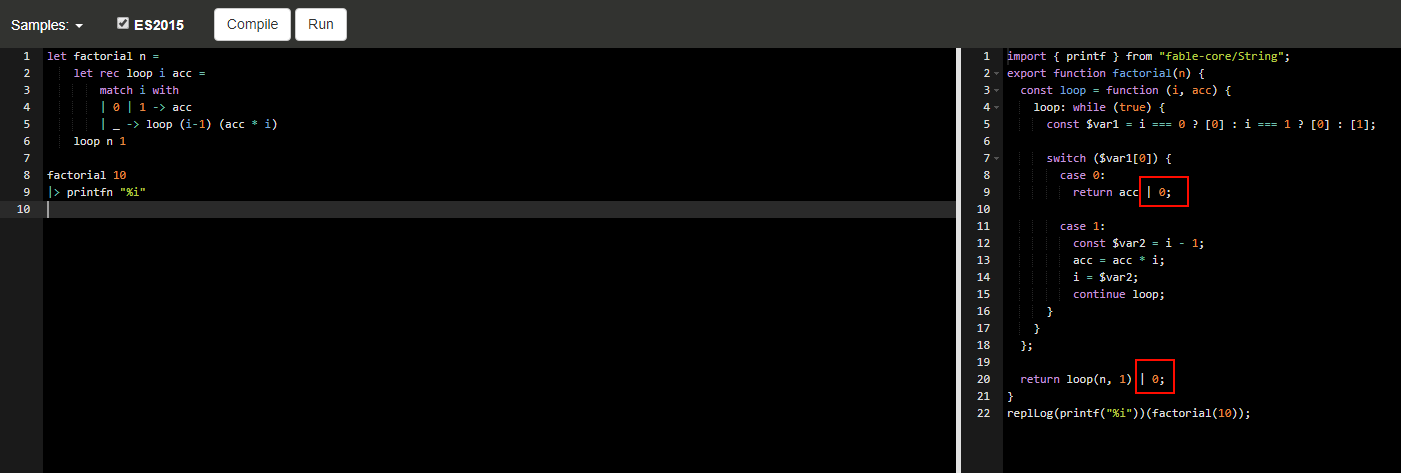
What is it doing? Does it have runtime cost?
/cc @ncave @alfonsogarciacaro
 forki
forki
All 12 comments
value | 0 = 0 when value = undefined so I think it like a guard against undefined values of integers if they are not initialized, not sure tho :smile:
 Zaid-Ajaj
on 19 Oct 2017
Zaid-Ajaj
on 19 Oct 2017
but why would we do that!?
forki
on 19 Oct 2017
In JavaScript it transforms a float into a int:
1.000001 | 0 produces 1.
The return type of the factorial function is int, that's a way to ensure it. That's the reason I think.
 xtuc
on 19 Oct 2017
xtuc
on 19 Oct 2017
@xtuc thanks that makes sense!
forki
on 19 Oct 2017
Let's maybe wait @alfonsogarciacaro's anwser.
xtuc
on 19 Oct 2017
It converts a JavaScript number into a 32-bit signed integer with overflow:
2147483648 | 0 // returns -2147483648
And if you want to convert a JavaScript number into a 32-bit unsigned integer with overflow, you can use >>> 0 instead:
4294967296 >>> 0 // returns 0
 Pauan
on 19 Oct 2017
Pauan
on 19 Oct 2017
Hehe, I'm not sure what | 0 does exactly either :wink:
I added it after a suggestion from a user. This is similar to what asm.js does to indicate an expression is an int, and it could give a hint to the JS compiler that the expression doesn't need to be allocated. But I'm not really sure if JS engines can use it for optimization in no asm.js modules 🤔
 alfonsogarciacaro
on 19 Oct 2017
alfonsogarciacaro
on 19 Oct 2017
@alfonsogarciacaro Yes the JS engines can optimize it even for regular JS code, not just asm.js
But more importantly, it correctly handles overflow, which would not be handled correctly if you did not use | 0
Pauan
on 19 Oct 2017
awesome! good to know /cc @carstenkoenig
forki
on 19 Oct 2017
thanks for the CC - I heard something like this a while ago (something like cast to int ;) ) - I was just wondering if it would have some performance impact as you don't need the second one in the example above - but I guess it's very minor if it's there at all
 CarstenKoenig
on 19 Oct 2017
CarstenKoenig
on 19 Oct 2017
One last question: in the compiled source it's doing | 0 twice. But it's only one place where overflow can happen. Is that needed?
forki
on 19 Oct 2017
@forki The | 0 is needed for integer literals and also every time an operator is used:
500 | 0
(5 + 10) | 0
(5 - 10) | 0
(5 * 10) | 0
(5 / 10) | 0
etc.
I'm not 100% sure if it needs the | 0 on integer literals, but I know it needs them on all mathematical operators.
Looking at your code example, both of the | 0 seem unnecessary.
Instead, it's missing a lot of | 0:
factorial(10 | 0)
loop(n, 1 | 0)
const $var2 = (i - 1) | 0;
acc = (acc * i) | 0;
Also, rather than using (acc * i) | 0 it should use Math.imul(acc, i). The reason is because multiplying two large integers can give the wrong result (because the number is too big), but Math.imul always behaves correctly.
Pauan
on 19 Oct 2017
Related issues
alfonsogarciacaro
·
3Comments
 funlambda
·
4Comments
funlambda
·
4Comments
 ncave
·
3Comments
ncave
·
3Comments
 theprash
·
3Comments
alfonsogarciacaro
·
3Comments
theprash
·
3Comments
alfonsogarciacaro
·
3Comments
Most helpful comment
@alfonsogarciacaro Yes the JS engines can optimize it even for regular JS code, not just asm.js
But more importantly, it correctly handles overflow, which would not be handled correctly if you did not use
| 0