Extensions: Array fields in from GENERATE_SCHEMA_VIEWS remove the row from bigquery when empty or not present.
[REQUIRED] Step 2: Describe your configuration
- Extension name: firestore-bigquery-export (Specifically the GENERATE_SCHEMA_VIEWS script)
- Extension version: 0.1.6
[REQUIRED] Step 3: Describe the problem
If you have array-typed objects and the array-typed object is empty, the rows are skipped in bigquery, where I think they should be NULL (or documentation should say the array must never be empty or your row wont be shown).
Steps to reproduce:
- Create a schema with an array.
- Make some value in the firestore not have the array value, or have it empty.
- Search for the document in the "*_schema_latest" table generated by the script.
Expected result
You would find the row you searched for.
Actual result
You get an empty result.
 iislucas
All 14 comments
I think the issue is that array fields are being added with "CROSS JOIN", where they should be added with "LEFT JOIN" here: https://github.com/firebase/extensions/blob/master/firestore-bigquery-export/scripts/gen-schema-view/src/schema.ts#L260
iislucas
on 4 May 2020
If I understand you correctly, I think this is by design as specified in the documentation:
https://github.com/firebase/extensions/blob/next/firestore-bigquery-export/guides/GENERATE_SCHEMA_VIEWS.md#cloud-firestore-arrays
The pertinent line:
If the array is empty, it will be ignored by the schema-views script.
 russellwheatley
on 5 May 2020
russellwheatley
on 5 May 2020
The 'it' in that sentence would normally be interpreted as "the array", rather that the whole row. I don't think "the row" is likely to be an interpretation anyone would expect/want.
But if that is really the current goal, then making the sentence clearer would fix it; and this can then become a feature request: don't ignore the row is an array is empty; ignore the array instead. I can't image any cases when ignoring the row would be good. That can be fixed/improved as per: https://github.com/firebase/extensions/issues/298#issuecomment-623715017 :)
iislucas
on 5 May 2020
I agree with you @iislucas, it shouldn't ignore the row. I will take a look and get back to you.
russellwheatley
on 5 May 2020
I had a look at implementing a LEFT JOIN at this spot for the changelog view:https://github.com/firebase/extensions/blob/master/firestore-bigquery-export/scripts/gen-schema-view/src/schema.ts#L260 & also at this spot for the latest view: https://github.com/firebase/extensions/blob/master/firestore-bigquery-export/scripts/gen-schema-view/src/snapshot.ts#L163. Whilst it solved the initial problem, It did generate a new issue. It generates rows for every document even if there is no schema related data in the document:
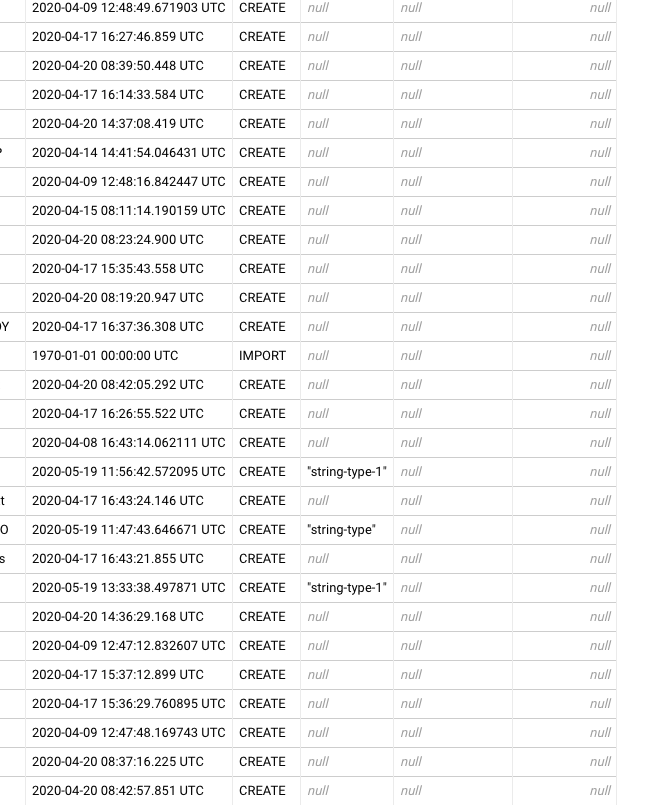
Maybe there is another way of creating a query that will maintain rows that have empty arrays whilst ignoring rows that have none of the schema properties. I'm not sure at this moment in time. It needs further investigation, or perhaps a decision on either LEFT JOIN or CROSS JOIN as desired behaviour.
russellwheatley
on 19 May 2020
A more standard SQL-esk way might be to create a separate table for the array, a table that shares the document_name, and this would also enable you to easily support https://github.com/firebase/extensions/issues/293 ?
iislucas
on 19 May 2020
Apologies if this is too off-topic: Would this issue go away if a nested representation for exporting were supported?
I've experimented w/ constructing a view of nested structs and array, and it seems quite generic and convenient (Example below).
Is there a reason that a flattened representation was preferred to a nested one?
SELECT (
  select array_agg(
    struct(
      timestamp_seconds(cast(json_extract_scalar(d, '$.date._seconds') as int64)) as date,
      json_extract_scalar(d, '$.text') as text,
      struct(
        json_extract_scalar(d, '$.user.name') as text,
        json_extract_scalar(d, '$.user.photo') as photo
      ) as user
    )
) from unnest(json_extract_array(data, '$.comments')) as d) as comments,
json_extract_scalar(data, '$.reference') as reference,
struct(
  json_extract_scalar(data, '$.review.text') as text,
  json_extract_scalar(data, '$.review.reaction') as reaction,
  json_extract_scalar(data, '$.review.delivery_app') as delivery_app,
  json_extract_array(data, '$.review.emojis') as emojis,
  json_extract_array(data, '$.review.tags') as tags
) as review,
struct(
  json_extract_scalar(data, '$.restaurant.name') as text,
  json_extract_scalar(data, '$.restaurant.reference') as reference
) as restaurant,
json_extract_scalar(data, '$.dish') as dish,
json_extract_scalar(data, '$.meal_type') as meal_type,
timestamp_seconds(cast(json_extract_scalar(data, '$.date._seconds') as int64)) as date
FROM `table.firestore_export.discover_items_raw_latest` LIMIT 10;
 jackdreilly
on 22 Jun 2020
jackdreilly
on 22 Jun 2020
I've just been using the LEFT join thing as I found that I wanted to know if I had bad records, rather than hide them.
iislucas
on 30 Jul 2020
Hi Lucas,
Would it be possible for you to share some sample data and sample schema? This would really help us understand the use case.
Thanks!
Kara
 karayu
on 4 Aug 2020
karayu
on 4 Aug 2020
+1 to this issue
I see Lucas left things hanging, but I'm happy to answer any questions in regards to valid use cases @karayu
 nwparker
on 27 Aug 2020
nwparker
on 27 Aug 2020
Apologies if this is too off-topic: Would this issue go away if a nested representation for exporting were supported?
I've experimented w/ constructing a view of nested structs and array, and it seems quite generic and convenient (Example below).
Is there a reason that a flattened representation was preferred to a nested one?
SELECT (
  select array_agg(
    struct(
      timestamp_seconds(cast(json_extract_scalar(d, '$.date._seconds') as int64)) as date,
      json_extract_scalar(d, '$.text') as text,
      struct(
        json_extract_scalar(d, '$.user.name') as text,
        json_extract_scalar(d, '$.user.photo') as photo
      ) as user
    )
) from unnest(json_extract_array(data, '$.comments')) as d) as comments,
json_extract_scalar(data, '$.reference') as reference,
struct(
  json_extract_scalar(data, '$.review.text') as text,
  json_extract_scalar(data, '$.review.reaction') as reaction,
  json_extract_scalar(data, '$.review.delivery_app') as delivery_app,
  json_extract_array(data, '$.review.emojis') as emojis,
  json_extract_array(data, '$.review.tags') as tags
) as review,
struct(
  json_extract_scalar(data, '$.restaurant.name') as text,
  json_extract_scalar(data, '$.restaurant.reference') as reference
) as restaurant,
json_extract_scalar(data, '$.dish') as dish,
json_extract_scalar(data, '$.meal_type') as meal_type,
timestamp_seconds(cast(json_extract_scalar(data, '$.date._seconds') as int64)) as date
FROM `table.firestore_export.discover_items_raw_latest` LIMIT 10;
Responding to this specific snippet. It doesn't quite work.
Instead you want something like this:
SELECT
    ARRAY(
        SELECT
            struct(
                timestamp_seconds(cast(json_extract_scalar(d, '$.date._seconds') as int64)) as date,
                json_extract_scalar(d, '$.text') as text,
                struct(
                    json_extract_scalar(d, '$.user.name') as text,
                    json_extract_scalar(d, '$.user.photo') as photo
                ) as user
            )
        FROM
            unnest(json_extract_array(data, '$.comments')) as d
    ) as comments,
    json_extract_scalar(data, '$.reference') as reference,
    struct(
        json_extract_scalar(data, '$.review.text') as text,
        json_extract_scalar(data, '$.review.reaction') as reaction,
        json_extract_scalar(data, '$.review.delivery_app') as delivery_app,
        json_extract_array(data, '$.review.emojis') as emojis,
        json_extract_array(data, '$.review.tags') as tags
    ) as review,
    struct(
        json_extract_scalar(data, '$.restaurant.name') as text,
        json_extract_scalar(data, '$.restaurant.reference') as reference
    ) as restaurant,
    json_extract_scalar(data, '$.dish') as dish,
    json_extract_scalar(data, '$.meal_type') as meal_type,
    timestamp_seconds(cast(json_extract_scalar(data, '$.date._seconds') as int64)) as date
FROM
    `table.firestore_export.discover_items_raw_latest`
LIMIT
    10;
Notice my use of array instead of array_agg
nwparker
on 28 Aug 2020
I believe that nested representations would be the way to fix this. I need to do it as an intermediate step and store the results in a third table. Nested fields would be awesome!
 pablomargareto
on 22 Sep 2020
pablomargareto
on 22 Sep 2020
@russellwheatley I did not quite get when I would run into issues with the LEFT JOIN?
Whilst it solved the initial problem, It did generate a new issue. It generates rows for every record even if there is no schema related data in the record:
When you are referring to a "record". You mean a record in the array?
I am probably misunderstanding it, but how would I specify a schema for the records in the array? I only saw how to do it for a map.
Let me phrase it in another way. Let's say I have a collection school with many documents schoolclass and there is a property students which is of type array. Let's assume I ensure that the records within students are either consistent or the array is empty. And I want schoolclasses without students (or empty students: []) to appear as a row in my schema-view. And just be null for the columns.
Does LEFT JOIN work for me?
EDIT: Adding examples
{
    "school": {
        "id1234": {
            "type": "schoolclass",
            "name": "Class A",
            "students": []
        },

        "id135397": {
            "type": "schoolclass",
            "name": "Class B",
            "students": [
                "John Doe",
                "Jane Dane"
            ]
        }
    }
}
The result should be:
| document_name | document_id | operation | name | students_member | students_index |
| ------------- | ------------- | ----- | - | - | - |
| ... | id1234 | CREATE | Class A | null | null |
| ... | id135397 | CREATE | Class B | John Dow | 0 |
| ... | id135397 | CREATE | Class B | Jane Dane | 1 |
 haynzz
on 6 Oct 2020
haynzz
on 6 Oct 2020
@haynzz I've updated it to be a bit more clear. A record is a Firestore document inserted into BigQuery.
The BigQuery extension does not handle typed arrays, that is a feature request already however.
Use a LEFT-JOIN so your rows are not hidden in the event the students property is an empty array. There is a PR for changing to a LEFT-JOIN that you can track here: #442.
Hope this helps!
russellwheatley
on 6 Oct 2020
Related issues
 nicoqh
·
3Comments
nicoqh
·
3Comments
 AlexAmin
·
6Comments
AlexAmin
·
6Comments
 ccjernigan
·
4Comments
ccjernigan
·
4Comments
 NLegendre
·
4Comments
NLegendre
·
4Comments
 yulioaj290
·
5Comments
yulioaj290
·
5Comments
Most helpful comment
Apologies if this is too off-topic: Would this issue go away if a nested representation for exporting were supported?
I've experimented w/ constructing a view of nested structs and array, and it seems quite generic and convenient (Example below).
Is there a reason that a flattened representation was preferred to a nested one?