Etcher: Etcher 1.4.4 Ignores Privacy Setting
- Etcher version: 1.4.4
- Operating system and architecture: macOS 10.14 "Mojave" and MacBook Pro (Late 2016)
- Image flashed: ubuntu-18.04.1-desktop-amd64.iso
- Do you see any meaningful error information in the DevTools? No
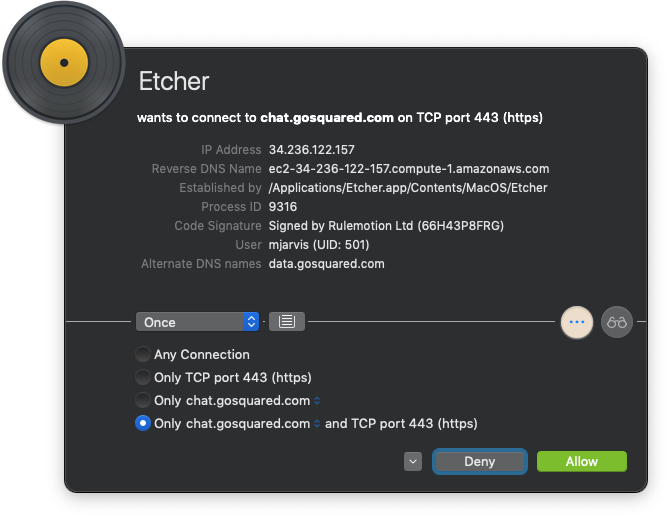
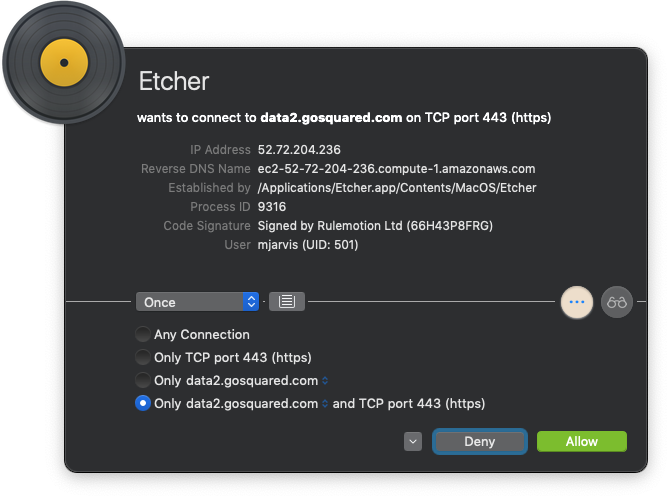
I have the Little Snitch firewall installed, and when I installed Etcher and tried using it I was surprised at the number of outbound connections it made.
I'm posting an issue because if you go into the settings and de-select the option, "Anonymously report errors and usage information to resin.io," the app ignores the setting and still makes a large number of connections to well-known web usage sites such as Mixpanel, GoSquared, and Google.
I do not know if this is a bug in the Etcher code, or if it's cruft that is baked into the Electron JS framework. Regardless, it's misleading to give a user the option to opt-out of usage reporting, and still make the connections anyway.




 mojotx
All 45 comments
This is due to the services being registered but not really used with the flag disabled, so while it won't cause any harm, we can surely prevent the registration in the analytics module.
For instance, at this line here https://github.com/resin-io/etcher/blob/master/lib/gui/app/modules/analytics.js#L33 you can see what I mean :)
 thundron
on 16 Oct 2018
thundron
on 16 Oct 2018
I wonder if some of those warnings are triggered by a) the Etcher auto-update check and b) the Etcher success-banner?
 lurch
on 16 Oct 2018
lurch
on 16 Oct 2018
@lurch I was looking into the latter as well, but good guess on the auto-updater. It should be the call to AWS S3
thundron
on 16 Oct 2018
@thundron If it's making the network connections regardless, how is that not harmful? Even if it doesn't send any _data_, it still tells Google and the like that you're using Etcher.
 SilverWolf32
on 29 Oct 2018
SilverWolf32
on 29 Oct 2018
Why bootable USB maker needs so much analytical data and connection to Facebook? Ignoring the user preference just takes the cake, please address this issue. Thank you.
 LeBaux
on 10 Nov 2018
LeBaux
on 10 Nov 2018
There is also issue #2057
It appears that etcher defaults to sending errors and usage data, and the program is opt-out rather than opt-in. Certainly it's not GDPR compliant if it is.
 kevcampb
on 5 Dec 2018
kevcampb
on 5 Dec 2018
Checking back in, this is still a thing: the latest v1.4.9 is still using network with analytics turned off.
SilverWolf32
on 28 Jan 2019
Also, I can confirm that this is not caused by Electron. My own tiny Electron app is showing 0 bytes of network usage.
SilverWolf32
on 28 Jan 2019
I'm trying to disable analytics in a local build, including replacing all of analytics.js with a stub, and it's _still_ making network calls to tracking services. How do I properly disable that?
SilverWolf32
on 28 Jan 2019
@SilverWolf32 We're working on it, it's because we have a webview in the final flashing page that loads up analytics too and we need to pass the opt-out flag when connecting to that url too (we found out we currently don't), can't tell you when it'll be available though as we're making some major updates related to electron & npm first.
This is without doubt not an issue in electron itself so you're not wrong on that, just wanted to let everyone know that it's on our to-do list
thundron
on 29 Jan 2019

lol
 sneak
on 29 Mar 2019
sneak
on 29 Mar 2019
There's _ads_ in the software now? That's kind of annoying. Good thing it's open-source, and easy to get up and running.
(At least they're more along the lines of "here's a cool project", rather than Google ad-network-supplied stuff. That makes a world of difference. But still.)
SilverWolf32
on 29 Mar 2019
look at what the ad is for - setting up a raspberry pi to block the kind of trackers etcher ships turned on by default. definitely a “do as i say, not as i do” kind of thing.
sneak
on 29 Mar 2019
Since the software is not compliant with the law as it stands, could a release be made that removes tha analytics completely?
They can then be added in once they're strictly opt-in, which is what the law requires.
 unikitty37
on 28 Apr 2019
unikitty37
on 28 Apr 2019
Can we ask the fundamental question of “what possible benefit does an application whose function is ‘flash file a to block device b’ derive from networked real-time surveillance?”
Like, what is the best case scenario for the benefit of receiving analytics from the user base? What is this accomplishing? Why is this even a discussion?
sneak
on 28 Apr 2019
I completely agree with @sneak. This is a graphical front end for a simple process: flashing a file to a block device. It replaces having to run something like dd if=file.img of=/dev/disk2 bs=512.
Analytics might be interesting, but they aren't essential. I think the problem is that this project did not arise as an open-source idea from an individual committed to OSS principles--instead, it was released by Balena, a start-up software company, and I suspect THEY are the ones who want to leverage this tool for commercial purposes. I note that they are working on an "Etcher Pro" product. What's next? Pop-up ads redirecting people to Etcher Pro?
Maybe it's time for someone to fork this project and rip out the spyware.
mojotx
on 29 Apr 2019
To be fair, company != bad. And I think their Etcher Pro is actually a hardware device. But yes, forking does sound like a good idea.
_Edit:_ Not that I'm defending what they're doing. But it's not necessarily just _because they're a company_.
SilverWolf32
on 29 Apr 2019
I understand that, @SilverWolf32. Companies are a GOOD thing, because developers have to eat! The money to live has to come from somewhere, and donations to open-source projects are seldom sufficient for developers to survive, unless it's a really popular project, AND the developers are willing to live frugally! 🙂
My point is that corporations DO love analytics and marketing. I've worked for some companies where product management was a separate department, and their job was to dream up new ways to squeeze more revenue from our customers. I do not know if the analytics were inserted at the request of the Balena upper management, or if someone just thought it would be nice to have. It doesn't really matter. It needs to be fixed, and eventually it probably WILL be fixed, but it doesn't sound like it is a big priority to the core team of developers, at least, not compared to other issues.
In theory, there is nothing stopping someone from forking the code and removing the analytics. However, it only takes a few minutes to complain on Github, but it would take hours to fork the project and fix it correctly. That's why we complain, but aren't fixing it. I am guilty of that myself! 😄
I think the app is a very good app, and I am grateful for the efforts of the people who created it. If I can ever find the time, I would be willing to see if I could fix it myself. However, I stay pretty busy with my own job, as well as spending time with my family, etc. Since I didn't pay anything for the software, I cannot complain too much!
mojotx
on 29 Apr 2019
I understand the doubts you might have about sending out data to what is in fact a company you don't know everything about, but our analytics are anonymous and as such they're only used to monitor various things about the application itself, mainly monitoring how good/bad each release is doing in terms of usability and old/new errors that we try to solve.
If we were to base our development process on user feedback only then the application itself would suffer, while our goal is and has always been to provide the best experience with Etcher as well as keeping it real so that a couple users saying that Etcher is bad doesn't affect the other hundreds of thousands users that use it everyday (as we see in the analytics 😄) and I'm not talking about you of course, it's to put it into perspective as to why anonymous analytics aren't such a bad thing even in a simple UI layer for flashing like Etcher is (as of now, at least).
I also understand this isn't the first thing that comes to mind for sure when seeing that deactivating analytics still doesn't stop a couple calls, which is why github issues are a thing and I thank you for being active and having opened this issue specifically! So returning to the subject of this issue, we recently updated our code so that external content also reads the opt-out anonymous analytics config and behaves accordingly (e.g. the webviews we have for the featured project and the success banner which we revamped recently and needed some adjustments).
Closing this one, feel free to open a new issue if it happens again. It's what we're here for!
thundron
on 7 May 2019
You misunderstand.
If Etcher is used by an EU citizen, the law requires that you not collect any analytics until that user has given explicit, informed, OPT-IN consent.
It’s also unlawful to tie that consent to other things — so you can’t disable functionality until the user consents.
I suggest you look at the maximum penalties for GDPR infringements and feed back to management exactly what liabilities these analytics are exposing you to — they might be a bit less keen on them at that point.
unikitty37
on 7 May 2019
I completely agree that analytics should definitely be opt-in (although disabling them properly is essential even without that, thank you @thundron).
But @unikitty37, you mention that consent can't be tied to other things. Does that apply here? I don't recall disabling analytics ever disabling some feature of Etcher along with it. Although I haven't used Etcher in a while, so I suppose they could have added that in recently.
SilverWolf32
on 7 May 2019
I wasn’t claiming that Etcher was tying consents so much as mentioning it as part of the GDPR requirements — apologies for being unclear.
(Some companies have been known to add that sort of requirement when they’re told they need to get consent first, so I thought it was worth adding up front:)
unikitty37
on 7 May 2019
but our analytics are anonymous and as such they're only used to monitor various things about the application itself, mainly monitoring how good/bad each release is doing in terms of usability and old/new errors that we try to solve.
it turns out that you don’t get to crowdsource your functional testing without the consent of those whose computers and electricity you are using to run those mass functional tests.
sneak
on 12 May 2019
I see this issue is marked as closed, yet https://github.com/balena-io/etcher/blob/master/CHANGELOG.md does not mention anything about addressing the problem. How was the privacy issue fixed?
Note that I generally do not have problem opting-in if I am asked nicely and the purpose is explained. But opt-in by default is the reason I left Windows.
Thank you for clarification.
LeBaux
on 2 Jul 2019
@LeBaux We have an ongoing internal discussion on the changes to perform in order to have a better UX on the analytics side.
This issue though was intended for a bug: when deactivating the analytics, some were still being sent, which wasn't intended and has since been fixed (and this issue closed)
thundron
on 5 Jul 2019
Thanks for clarification. I hope Etcher will continue to thrive while meeting expectations of sometimes demanding & grumpy Linux userbase.
LeBaux
on 5 Jul 2019
We're doing our best to keep everyone happy and find a middle-ground where all can stay :P
thundron
on 5 Jul 2019
The only demand that I have is that the software not do things to my computer without my consent. That’s the difference between a tool and malware.
There is no “middle ground” with consent. Either you have it, or you do not.
sneak
on 5 Jul 2019
@sneak next time maybe start off with reading the comments (more than last 2) before bringing your staff of rushed ethical judgement. Cheers!
LeBaux
on 6 Jul 2019
https://github.com/balena-io/etcher/issues/1718
2017 to 2019 (problem still exists!) is not “rushed”.
sneak
on 6 Jul 2019
sneak
on 6 Jul 2019
Etcher still has this bug; information is transmitted without the user’s consent.
sneak
on 6 Jul 2019
Well, to be fair, I would argue that that's a _different_ bug; while it was certainly mentioned in this thread, the issue was originally about the opt-out checkbox not working.
We should definitely carry on with the other issue, though!
SilverWolf32
on 7 Jul 2019
just saying http://www.enforcementtracker.com/
 saitam1
on 19 Jul 2019
saitam1
on 19 Jul 2019
Actually this could turn out really bad. Balena Inc know that they have gdpr violations since august 2017 (https://github.com/balena-io/etcher/issues/1718). Regarding the fine this could be a reason to quote a big amount and not just 20k or so for educational propose :grimacing:
Maybe the legal team of balena ([email protected]) isn't aware of this? @alexandrosm is?
 rradar
on 25 Aug 2019
rradar
on 25 Aug 2019
Has anyone made a GDPR violation report on this yet? If not, it's about time.
 muscarina
on 3 Nov 2019
muscarina
on 3 Nov 2019
FYI, there's an alternative that does not collect analytics on you, so it is 100% GDPR compliant. https://gitlab.com/bztsrc/usbimager
It can read compressed images, able to verify writes, has multilingual support, and shockingly no more than 128 kilobytes. FOSS and MIT licensed, give it a try if you'd like.
Cheers,
bzt
 bztsrc
on 21 Feb 2020
bztsrc
on 21 Feb 2020
That‘a great! Thank you for the link.
I am also considering just forking Etcher, removing the trademarks and spyware, and re-releasing.
sneak
on 21 Feb 2020
Ok. Seriously?
- etcher size: >400MB (>100MB app + ~300MB dependencies)
- usbimager size: 0,25MB
Essentially they do the same: _uncompress, write, verify_
Can it really be that etcher uses almost half a gigabyte more of code just fore _advanced features_ like spyware, adware (or modern 'promoted content') and security risks?
@sneak I guess their is really no need for a fork anymore :laughing:
rradar
on 7 Mar 2020
Ok. Seriously?
Seriously. :-) I've added compressed backup capability, configurable buffer size and more translations to it, so USBImager is now 251 kilobytes uncompressed. It is a single portable executable, no additional files nor dependencies, and it is not expected to grow much bigger (maybe a little bit if more translations added in the future).
Cheers,
bzt
bztsrc
on 11 Mar 2020
apt purge balena-etcher-electron
Reading package lists... Done
Building dependency tree
Reading state information... Done
The following packages will be REMOVED:
  balena-etcher-electron*
0 upgraded, 0 newly installed, 1 to remove and 1 not upgraded.
After this operation, 429 MB disk space will be freed.
429MB :free: :eyes:
I'm really happy that usbimager doesn't even need privacy settings :tada:
rradar
on 18 Mar 2020
Ok. Seriously?
Seriously. :-) I've added compressed backup capability, configurable buffer size and more translations to it, so USBImager is now 251 kilobytes uncompressed. It is a single portable executable, no additional files nor dependencies, and it is not expected to grow much bigger (maybe a little bit if more translations added in the future).
Cheers,
bzt
You say bzt? I say MVP.
Thanks for this!
muscarina
on 21 Mar 2020
@bztsrc thank you for your privacy-respected fork.
 gafarma89
on 23 May 2020
gafarma89
on 23 May 2020
It's not a fork, it's a different implementation...
But that a USB IMAGE WRITER has privacy considerations is just funny. Sad.
 sinni800
on 24 May 2020
sinni800
on 24 May 2020
What's also sad is watching people not understand the difference between personal and anonymous data.
I think the discussion is long concluded and there's no need to further comment, we've been extremely clear in both admitting what was (previously) an issue and clarifying what our scope is after fixing those.
thundron
on 29 May 2020
Related issues
 codeinabox
·
5Comments
codeinabox
·
5Comments
 grash54
·
5Comments
grash54
·
5Comments
 dilbert-tctc
·
5Comments
dilbert-tctc
·
5Comments
 davidrnewman
·
4Comments
davidrnewman
·
4Comments
 zamber
·
5Comments
zamber
·
5Comments
Most helpful comment
FYI, there's an alternative that does not collect analytics on you, so it is 100% GDPR compliant. https://gitlab.com/bztsrc/usbimager
It can read compressed images, able to verify writes, has multilingual support, and shockingly no more than 128 kilobytes. FOSS and MIT licensed, give it a try if you'd like.
Cheers,
bzt