Eslint-plugin-react: (react/jsx-key) false positive for a not array .map() method
i use library fp-ts@1 and there is, for example, an Option. it has a method map, but it has nothing common with an array type. there is no need in key but eslint thinks differently. i think, it just search for .map( in jsx, but it has to check the type.
const qwe = {
    map: (a: () => ReactNode) => a(),
};
const asd = () => (
    <span>
        {qwe.map(() => (
            <span>qwe</span>
        ))}
    </span>
);
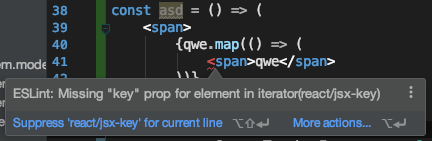
and it does not fail on this, thought it should
const map = <A, B>(m: (a: A) => B) => (as: A[]): B[] => as.map(m);
const asd = () => <span>{map(() => <span>qwe</span>)([])}</span>;

 scink
scink
All 3 comments
It is hard to find out the type of a variable in ESLint, so the current cheap solution is to blindly assume that every .map is the array .map. In the future it might be possible to get type informations might with @typescript-eslint/experimental-utils
.
 golopot
on 8 Nov 2019
golopot
on 8 Nov 2019
The solution here is to disable this rule, either overall or with an override comment. There's no way to reliably - for JavaScript - determine if a variable is an array or not, so "anything with an array method name" is treated as one.
 ljharb
on 9 Nov 2019
ljharb
on 9 Nov 2019
Similar story here—we're using an Option type, along with other types that also implement a map method, such as RemoteData/Observable/Either/Validation.
I looked into enabling this rule on our project and it produced 68 false positives. I don't think it would be reasonable for us to add disable comments in that many places.
In any case, I realise our use case is probably the exception, not the rule!
 OliverJAsh
on 21 Nov 2019
OliverJAsh
on 21 Nov 2019
Related issues
 ahmed1490
·
3Comments
ahmed1490
·
3Comments
 budarin
·
3Comments
budarin
·
3Comments
 sompylasar
·
3Comments
sompylasar
·
3Comments
 Arcanemagus
·
3Comments
Arcanemagus
·
3Comments
 sstur
·
3Comments
sstur
·
3Comments
Most helpful comment
Similar story here—we're using an
Optiontype, along with other types that also implement amapmethod, such asRemoteData/Observable/Either/Validation.I looked into enabling this rule on our project and it produced 68 false positives. I don't think it would be reasonable for us to add disable comments in that many places.
In any case, I realise our use case is probably the exception, not the rule!