Elpy: Eshell does not recognize activated virtual env
If I open a new eshell when having a virtual env activated the eshell does not recognize the virtual environment. Is this supposed to work or have I configured elpy incorrectly?
Regards, Micke.
 clearmisp
All 15 comments
Opening a shell (M-x shell instead of M-x eshell) works, the new shell uses the activated virtual environment.
clearmisp
on 8 Sep 2017
Hello, and thanks for the report! This is strange. pyvenv sets exec-path, which should affect eshell, too. How do you notice that eshell is not recognizing the virtualenv?
 jorgenschaefer
on 22 Sep 2017
jorgenschaefer
on 22 Sep 2017
- I activate the environment using M-x pyvenv-activate.
- I open a new eshell using M-x eshell.
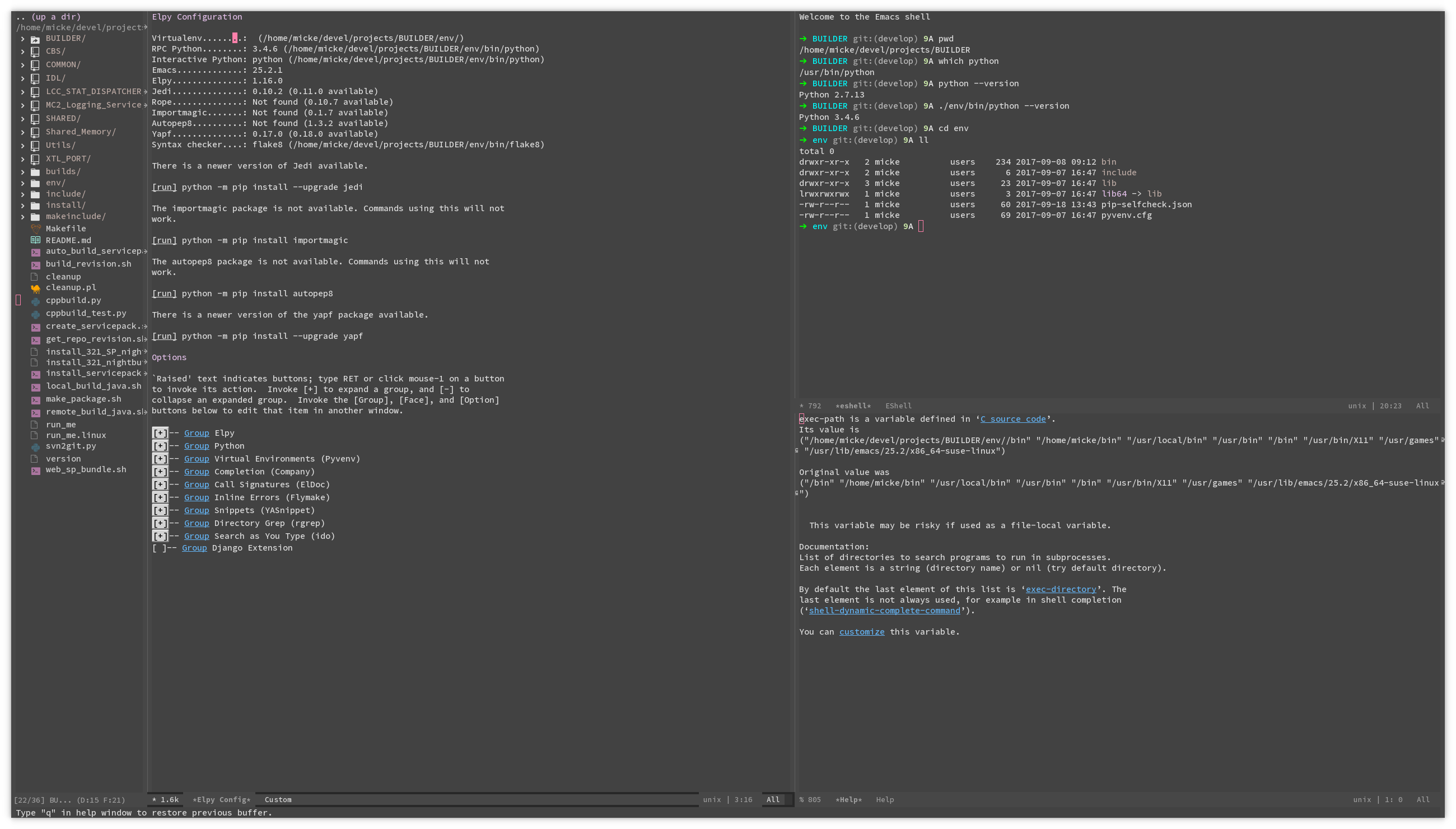
- In the new eshell I do 'which python', I get '/usr/bin/python' which of course is incorrect. If I do 'python --version' in the eshell I get 2.7.13, it should be 3.4.6.
- elpy-config shows correct values of everything (I think).
- The bin dir of the virtual env is prepended to exec-path, still I do not get the correct python in eshell.
I have tried to illustrate all this in a screenshot, I hope you can see all the info.
clearmisp
on 22 Sep 2017
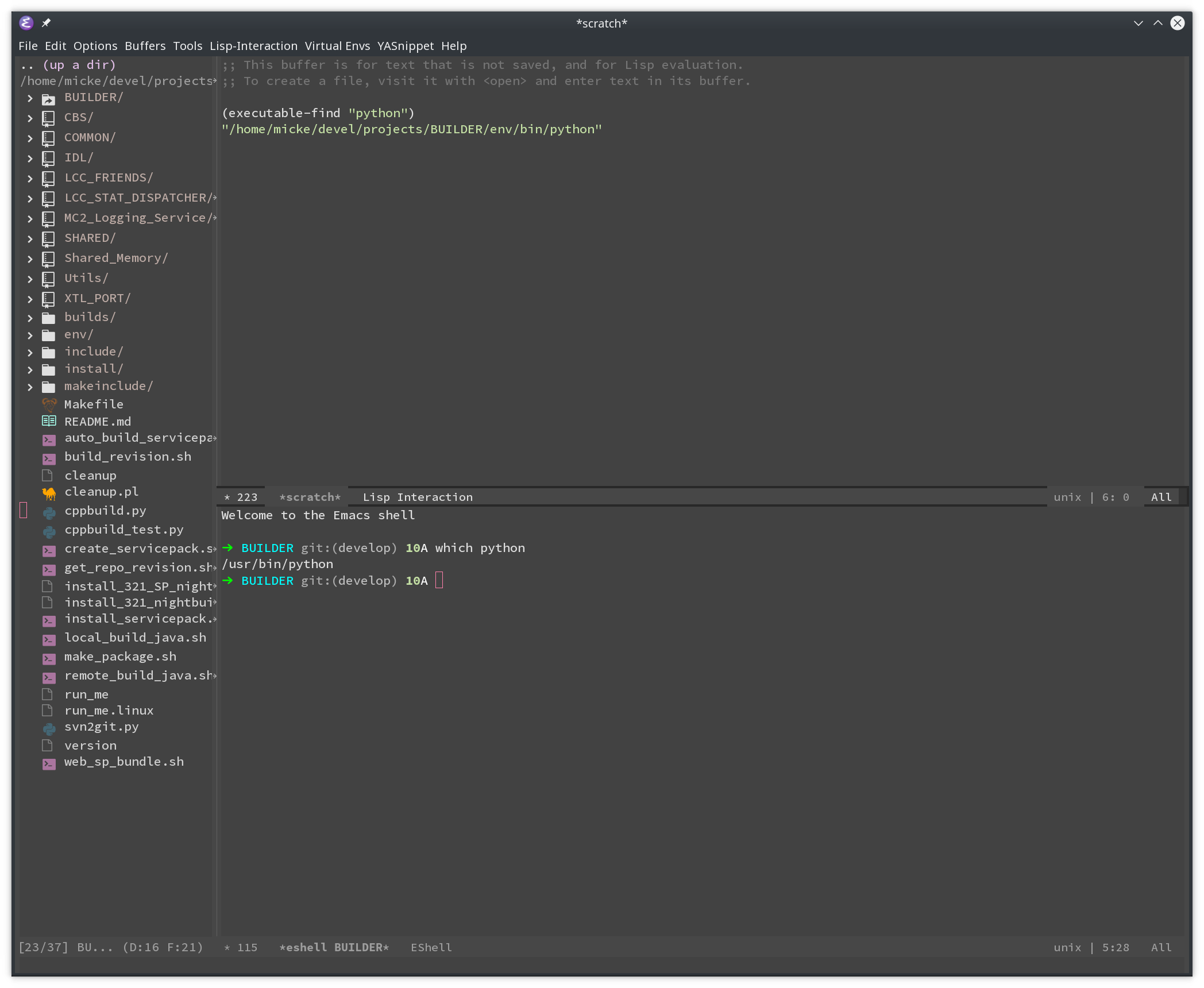
Does M-: (executable-find "python") find the Python interpreter in the virtualenv?
jorgenschaefer
on 22 Sep 2017
It seem so. I evaluated (executable-find "python") in the scratch buffer and printed the result. At the same time eshell finds my system installed python, not the one in the virtualenv.
clearmisp
on 24 Sep 2017
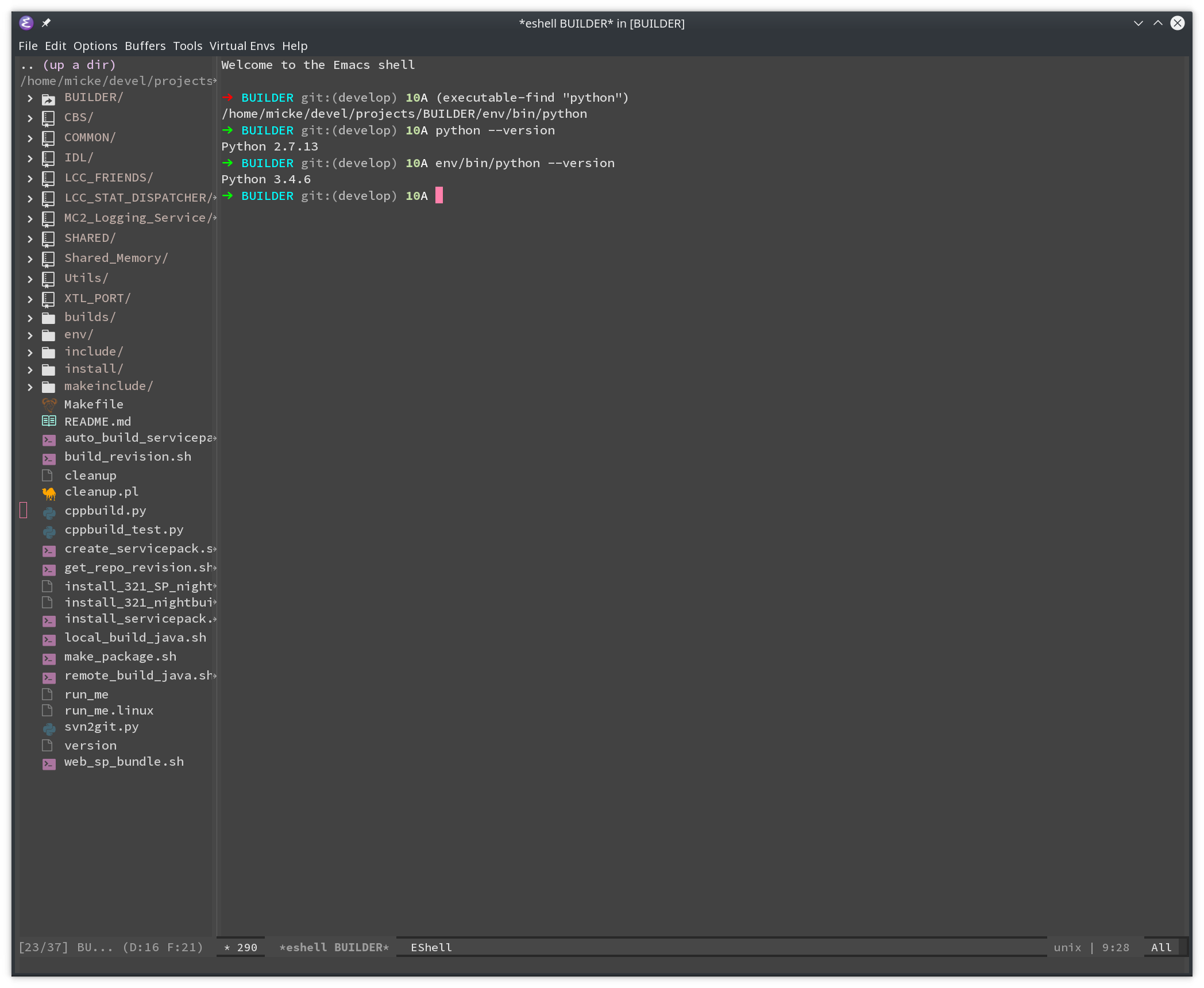
This is even more strange; executable-find evaluated in eshell returns the python in the virtualenv but the python command in eshell returns the system wide installed python.
clearmisp
on 24 Sep 2017
That seems to be a problem of eshell, I'm afraid …
jorgenschaefer
on 29 Sep 2017
@clearmisp I recommend using https://github.com/porterjamesj/virtualenvwrapper.el if you're using virtualenvwrapper. I've been using ti for a while and it works
 gopar
on 12 Jan 2018
gopar
on 12 Jan 2018
Hm. I'd be curious what virtualenvwrapper.el does that pyvenv.el does not, because Elpy recommends the latter. And I wrote the latter because there was nothing around that really worked well back then. If that changed, Elpy might want to switch suggested venv packages. Or some features could be added to pyvenv.
jorgenschaefer
on 19 Jan 2018
virtualenvwrapper will only work on eshell, it doesn't affect anything else. So pyenv is still the better route to go
gopar
on 19 Jan 2018
Oh. That's interesting, thank you :-)
jorgenschaefer
on 19 Jan 2018
It would seem that there is a missing eshell-modify-global-environment for pyvenv to work. The following works for me:
(setq eshell-modify-global-environment t)
(defun smf/post-venv-hook ()
  (setq eshell-path-env (mapconcat 'identity exec-path ":")))

(add-hook 'pyvenv-post-activate-hooks #'smf/post-venv-hook)
(add-hook 'pyvenv-post-deactivate-hooks #'smf/post-venv-hook)
It even works after the eshell buffer has started :-)
 seanfarley
on 2 Feb 2018
seanfarley
on 2 Feb 2018
Nice. Filed a feature request with pyvenv. I won't be able to work on this in the near future, so any help would be welcome :-)
jorgenschaefer
on 2 Feb 2018
It would seem that there is a missing
eshell-modify-global-environmentfor pyvenv to work. The following works for me:(setq eshell-modify-global-environment t) (defun smf/post-venv-hook () (setq eshell-path-env (mapconcat 'identity exec-path ":"))) (add-hook 'pyvenv-post-activate-hooks #'smf/post-venv-hook) (add-hook 'pyvenv-post-deactivate-hooks #'smf/post-venv-hook)It even works after the eshell buffer has started :-)
this didn't work for me but virtualenvwrapper did.
 rafiks
on 14 Apr 2019
rafiks
on 14 Apr 2019
Apparently the associated PR in pyvenv has been merged.
 galaunay
on 6 Jul 2019
galaunay
on 6 Jul 2019
Related issues
 ghost
·
5Comments
ghost
·
5Comments
 kapilsh
·
3Comments
kapilsh
·
3Comments
 kootenpv
·
3Comments
kootenpv
·
3Comments
 chechoRP
·
5Comments
chechoRP
·
5Comments
 rthompsonj
·
6Comments
rthompsonj
·
6Comments