What happens?
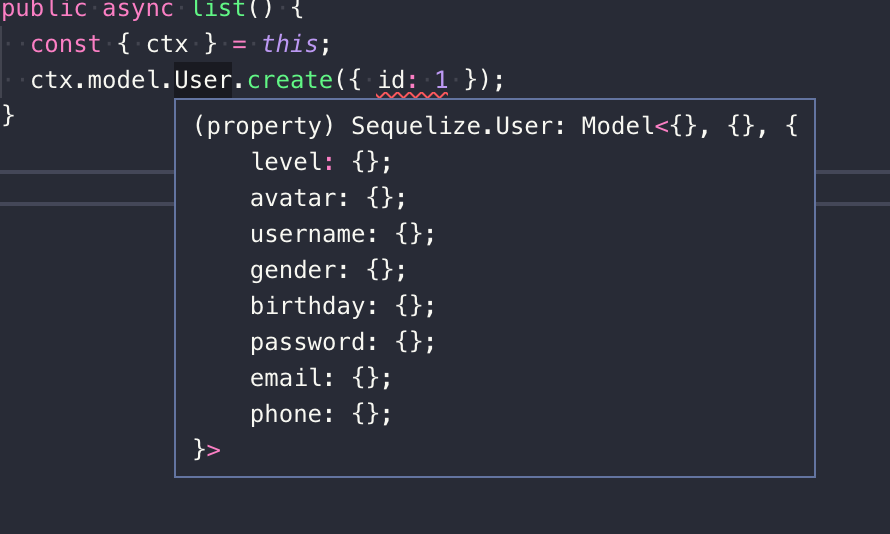
定义的model在使用的时候类型都是{}
例如:

Mini Showcase Repository(REQUIRED)
仓库地址: [email protected]:zhaofinger/test-egg-ts-model.git
model 定义
import { Application } from 'egg';

export default(app: Application) => {
  const { INTEGER, STRING, DATEONLY, ENUM } = app.Sequelize;
  const User = app.model.define('user', {
    level: { type: INTEGER, defaultValue: 0 },
    avatar: { type: STRING(1000), allowNull: false },
    username: { type: STRING(50), allowNull: false },
    gender: { type: ENUM('male', 'female', 'unknown'), defaultValue: 'unknown', allowNull: false },
    birthday: DATEONLY,
    password: STRING(100),
    email: { type: STRING(50), unique: true },
    phone: { type: STRING(50), unique: true },
  }, {
    freezeTableName: true,
    paranoid: true,
  });

  return User;
}
service 中使用
import { Service } from 'egg';

/**
 * Test Service
 */
export default class User extends Service {
  public async list() {
    const { ctx } = this;
    ctx.model.User.create({ id: 1 });
  }
}
How To Reproduce
Steps to reproduce the behavior:
- yarn
- yarn dev
- 在service/user.ts中使用model操作
Expected behavior
- 使用的时候可以给出正确的类型提示校验
Context
- Node Version: v10.15.0
- Egg Version: 2.21.1
- Plugin Name: egg-sequelize
- Plugin Version: 4.3.1
- Platform: macOS Mojave
 zhaofinger
All 3 comments
类型提示如下:
zhaofinger
on 17 Apr 2019
这个跟 egg 没关系,这个是 Sequelize 的声明导致的,要你自己指定 CreationAttributes 的类型,ts 是静态类型检查,是没法分析的出 id: { type: INTEGER, defaultValue: 0 } 是什么类型的
import { Application } from 'egg';

interface CreationAttributes {
  id?: number;
  level?: number;
  avatar?: number;
  username?: string;
  gender?: string;
  birthday?: string;
  password?: string;
  email?: string;
  phone?: string;
}

export default(app: Application) => {
  const { INTEGER, STRING, DATEONLY, ENUM } = app.Sequelize;
  const User = app.model.define<{}, CreationAttributes, CreationAttributes>('user', {
    level: { type: INTEGER, defaultValue: 0 },
    avatar: { type: STRING(1000), allowNull: false },
    username: { type: STRING(50), allowNull: false },
    gender: { type: ENUM('male', 'female', 'unknown'), defaultValue: 'unknown', allowNull: false },
    birthday: DATEONLY,
    password: STRING(100),
    email: { type: STRING(50), unique: true },
    phone: { type: STRING(50), unique: true },
  }, {
    freezeTableName: true,
    paranoid: true,
  });

  return User;
};
 whxaxes
on 18 Apr 2019
whxaxes
on 18 Apr 2019
❤1
🎉1
😄1
👍1
OK, tks!
zhaofinger
on 18 Apr 2019
Was this page helpful?
0 / 5 - 0 ratings
Related issues
 Seovos
·
3Comments
Seovos
·
3Comments
 dizhifeng
·
3Comments
dizhifeng
·
3Comments
 kylezhang
·
3Comments
kylezhang
·
3Comments
 popomore
·
3Comments
popomore
·
3Comments
 aka99
·
3Comments
aka99
·
3Comments
Most helpful comment
这个跟 egg 没关系,这个是 Sequelize 的声明导致的,要你自己指定 CreationAttributes 的类型,ts 是静态类型检查,是没法分析的出
id: { type: INTEGER, defaultValue: 0 }是什么类型的