Efcore: EF Core 3.1 composite key and System.InvalidOperationException "When called from 'VisitLambda'..."
For unknown to me reason I can't use composite key. Getting an exception (see below).
Does anybody know what is the problem?
Here is a table in SQL Server
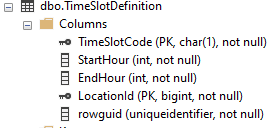
For simplification, I renamed below key columns and entity because it doesn't matter what the name it has.
Part of DbContext:
public DbSet<SomeClass> SomeClasses{ get; set; }
ModelBuilder part:
protected virtual void MapSomeClass(EntityTypeBuilder<SomeClass> config)
{
            config.ToTable("SomeClass");
            config.HasKey(t => new {t.Code, t.SomeId});
            config.Property(t => t.Code).HasColumnType("char(1)");
}
Query part:
var results = await _db.SomeClasses.AsNoTracking().ToListAsync();
Exception
**System.InvalidOperationException**
When called from 'VisitLambda', rewriting a node of type 'System.Linq.Expressions.ParameterExpression' must return a non-null value of the same type. Alternatively, override 'VisitLambda' and change it to not visit children of this type.
   at System.Linq.Expressions.ExpressionVisitor.VisitAndConvert[T](T node, String callerName)
   at System.Dynamic.Utils.ExpressionVisitorUtils.VisitParameters(ExpressionVisitor visitor, IParameterProvider nodes, String callerName)
   at System.Linq.Expressions.ExpressionVisitor.VisitLambda[T](Expression`1 node)
   at System.Linq.Expressions.Expression`1.Accept(ExpressionVisitor visitor)
   at Microsoft.EntityFrameworkCore.Query.Internal.RelationalProjectionBindingExpressionVisitor.Visit(Expression expression)
   at System.Dynamic.Utils.ExpressionVisitorUtils.VisitArguments(ExpressionVisitor visitor, IArgumentProvider nodes)
   at System.Linq.Expressions.ExpressionVisitor.VisitMethodCall(MethodCallExpression node)
   at System.Linq.Expressions.MethodCallExpression.Accept(ExpressionVisitor visitor)
   at Microsoft.EntityFrameworkCore.Query.Internal.RelationalProjectionBindingExpressionVisitor.Visit(Expression expression)
   at System.Linq.Expressions.ExpressionVisitor.VisitMember(MemberExpression node)
   at System.Linq.Expressions.MemberExpression.Accept(ExpressionVisitor visitor)
   at Microsoft.EntityFrameworkCore.Query.Internal.RelationalProjectionBindingExpressionVisitor.Visit(Expression expression)
   at Microsoft.EntityFrameworkCore.Query.Internal.RelationalProjectionBindingExpressionVisitor.VisitNew(NewExpression newExpression)
   at System.Linq.Expressions.NewExpression.Accept(ExpressionVisitor visitor)
   at Microsoft.EntityFrameworkCore.Query.Internal.RelationalProjectionBindingExpressionVisitor.Visit(Expression expression)
   at Microsoft.EntityFrameworkCore.Query.Internal.RelationalProjectionBindingExpressionVisitor.Translate(SelectExpression selectExpression, Expression expression)
   at Microsoft.EntityFrameworkCore.Query.RelationalQueryableMethodTranslatingExpressionVisitor.TranslateSelect(ShapedQueryExpression source, LambdaExpression selector)
   at Microsoft.EntityFrameworkCore.Query.QueryableMethodTranslatingExpressionVisitor.VisitMethodCall(MethodCallExpression methodCallExpression)
   at Microsoft.EntityFrameworkCore.Query.RelationalQueryableMethodTranslatingExpressionVisitor.VisitMethodCall(MethodCallExpression methodCallExpression)
   at System.Linq.Expressions.MethodCallExpression.Accept(ExpressionVisitor visitor)
   at Microsoft.EntityFrameworkCore.Query.QueryCompilationContext.CreateQueryExecutor[TResult](Expression query)
   at Microsoft.EntityFrameworkCore.Storage.Database.CompileQuery[TResult](Expression query, Boolean async)
   at Microsoft.EntityFrameworkCore.Query.Internal.QueryCompiler.CompileQueryCore[TResult](IDatabase database, Expression query, IModel model, Boolean async)
   at Microsoft.EntityFrameworkCore.Query.Internal.QueryCompiler.<>c__DisplayClass12_0`1.<ExecuteAsync>b__0()
   at Microsoft.EntityFrameworkCore.Query.Internal.CompiledQueryCache.GetOrAddQueryCore[TFunc](Object cacheKey, Func`1 compiler)
   at Microsoft.EntityFrameworkCore.Query.Internal.CompiledQueryCache.GetOrAddQuery[TResult](Object cacheKey, Func`1 compiler)
   at Microsoft.EntityFrameworkCore.Query.Internal.QueryCompiler.ExecuteAsync[TResult](Expression query, CancellationToken cancellationToken)
   at Microsoft.EntityFrameworkCore.Query.Internal.EntityQueryProvider.ExecuteAsync[TResult](Expression expression, CancellationToken cancellationToken)
   at Microsoft.EntityFrameworkCore.Query.Internal.EntityQueryable`1.GetAsyncEnumerator(CancellationToken cancellationToken)
   at System.Runtime.CompilerServices.ConfiguredCancelableAsyncEnumerable`1.GetAsyncEnumerator()
   at Microsoft.EntityFrameworkCore.EntityFrameworkQueryableExtensions.ToListAsync[TSource](IQueryable`1 source, CancellationToken cancellationToken)
...
Further technical details
EF Core version: 3.1
Database provider: Microsoft.EntityFrameworkCore.SqlServer
Target framework: .NET Core 3.1
Operating system: Windows 10
IDE: Visual Studio 2019 16.7.3
 apavelm
All 4 comments
This issue is lacking enough information for us to effectively reproduce. Please post a runnable project/solution or complete code listing that demonstrates the behavior you are seeing.
 smitpatel
on 22 Sep 2020
smitpatel
on 22 Sep 2020
@smitpatel Thank you for your reply.
I'm not sure what additional information do you need.
I tried to execute this code from xUnit test project. So, before query execution there is only DbContext creation (I provided DbSet and ModelBuilder) and another simple query from another table (which is working fine [no composite key there]).
Hope it will help
apavelm
on 22 Sep 2020
We need stand-alone repro code which we can run and it shows the behavior you are seeing. I tried to create repro using bits and pieces provided but it works fine for me.
smitpatel
on 22 Sep 2020
@smitpatel I did some investigation around this and something is not clear to me (maybe it is not EF issue).
When I'm running the code above in real application, it works.
When I am doing the same under xUnit test with DbContext injection - it works only for simple Primary Keys, not for composite. And this looks odd.
apavelm
on 23 Sep 2020
Related issues
 ghost
·
3Comments
ghost
·
3Comments
 spottedmahn
·
3Comments
spottedmahn
·
3Comments
 bgribaudo
·
3Comments
bgribaudo
·
3Comments
 HappyNomad
·
3Comments
HappyNomad
·
3Comments
 miguelhrocha
·
3Comments
miguelhrocha
·
3Comments