Efcore: Entity Framework 3.0 HasNoKey() for Key less table not working
I am started with .NET Core 3.0 and add ASP.NET Core identity. In tbl_SYS_AspNet_UserRoles there is no primary key.
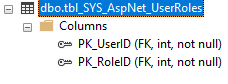
Steps to reproduce
I scaffold dbcontext and model for another tables in database, using Entity Framework Core tools reference - .NET CLI and Entity Framework generates e.HasNoKey() method in model builder for tbl_SYS_AspNet_UserRoles. I also read doc from Microsoft Documentation .
But when I run the project and query for data from another table dbcontext generate , an error:
_'The navigation '' cannot be added because it targets the keyless entity type 'tbl_SYS_AspNet_UserRoles'. Navigations can only target entity types with keys.'_
Further technical details
EF Core version:Microsoft.EntityFrameworkCore Version="3.0.0"
Database provider: Microsoft.EntityFrameworkCore.SqlServer Version="3.0.0"
Target framework: .NET Core 3.0
IDE: Visual Studio Comunity 2019 16.3.5
Full reference of other Asp.Net Core Identity and Entityframework
Microsoft.AspNetCore.Identity Version="2.2.0"
Microsoft.AspNetCore.Identity.EntityFrameworkCore Version="3.0.0"
Microsoft.EntityFrameworkCore Version="3.0.0"
Microsoft.EntityFrameworkCore.Design Version="3.0.0"
Microsoft.AspNetCore.Diagnostics.EntityFrameworkCore Version="3.0.0"
Microsoft.EntityFrameworkCore.SqlServer Version="3.0.0"
Microsoft.EntityFrameworkCore.Tools Version="3.0.0"
Microsoft.Extensions.Configuration.Json Version="3.0.0"
Microsoft.Extensions.DependencyInjection.Abstractions Version="3.0.0"
Microsoft.IdentityModel.Tokens Version="5.5.0"
 kuntalbose
All 18 comments
You cannot mix version 2 and 3! Update Ms.AspnetCore.Identity
 ErikEJ
on 20 Oct 2019
ErikEJ
on 20 Oct 2019
Ok ,Thanks for reply .But latest version of AspNetCore.Identity is 2.2 and I devlop my application in .Net Core 3.0 ,so should I wait until AspNetCore.Identity 3.0?
Currently I add a fake Identity column in tbl_SYS_AspNet_UserRoles to solve the problem temporarily.
Please suggest me if I am doing wrong.
kuntalbose
on 20 Oct 2019
You should read the upgrade guide!
https://docs.microsoft.com/en-us/aspnet/core/migration/22-to-30?view=aspnetcore-3.0&tabs=visual-studio#remove-obsolete-package-references
ErikEJ
on 20 Oct 2019
Asper your advice I change .csproj like bellow
<Project Sdk="Microsoft.NET.Sdk.Web">

  <PropertyGroup>
    <TargetFramework>netcoreapp3.0</TargetFramework>

  </PropertyGroup>

  <ItemGroup>
    <FrameworkReference Include="Microsoft.AspNetCore.App" />
    <PackageReference Include="AutoMapper" Version="9.0.0" />
    <PackageReference Include="AutoMapper.Extensions.Microsoft.DependencyInjection" Version="7.0.0" />
    <PackageReference Include="Microsoft.AspNetCore.Authentication.JwtBearer" Version="3.0.0" />
    <PackageReference Include="Microsoft.AspNetCore.Identity.EntityFrameworkCore" Version="3.0.0" />
    <PackageReference Include="Microsoft.EntityFrameworkCore" Version="3.0.0" />
    <PackageReference Include="Microsoft.EntityFrameworkCore.Design" Version="3.0.0" />
     <PackageReference Include="Microsoft.AspNetCore.Diagnostics.EntityFrameworkCore" Version="3.0.0" />
    <PackageReference Include="Microsoft.EntityFrameworkCore.SqlServer" Version="3.0.0" />
    <PackageReference Include="Microsoft.EntityFrameworkCore.Tools" Version="3.0.0" />
    <PackageReference Include="Microsoft.Extensions.Configuration.Json" Version="3.0.0" />
    <PackageReference Include="Microsoft.Extensions.DependencyInjection.Abstractions" Version="3.0.0" />
    <PackageReference Include="Microsoft.IdentityModel.Tokens" Version="5.5.0" />
    <PackageReference Include="Microsoft.VisualStudio.Web.CodeGeneration.Design" Version="3.0.0" />
    <PackageReference Include="Swashbuckle.AspNetCore" Version="5.0.0-rc4" />
    <PackageReference Include="Swashbuckle.AspNetCore.Annotations" Version="5.0.0-rc4" />
    <PackageReference Include="Swashbuckle.AspNetCore.Filters" Version="5.0.0-rc8" />
    <PackageReference Include="Swashbuckle.AspNetCore.ReDoc" Version="5.0.0-rc4" />
    <PackageReference Include="System.IdentityModel.Tokens.Jwt" Version="5.5.0" />
  </ItemGroup>

</Project>
EF scaffolding generate bellow code for tbl_SYS_AspNet_UserRoles
modelBuilder.Entity<tbl_SYS_AspNet_UserRoles>(entity =>
            {
                entity.HasNoKey();

                entity.HasIndex(e => e.PK_RoleID)
                    .HasName("IX_AspNetUserRoles_RoleId");

                entity.HasOne(d => d.PK_Role)
                    .WithMany(p => p.tbl_SYS_AspNet_UserRoles)
                    .HasForeignKey(d => d.PK_RoleID)
                    .HasConstraintName("FK_AspNetUserRoles_AspNetRoles_RoleId");

                entity.HasOne(d => d.PK_User)
                    .WithMany(p => p.tbl_SYS_AspNet_UserRoles)
                    .HasForeignKey(d => d.PK_UserID)
                    .HasConstraintName("FK_AspNetUserRoles_AspNetUsers_UserId");
            });
But getting the exception still

kuntalbose
on 20 Oct 2019
@ikuntalb
In tbl_SYS_AspNet_UserRoles there is no primary key.
That table should have a composite key, and indeed you show an image with the two columns that make up the composite key. Can you provide more details on what you mean by, "no primary key?"
 ajcvickers
on 21 Oct 2019
ajcvickers
on 21 Oct 2019
hi @ajcvickers
Thanks for reply .Yes this is true this table have composite key ,but EF scaffolder generated code through an exception as shown in above image.For more details I will try to make simple project to replicate this ,may be today or tomorrow .
Thanks
kuntalbose
on 21 Oct 2019
@ikuntalb Ah! I see--thanks for the additional information.
ajcvickers
on 21 Oct 2019
@ErikEJ I tried scaffolding on the command line for the default Identity database and got this:
```C#
modelBuilder.Entity
{
entity.HasKey(e => new { e.UserId, e.RoleId });
entity.HasIndex(e => e.RoleId);

entity.HasOne(d => d.Role)
    .WithMany(p => p.AspNetUserRoles)
    .HasForeignKey(d => d.RoleId);

entity.HasOne(d => d.User)
    .WithMany(p => p.AspNetUserRoles)
    .HasForeignKey(d => d.UserId);
});
``
which seems correct and doesn't includeHasNoKey`. Is it possible this is an issue with the Power Tools?
ajcvickers
on 21 Oct 2019
No, not likely. The Power Tools does not influence this at all. I guess the user has been modifying the dB schema by hand, but if we could see a full create SQL script from the scaffolded database?
ErikEJ
on 21 Oct 2019
Thanks @ErikEJ
@ikuntalb We are not able to reproduce this using the default schema for ASP.NET Core Identity. If you have changed the schema and removed the primary key, then that would cause what you are seeing, but then this would be correct because the model requires that primary key to work correctly.
ajcvickers
on 21 Oct 2019
Hi @ErikEJ and @ajcvickers
Thanks for your taughts and comment,yes I change table name and column name but as I can remember I am not change any relation or remove any primary key ,I will check my code again and make a sample if it reproduce the same error I will definitely revert with sample.
Thanks for your valuable time and suggestion .
kuntalbose
on 21 Oct 2019
Renaming table/column names in database requires you to update references. So likely you need to drop the PK to rename the column. You would also need to recreate it afterwards.
 smitpatel
on 21 Oct 2019
smitpatel
on 21 Oct 2019
Hi all
Bellow is my custom .net core identity DB script and EF genarated context and its still genarate bellow code for tbl_SYS_AspNet_UserRoles
USE [aspnetcore_identity_test]
GO
/****** Object:  Table [dbo].[tbl_SYS_AspNet_RoleClaims]    Script Date: 10/22/2019 7:44:38 AM ******/
SET ANSI_NULLS ON
GO
SET QUOTED_IDENTIFIER ON
GO
CREATE TABLE [dbo].[tbl_SYS_AspNet_RoleClaims](
    [Id] [int] IDENTITY(1,1) NOT NULL,
    [FK_RoleID] [int] NOT NULL,
    [ClaimType] [nvarchar](max) NULL,
    [ClaimValue] [nvarchar](max) NULL,
 CONSTRAINT [PK_AspNetRoleClaims] PRIMARY KEY CLUSTERED
(
    [Id] ASC
)WITH (PAD_INDEX = OFF, STATISTICS_NORECOMPUTE = OFF, IGNORE_DUP_KEY = OFF, ALLOW_ROW_LOCKS = ON, ALLOW_PAGE_LOCKS = ON) ON [PRIMARY]
) ON [PRIMARY] TEXTIMAGE_ON [PRIMARY]
GO
/****** Object:  Table [dbo].[tbl_SYS_AspNet_Roles]    Script Date: 10/22/2019 7:44:38 AM ******/
SET ANSI_NULLS ON
GO
SET QUOTED_IDENTIFIER ON
GO
CREATE TABLE [dbo].[tbl_SYS_AspNet_Roles](
    [PK_RoleID] [int] IDENTITY(1,1) NOT NULL,
    [Name] [nvarchar](256) NULL,
    [NormalizedName] [nvarchar](256) NULL,
    [ConcurrencyStamp] [nvarchar](max) NULL,
 CONSTRAINT [PK_AspNetRoles] PRIMARY KEY CLUSTERED
(
    [PK_RoleID] ASC
)WITH (PAD_INDEX = OFF, STATISTICS_NORECOMPUTE = OFF, IGNORE_DUP_KEY = OFF, ALLOW_ROW_LOCKS = ON, ALLOW_PAGE_LOCKS = ON) ON [PRIMARY]
) ON [PRIMARY] TEXTIMAGE_ON [PRIMARY]
GO
/****** Object:  Table [dbo].[tbl_SYS_AspNet_UserClaims]    Script Date: 10/22/2019 7:44:38 AM ******/
SET ANSI_NULLS ON
GO
SET QUOTED_IDENTIFIER ON
GO
CREATE TABLE [dbo].[tbl_SYS_AspNet_UserClaims](
    [Id] [int] IDENTITY(1,1) NOT NULL,
    [FK_UserID] [int] NOT NULL,
    [ClaimType] [nvarchar](max) NULL,
    [ClaimValue] [nvarchar](max) NULL,
 CONSTRAINT [PK_AspNetUserClaims] PRIMARY KEY CLUSTERED
(
    [Id] ASC
)WITH (PAD_INDEX = OFF, STATISTICS_NORECOMPUTE = OFF, IGNORE_DUP_KEY = OFF, ALLOW_ROW_LOCKS = ON, ALLOW_PAGE_LOCKS = ON) ON [PRIMARY]
) ON [PRIMARY] TEXTIMAGE_ON [PRIMARY]
GO
/****** Object:  Table [dbo].[tbl_SYS_AspNet_UserInformation]    Script Date: 10/22/2019 7:44:38 AM ******/
SET ANSI_NULLS ON
GO
SET QUOTED_IDENTIFIER ON
GO
CREATE TABLE [dbo].[tbl_SYS_AspNet_UserInformation](
    [PK_UserID] [int] IDENTITY(1,1) NOT NULL,
    [FK_UserID_CreatedBy] [int] NULL,
    [FK_DateKey_CreatedOn] [int] NULL,
    [FK_TimeKey_CreatedOn] [int] NULL,
    [IsDeleted] [bit] NULL,
    [IsActive] [bit] NULL,
    [FK_UserID_ModifiedBy] [int] NULL,
    [FK_DateKey_ModifiedOn] [int] NULL,
    [FK_TimeKey_ModifiedOn] [int] NULL,
    [FK_ClientID] [int] NULL,
    [UserName] [nvarchar](256) NULL,
    [NormalizedUserName] [nvarchar](256) NULL,
    [Email] [nvarchar](256) NULL,
    [NormalizedEmail] [nvarchar](256) NULL,
    [EmailConfirmed] [bit] NOT NULL,
    [PasswordHash] [nvarchar](max) NULL,
    [SecurityStamp] [nvarchar](max) NULL,
    [ConcurrencyStamp] [nvarchar](max) NULL,
    [PhoneNumber] [nvarchar](max) NULL,
    [PhoneNumberConfirmed] [bit] NOT NULL,
    [TwoFactorEnabled] [bit] NOT NULL,
    [LockoutEnd] [datetimeoffset](7) NULL,
    [LockoutEnabled] [bit] NOT NULL,
    [AccessFailedCount] [int] NOT NULL,
    [Password] [varchar](20) NULL,
    [Title] [varchar](50) NULL,
    [FirstName] [varchar](100) NULL,
    [MiddleName] [varchar](100) NULL,
    [LastName] [varchar](100) NULL,
    [Gender] [varchar](20) NULL,
    [MobileNo] [varchar](20) NULL,
    [DisplayUserName] [varchar](150) NULL,
    [UserImagePath] [varchar](500) NULL,
    [IsSuperAdmin] [bit] NULL,
    [Latitude] [varchar](50) NULL,
    [Longitude] [varchar](50) NULL,
    [Device_UUID] [varchar](50) NULL,
 CONSTRAINT [PK_AspNetUsers] PRIMARY KEY CLUSTERED
(
    [PK_UserID] ASC
)WITH (PAD_INDEX = OFF, STATISTICS_NORECOMPUTE = OFF, IGNORE_DUP_KEY = OFF, ALLOW_ROW_LOCKS = ON, ALLOW_PAGE_LOCKS = ON) ON [PRIMARY]
) ON [PRIMARY] TEXTIMAGE_ON [PRIMARY]
GO
/****** Object:  Table [dbo].[tbl_SYS_AspNet_UserLogins]    Script Date: 10/22/2019 7:44:38 AM ******/
SET ANSI_NULLS ON
GO
SET QUOTED_IDENTIFIER ON
GO
CREATE TABLE [dbo].[tbl_SYS_AspNet_UserLogins](
    [LoginProvider] [nvarchar](128) NOT NULL,
    [ProviderKey] [nvarchar](128) NOT NULL,
    [ProviderDisplayName] [nvarchar](max) NULL,
    [FK_UserID] [int] NOT NULL,
 CONSTRAINT [PK_AspNetUserLogins] PRIMARY KEY CLUSTERED
(
    [LoginProvider] ASC,
    [ProviderKey] ASC
)WITH (PAD_INDEX = OFF, STATISTICS_NORECOMPUTE = OFF, IGNORE_DUP_KEY = OFF, ALLOW_ROW_LOCKS = ON, ALLOW_PAGE_LOCKS = ON) ON [PRIMARY]
) ON [PRIMARY] TEXTIMAGE_ON [PRIMARY]
GO
/****** Object:  Table [dbo].[tbl_SYS_AspNet_UserRoles]    Script Date: 10/22/2019 7:44:38 AM ******/
SET ANSI_NULLS ON
GO
SET QUOTED_IDENTIFIER ON
GO
CREATE TABLE [dbo].[tbl_SYS_AspNet_UserRoles](
    [PK_UserID] [int] NOT NULL,
    [PK_RoleID] [int] NOT NULL
) ON [PRIMARY]
GO
/****** Object:  Table [dbo].[tbl_SYS_AspNet_UserTokens]    Script Date: 10/22/2019 7:44:38 AM ******/
SET ANSI_NULLS ON
GO
SET QUOTED_IDENTIFIER ON
GO
CREATE TABLE [dbo].[tbl_SYS_AspNet_UserTokens](
    [UserId] [int] NOT NULL,
    [LoginProvider] [nvarchar](128) NOT NULL,
    [Name] [nvarchar](128) NOT NULL,
    [Value] [nvarchar](max) NULL,
 CONSTRAINT [PK_AspNetUserTokens] PRIMARY KEY CLUSTERED
(
    [UserId] ASC,
    [LoginProvider] ASC,
    [Name] ASC
)WITH (PAD_INDEX = OFF, STATISTICS_NORECOMPUTE = OFF, IGNORE_DUP_KEY = OFF, ALLOW_ROW_LOCKS = ON, ALLOW_PAGE_LOCKS = ON) ON [PRIMARY]
) ON [PRIMARY] TEXTIMAGE_ON [PRIMARY]
GO
ALTER TABLE [dbo].[tbl_SYS_AspNet_UserInformation] ADD  CONSTRAINT [DF_tbl_SYS_AspNet_Users_FK_DateKey_CreatedOn]  DEFAULT ((((rtrim(datepart(year,getdate()))+replicate('0',(2)-len(rtrim(datepart(month,getdate())))))+rtrim(datepart(month,getdate())))+replicate('0',(2)-len(rtrim(datepart(day,getdate())))))+rtrim(datepart(day,getdate()))) FOR [FK_DateKey_CreatedOn]
GO
ALTER TABLE [dbo].[tbl_SYS_AspNet_UserInformation] ADD  CONSTRAINT [DF_tbl_SYS_AspNet_Users_FK_TimeKey_CreatedOn]  DEFAULT ((datepart(hour,getdate())*(3600)+datepart(minute,getdate())*(60))+datepart(second,getdate())) FOR [FK_TimeKey_CreatedOn]
GO
ALTER TABLE [dbo].[tbl_SYS_AspNet_UserInformation] ADD  CONSTRAINT [DF_tbl_SYS_AspNet_Users_IsDeleted]  DEFAULT ((0)) FOR [IsDeleted]
GO
ALTER TABLE [dbo].[tbl_SYS_AspNet_UserInformation] ADD  CONSTRAINT [DF_tbl_SYS_AspNet_Users_IsActive]  DEFAULT ((1)) FOR [IsActive]
GO
ALTER TABLE [dbo].[tbl_SYS_AspNet_RoleClaims]  WITH CHECK ADD  CONSTRAINT [FK_AspNetRoleClaims_AspNetRoles_RoleId] FOREIGN KEY([FK_RoleID])
REFERENCES [dbo].[tbl_SYS_AspNet_Roles] ([PK_RoleID])
ON DELETE CASCADE
GO
ALTER TABLE [dbo].[tbl_SYS_AspNet_RoleClaims] CHECK CONSTRAINT [FK_AspNetRoleClaims_AspNetRoles_RoleId]
GO
ALTER TABLE [dbo].[tbl_SYS_AspNet_UserClaims]  WITH CHECK ADD  CONSTRAINT [FK_AspNetUserClaims_AspNetUsers_UserId] FOREIGN KEY([FK_UserID])
REFERENCES [dbo].[tbl_SYS_AspNet_UserInformation] ([PK_UserID])
ON DELETE CASCADE
GO
ALTER TABLE [dbo].[tbl_SYS_AspNet_UserClaims] CHECK CONSTRAINT [FK_AspNetUserClaims_AspNetUsers_UserId]
GO
ALTER TABLE [dbo].[tbl_SYS_AspNet_UserLogins]  WITH CHECK ADD  CONSTRAINT [FK_AspNetUserLogins_AspNetUsers_UserId] FOREIGN KEY([FK_UserID])
REFERENCES [dbo].[tbl_SYS_AspNet_UserInformation] ([PK_UserID])
ON DELETE CASCADE
GO
ALTER TABLE [dbo].[tbl_SYS_AspNet_UserLogins] CHECK CONSTRAINT [FK_AspNetUserLogins_AspNetUsers_UserId]
GO
ALTER TABLE [dbo].[tbl_SYS_AspNet_UserRoles]  WITH CHECK ADD  CONSTRAINT [FK_AspNetUserRoles_AspNetRoles_RoleId] FOREIGN KEY([PK_RoleID])
REFERENCES [dbo].[tbl_SYS_AspNet_Roles] ([PK_RoleID])
ON DELETE CASCADE
GO
ALTER TABLE [dbo].[tbl_SYS_AspNet_UserRoles] CHECK CONSTRAINT [FK_AspNetUserRoles_AspNetRoles_RoleId]
GO
ALTER TABLE [dbo].[tbl_SYS_AspNet_UserRoles]  WITH CHECK ADD  CONSTRAINT [FK_AspNetUserRoles_AspNetUsers_UserId] FOREIGN KEY([PK_UserID])
REFERENCES [dbo].[tbl_SYS_AspNet_UserInformation] ([PK_UserID])
ON DELETE CASCADE
GO
ALTER TABLE [dbo].[tbl_SYS_AspNet_UserRoles] CHECK CONSTRAINT [FK_AspNetUserRoles_AspNetUsers_UserId]
GO
ALTER TABLE [dbo].[tbl_SYS_AspNet_UserTokens]  WITH CHECK ADD  CONSTRAINT [FK_AspNetUserTokens_AspNetUsers_UserId] FOREIGN KEY([UserId])
REFERENCES [dbo].[tbl_SYS_AspNet_UserInformation] ([PK_UserID])
ON DELETE CASCADE
GO
ALTER TABLE [dbo].[tbl_SYS_AspNet_UserTokens] CHECK CONSTRAINT [FK_AspNetUserTokens_AspNetUsers_UserId]
GO
modelBuilder.Entity<tbl_SYS_AspNet_UserRoles>(entity =>
            {
                entity.HasNoKey();

                entity.HasOne(d => d.PK_Role)
                    .WithMany(p => p.tbl_SYS_AspNet_UserRoles)
                    .HasForeignKey(d => d.PK_RoleID)
                    .HasConstraintName("FK_AspNetUserRoles_AspNetRoles_RoleId");

                entity.HasOne(d => d.PK_User)
                    .WithMany(p => p.tbl_SYS_AspNet_UserRoles)
                    .HasForeignKey(d => d.PK_UserID)
                    .HasConstraintName("FK_AspNetUserRoles_AspNetUsers_UserId");
            });
Please point me where I am doing wrong.
kuntalbose
on 22 Oct 2019
You are not creating a primary key for tbl_SYS_AspNet_UserRoles!
ErikEJ
on 22 Oct 2019
@ErikEJ If we have a table with no primary key for whatsoever reason, how will this work? I see lot of System.InvalidOperationException: 'The navigation '' cannot be added because it targets the keyless entity type ''. Navigations can only target entity types with keys.'
Same as : https://github.com/aspnet/EntityFrameworkCore/issues/18633 ???
 ACBNair
on 11 Dec 2019
ACBNair
on 11 Dec 2019
You are not creating a primary key for tbl_SYS_AspNet_UserRoles!
Sorry @ErikEJ, are you meaning we need to remove the entity.HasNoKey(); line?
 enricobenedos
on 15 Jan 2020
enricobenedos
on 15 Jan 2020
@enricobenedos No, I am talking about your SQL script
ErikEJ
on 16 Jan 2020
I had the same problem here. These are my codes:
[...]
public partial class Radusergroup
{

        public string Username { get; set; }
        public string Groupname { get; set; }
        public int Priority { get; set; }

}
[...]
[...]
modelBuilder.Entity<Radusergroup>(entity =>
{

                entity.HasNoKey();

                entity.ToTable("radusergroup");

                entity.HasIndex(e => e.Username)
                    .HasName("username");

                entity.Property(e => e.Groupname)
                    .IsRequired()
                    .HasColumnName("groupname")
                    .HasMaxLength(64)
                    .HasDefaultValueSql("''''''");

                entity.Property(e => e.Priority)
                    .HasColumnName("priority")
                    .HasColumnType("int(11)")
                    .HasDefaultValueSql("'1'");

                entity.Property(e => e.Username)
                    .IsRequired()
                    .HasColumnName("username")
                    .HasMaxLength(64)
                    .HasDefaultValueSql("''''''");
});
[...]
As @ErikEJ said, you are not creating a key for your table. He is right, however, sometimes, you can't change the database for some reason. In my case, this is a database which another application uses, so I don't want to compromise that other application, so my solution was simply turn my attribute "username" into a key, like this:
public partial class Radusergroup
{
   [Key]
   public string Username { get; set; }
   public string Groupname { get; set; }
   public int Priority { get; set; }
}
and remove the HasNoKey on your context:
[...]
modelBuilder.Entity<Radusergroup>(entity =>
{

                //entity.HasNoKey();

                entity.ToTable("radusergroup");

                entity.HasIndex(e => e.Username)
                    .HasName("username");

                entity.Property(e => e.Groupname)
                    .IsRequired()
                    .HasColumnName("groupname")
                    .HasMaxLength(64)
                    .HasDefaultValueSql("''''''");

                entity.Property(e => e.Priority)
                    .HasColumnName("priority")
                    .HasColumnType("int(11)")
                    .HasDefaultValueSql("'1'");

                entity.Property(e => e.Username)
                    .IsRequired()
                    .HasColumnName("username")
                    .HasMaxLength(64)
                    .HasDefaultValueSql("''''''");
});
[...]
That will probably solve it.
 huandertironi
on 30 Oct 2020
huandertironi
on 30 Oct 2020
Related issues
 HappyNomad
·
3Comments
HappyNomad
·
3Comments
 spottedmahn
·
3Comments
spottedmahn
·
3Comments
 ryanwinter
·
3Comments
ryanwinter
·
3Comments
 yukozh
·
3Comments
yukozh
·
3Comments
 ghost
·
3Comments
ghost
·
3Comments
Most helpful comment
You are not creating a primary key for tbl_SYS_AspNet_UserRoles!