For some unknown reason my identities are jumping. Why could that be? Where do I start to look for why something like this happening?
Jump 1 Example

Jump 2 Example

Model
c#
[Table("Customers", Schema = "Customers")]
public class Customer : IValidatableObject
{
    public int Id { get; set; }
    ...
}
Table Generated from the Migration
``` sql
CREATE TABLE [Customers].[Customers] (
[Id] INT IDENTITY (1, 1) NOT NULL,
...
)
 spottedmahn
All 8 comments
This stackoverflow questions answers it in detail.
http://stackoverflow.com/questions/14146148/identity-increment-is-jumping-in-sql-server-database
It is the way SqlServer works (on restart) not something specific to EF behavior (which merely uses database values created by SqlServer)
 smitpatel
on 22 Apr 2017
smitpatel
on 22 Apr 2017
@smitpatel Shouldn't this be reported as a bug? As this gives great danger, gaps can grow very quickly, reaching int.maxvalue without having so many items.
I just had the same issue and it affects all my tables now.
related: https://stackoverflow.com/questions/39671899/ids-jumping-up-1000-every-time-i-build-my-app-and-insert-a-new-record
related: https://stackoverflow.com/questions/21563320/why-identity-number-in-ef-jump-to-a-big-number
 wstaelens
on 4 Mar 2019
wstaelens
on 4 Mar 2019
@wstaelens - While behavior can cause potential issue like that, the behavior is out of the hands of EF team. We just take SqlServer gives to us. So if you think this is a bug then it should be reported to SqlServer product.
From EF Core perspective, you can avoid hitting the issue but possibly not using identity. A user defined sequence or some client side value generation code or no value generation could work in EF Core.
smitpatel
on 4 Mar 2019
@smitpatel this never happened to us before with regular EF and .NET but it happens now when I'm using EF Core and .NET Core. Strange.
wstaelens
on 5 Mar 2019
this never happened to us before with regular EF and .NET but it happens now when I'm using EF Core and .NET Core. Strange.
I'm guessing you're using Sql LocalDB now and previously you weren't. Maybe not, just a guess 😊.
Did you review the referenced SO post? @wstaelens
spottedmahn
on 5 Mar 2019
I'm using SQL Server 2014 Express with SSMS.
I assume I don't use LocalDB (as it wouldn't be visible in SSMS?)
wstaelens
on 5 Mar 2019
Gotcha, not sure then 🤷♂️. @wstaelens
But you can use SSMS and LocalDB:
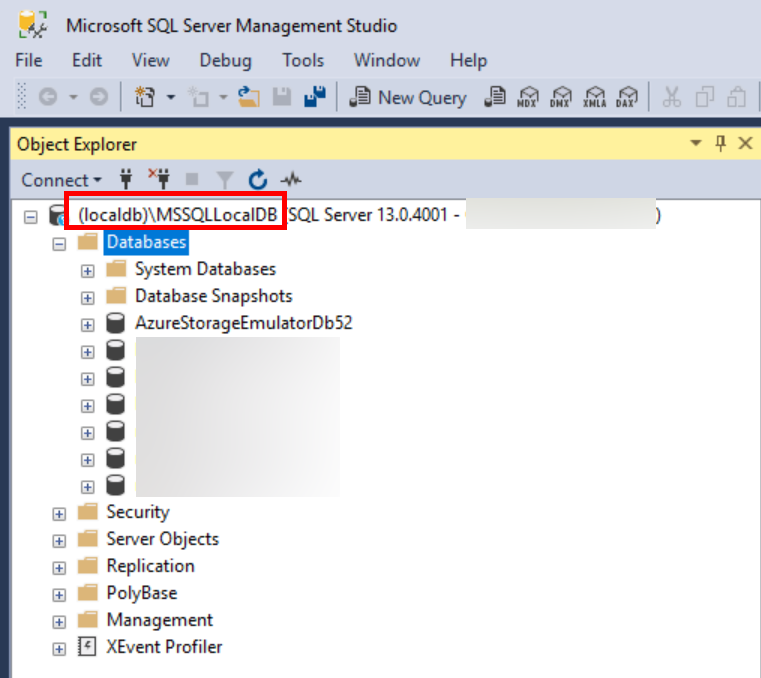
spottedmahn
on 5 Mar 2019
it's not localdb ;-)
anyway very annoying these gaps.
wstaelens
on 6 Mar 2019
Related issues
 bgribaudo
·
3Comments
bgribaudo
·
3Comments
 MontyGvMC
·
3Comments
spottedmahn
·
3Comments
MontyGvMC
·
3Comments
spottedmahn
·
3Comments
 ra0o0f
·
3Comments
ra0o0f
·
3Comments
 TPJ11
·
3Comments
TPJ11
·
3Comments