There's a paragraph about BigInt in 7.1 Type Conversion:
The BigInt type has no implicit conversions in the ECMAScript language; programmers must call BigInt explicitly to convert values from other types.
At the same time BigInt value can be conversed to Boolean value according Table 10: ToBoolean Conversions, likes the following:
1n ? 'true' : 'false' // 1n will be converted to true
So I suppose that paragraph about BigInt implicit conversions should be removed
 ufocoder
All 7 comments
I believe the paragraph's intention is to say that there is no way to implicitly convert a value into a BigInt, which is true.
 devsnek
on 20 Jul 2020
devsnek
on 20 Jul 2020
Indeed; it’s saying you can’t implicitly coerce into BigInt. You can coerce everything into other things.
 ljharb
on 20 Jul 2020
ljharb
on 20 Jul 2020
@devsnek @ljharb But you can implicitly coerce into BigInt :)
Please check this section 7.1.13 ToBigInt. It has the following conversion table:
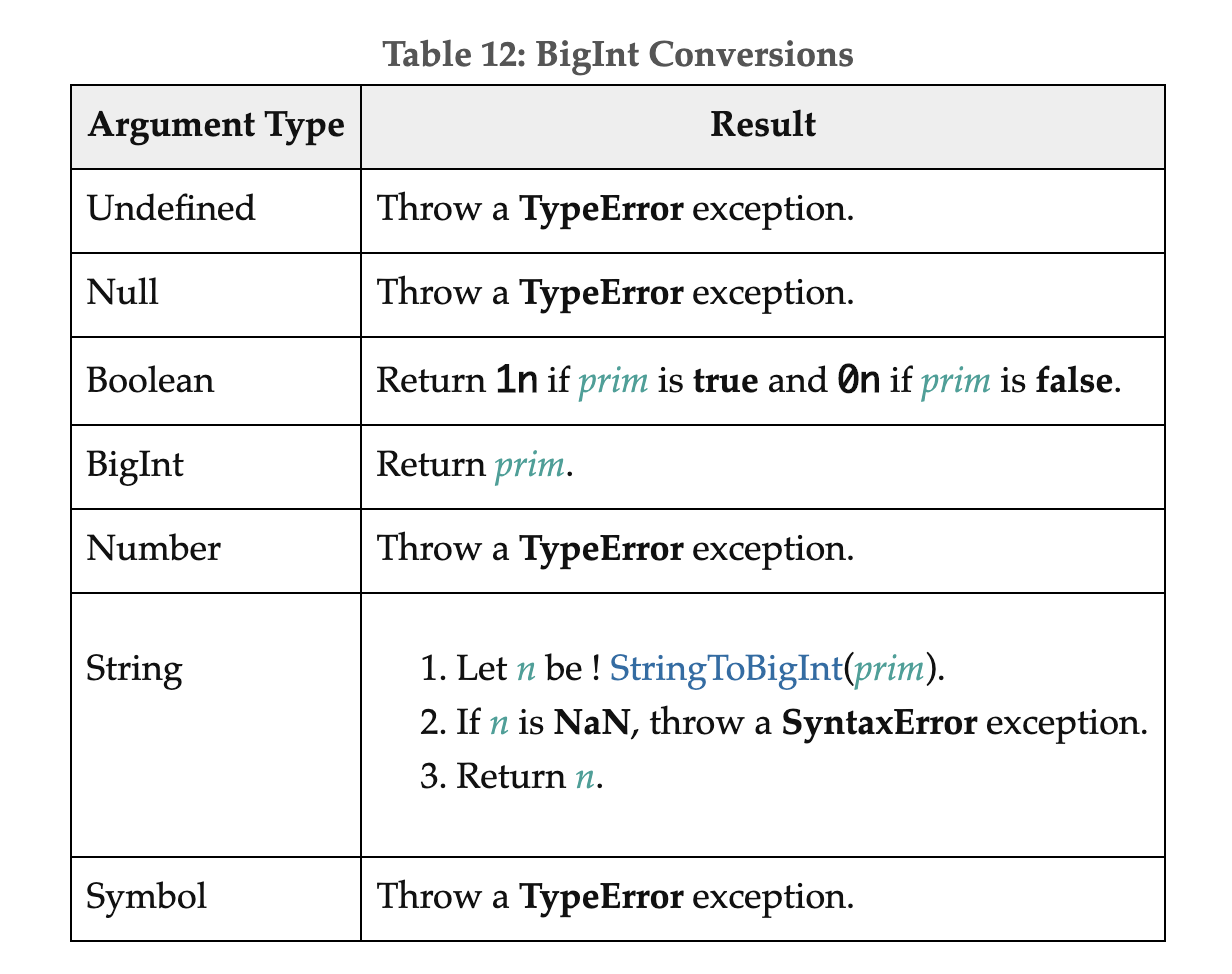
Therefore BitInt has conversion from Boolean and String types.
So developer can explicit convert to BigInt:
BigInt(false)   // will be converted to 0n
BigInt(true)    // will be converted to 1n
BigInt('1')     // will be converted to 1n
BigInt('2')     // will be converted to 2n
But coercions exist for String type, for example:
"1n" > 1n      // string "1n" will be converted to 1n BigInt,
"2n" == 2n     // string "2n" will be converted to 2n BigInt,
This coercions described in 7.2.14 Abstract Relational Comparison and 7.2.15 Abstract Equality Comparison
ufocoder
on 20 Jul 2020
That's an explicit, not an implicit, coercion to BigInt.
ljharb
on 20 Jul 2020
I try to describe my position other words
Explicit conversion (type casting) when developer call BigInt:
BigInt(false)   // 0n
BigInt(true)    // 1n
BigInt('1')     // 1n
BigInt('2')     // 2n
Not let's analyze one simple block of code:
'2' > 1n
In this binary expression will be executed abstract relational comparison operator >
There's a quote of 7.2.14 Abstract Relational Comparison
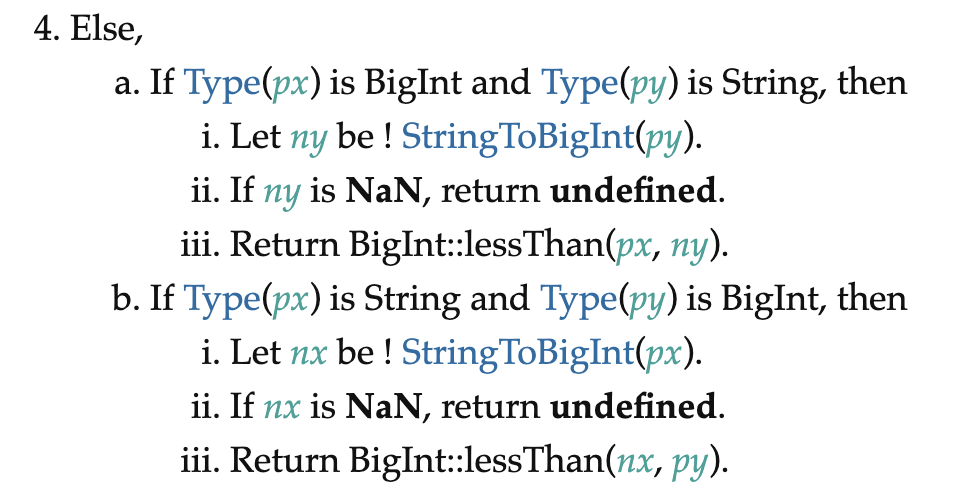
Further String value '2' will be implicitly converted to BigInt via abstract operator StringToBigInt
'2' > 1n expression after StringToBigInt operator eval will be converted to 2n > 1n
@ljharb Can you explain please why there's no implicit conversion (type coercion) in '2' > 1n expression?
Because I still sure that is implicit :)
_p.s. I've just try to understand why I not right in your opinion_
ufocoder
on 21 Jul 2020
I consider < and > "coercions" the same as if (x) "coercions" - not actually coercing the values; that's just how the spec describes those comparisons. You can never observe the "coerced" values, so they don't actually exist.
ljharb
on 21 Jul 2020
If coercion doesn't exist that you'll get a TypeError, isn't it?
Observed "coerced" values and not observed "coerced" values are coerced values both ;)
Anyway our dialog creates questions around paragraph from 7.1 Type Conversion.
I think it must be edit to exclude potential questions. So spec must be improved:
- Maybe specification needs to add its' meaning for
coercionterm. - Maybe specification needs to add some comments for sentence:
The BigInt type has no implicit conversions ..
But now without any improvements spec writes that coercion for BigInt exists via Table 12. BigInt conversions
ufocoder
on 21 Jul 2020
Related issues
 ENvironmentSet
·
5Comments
ENvironmentSet
·
5Comments
 codehag
·
3Comments
codehag
·
3Comments
 zloirock
·
4Comments
zloirock
·
4Comments
 michaelficarra
·
3Comments
michaelficarra
·
3Comments
 bkardell
·
3Comments
bkardell
·
3Comments
Most helpful comment
If coercion doesn't exist that you'll get a
TypeError, isn't it?Observed "coerced" values and not observed "coerced" values are coerced values both ;)
Anyway our dialog creates questions around paragraph from
7.1 Type Conversion.I think it must be edit to exclude potential questions. So spec must be improved:
coercionterm.The BigInt type has no implicit conversions ..But now without any improvements spec writes that coercion for
BigIntexists viaTable 12. BigInt conversions