Drf-yasg: [question] Example for Response Objects
I was wondering is there anyway to add an Example Object to the Response Object? I also see it is in the openapi.py.
I looked through the code and when I manually set Responses it's generate an Open API response at https://github.com/axnsan12/drf-yasg/blob/master/src/drf_yasg/inspectors/view.py#L234
Is there anyway to get it to set the example? If not I am willing to figure out how to get it working.
 vinayan3
All 14 comments
Hello,
You can set the examples field (and any other field) by directly passing a Response object instead of a serializer. Reading the documentation for swagger_auto_schema is a good start. The testproj folder also has an example of doing this.
 axnsan12
on 16 Mar 2018
axnsan12
on 16 Mar 2018
For latecomers, this StackOverflow post probably will help you to customize the response and the response example.
_Originally posted by @jerinpetergeorge in https://github.com/axnsan12/drf-yasg/issues/214#issuecomment-700413258_
 jerinpetergeorge
on 29 Sep 2020
jerinpetergeorge
on 29 Sep 2020
Hi @axnsan12 , I couldn't find the code that sets examples in the testproj, can you point me to it?
Also, I am setting examples this way:
post_response_schema = {
        status.HTTP_201_CREATED: openapi.Response(
            description="User successfully created",
            examples={
                "application/json": {}
            }
        ),
        ERROR_STATUS[EXPECTED_KEY_NOT_PRESENT_IN_REQUEST]: openapi.Response(
            description="Key error: Key not present",
            examples={
                "application/json": {
                    "error": EXPECTED_KEY_NOT_PRESENT_IN_REQUEST.format("email not present")
                }
            }
        ),
    }

@swagger_auto_schema(responses=post_response_schema)
def post
  ....
My redoc documentation shows the examples fine. But, my swagger just shows a loading spinner.
 divya1c
on 29 Oct 2020
divya1c
on 29 Oct 2020
my swagger just shows a loading spinner.
Did you mean _this spinner_ ? @divya1c
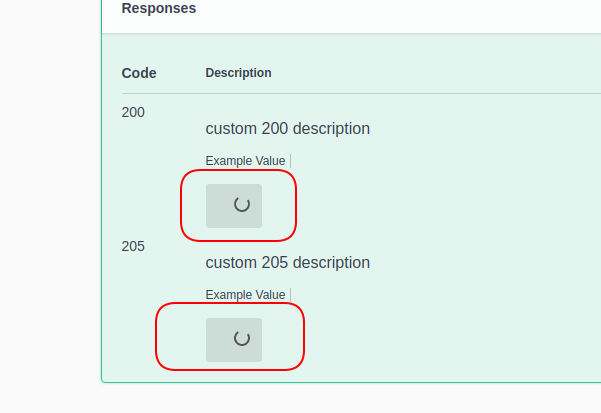
If so, click on Example Value and then you will be able to see the example data.
jerinpetergeorge
on 29 Oct 2020
Oh that works. That's weird though. Why doesn't it show by default? @jerinpetergeorge
divya1c
on 29 Oct 2020
Just CSS things :rofl:
jerinpetergeorge
on 29 Oct 2020
@jerinpetergeorge thx for your help btw do you know how to resolve loading spinner bug?
 lieric7766
on 30 Mar 2021
lieric7766
on 30 Mar 2021
Unfortunately, Nop @lieric7766
jerinpetergeorge
on 30 Mar 2021
Hi everyone! First of all I want to thank you, this is working :)
Is there any way to put a serializer as a response instead of manually creating all the possible responses? Maybe @jerinpetergeorge or @lieric7766 can help me with this.
I think the loading spinner shouldn't be a difficult thing to solve, if I do so I'll create a PR.
 ifranco14
on 7 May 2021
ifranco14
on 7 May 2021
Is there any way to put a serializer as a response instead of manually creating all the possible responses? Maybe @jerinpetergeorge or @lieric7766 can help me with this.
I think there is no way to do that. But, I wonder how would that serializer look like?
jerinpetergeorge
on 7 May 2021
I have a ViewSet @action (that internally do many things and that is not mapped to any entity) so the serializer of the POST method looks like:
{
    "field_1": "field_1_content",
    "field_2": "field_2_content",
    "field_3": "field_3_content",
}
Then, if everything goes well I would like to return as a response two different serialized objects. Something like
{
    "object_A": {
        "x": "field_1_content",
        "y": "field_2_content"
    },
    "object_B":  {
        "z": "field_3_content"
    }
}
The problem is that now it's only showing the serializer of the POST as the response object.
ifranco14
on 7 May 2021
Have you tried to set request_body and responses options of **@swagger_auto_schema(...)?
@swagger_auto_schema(
        request_body=RequestSerializer,
        responses={"200": ResponseSerializer}
)@ifranco14 Did you try sthg like:
from rest_framework import serializers
class ObjectSerializer(serializers.Serializer):
x = serializers.CharField()
y = serializers.CharField()
In your ViewSet
data_response = openapi.Response('Data response', ObjectSerializer)
@swagger_auto_schema(
method='post',
responses={200: data_response}
)
 Khaledjallouli
on 27 May 2021
Khaledjallouli
on 27 May 2021
Have you tried to set
request_bodyandresponsesoptions of **@swagger_auto_schema(...)?@swagger_auto_schema( request_body=RequestSerializer, responses={"200": ResponseSerializer} )
This one worked! Thanks a lot @jerinpetergeorge and @Khaledjallouli!
ifranco14
on 27 May 2021
Related issues
 marcosgeorgopoulos
·
4Comments
marcosgeorgopoulos
·
4Comments
 geekashu
·
5Comments
geekashu
·
5Comments
 nicholasgcoles
·
4Comments
nicholasgcoles
·
4Comments
 littlehome-eugene
·
4Comments
littlehome-eugene
·
4Comments
 gertjanol
·
5Comments
gertjanol
·
5Comments
Most helpful comment
Hello,
You can set the
examplesfield (and any other field) by directly passing aResponseobject instead of a serializer. Reading the documentation forswagger_auto_schemais a good start. Thetestprojfolder also has an example of doing this.