Dotty: Pattern matching doesn't infer type equalities between singletons.
Minimized code

sealed trait ModelNode {
  type Result
}
sealed trait RealNode {
  final type Result = Double
}

def eval(m: ModelNode): m.Result = m match {
  case m1: RealNode =>
    implicitly[m.type =:= m1.type]
    0.0
}
Expectation
Should compile. Both 0.0 : m.Result and implicitly[m.type =:= m1.type].
 alexknvl
All 7 comments
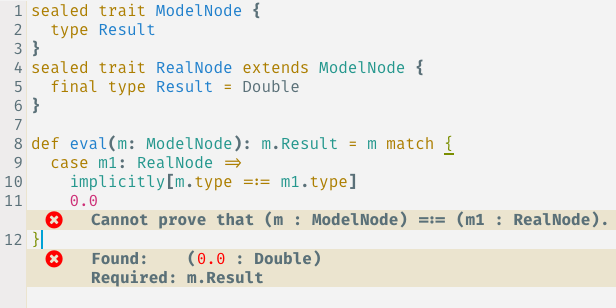
Corrected version that still doesn't compile (extends ModelNode):
sealed trait ModelNode {
  type Result
}
sealed trait RealNode extends ModelNode {
  final type Result = Double
}

def eval(m: ModelNode): m.Result = m match {
  case m1: RealNode =>
    implicitly[m.type =:= m1.type]
    0.0
}
This is a known limitation. I don't know if @AleksanderBG plans to solve it at some point or not, but in the meantime you can write this more explicit evidence-propagating version:
  case m1: (RealNode & m.type) =>
    implicitly[m.type =:= m1.type]
    0.0: m1.Result
 LPTK
on 7 Aug 2020
LPTK
on 7 Aug 2020
I'm planning to solve this specific issue, that is: patterns not being typed as intersection of their type and the singleton type of the scrutinee.
Adding arbitrary constraints to singleton types is a bit more problematic. There's no good way to do this in Dotty if I remember correctly - nullable types were going in a similar direction, but in the end they were implemented differently. I'll probably take a look at how exactly they were implemented and if it's possible to generalise that implementation to arbitrary constraints, but I cannot promise anything.
 abgruszecki
on 7 Aug 2020
abgruszecki
on 7 Aug 2020
Looks related to #8413.
 allanrenucci
on 7 Aug 2020
allanrenucci
on 7 Aug 2020
@abgruszecki
I'm planning to solve this specific issue, that is: patterns not being typed as intersection of their type and the singleton type of the scrutinee.
Note that this was not enough to fix this specific issue. I also had to add the type ascription in 0.0: m1.Result.
LPTK
on 7 Aug 2020
Ah, right, so it's primarily about putting constraints on type members. Other than constraining singleton types, I don't think there's a principled way of doing that. @alexknvl since you say this is a minimised issue, is there a source project? If it's something important that worked in Scala 2, I can try to figure out whether there's something I can do.
@allanrenucci thanks for finding that issue! I wanted to look for it and you saved me the effort :)
abgruszecki
on 7 Aug 2020
@abgruszecki It was an experiment in our internal code base at work (no public source code available). It doesn't work in Scala 2 either. I was trying to figure out some replacement for GADTs as they don't work well with serialization / deserialization typeclass derivation (e.g. using Magnolia).
alexknvl
on 9 Aug 2020
Related issues
 deusaquilus
·
3Comments
deusaquilus
·
3Comments
 LaymanMergen
·
3Comments
LaymanMergen
·
3Comments
 DarkDimius
·
3Comments
DarkDimius
·
3Comments
 adamgfraser
·
3Comments
adamgfraser
·
3Comments
 andreaTP
·
3Comments
andreaTP
·
3Comments