Dotty: Mysterious Behavior of Literal Type
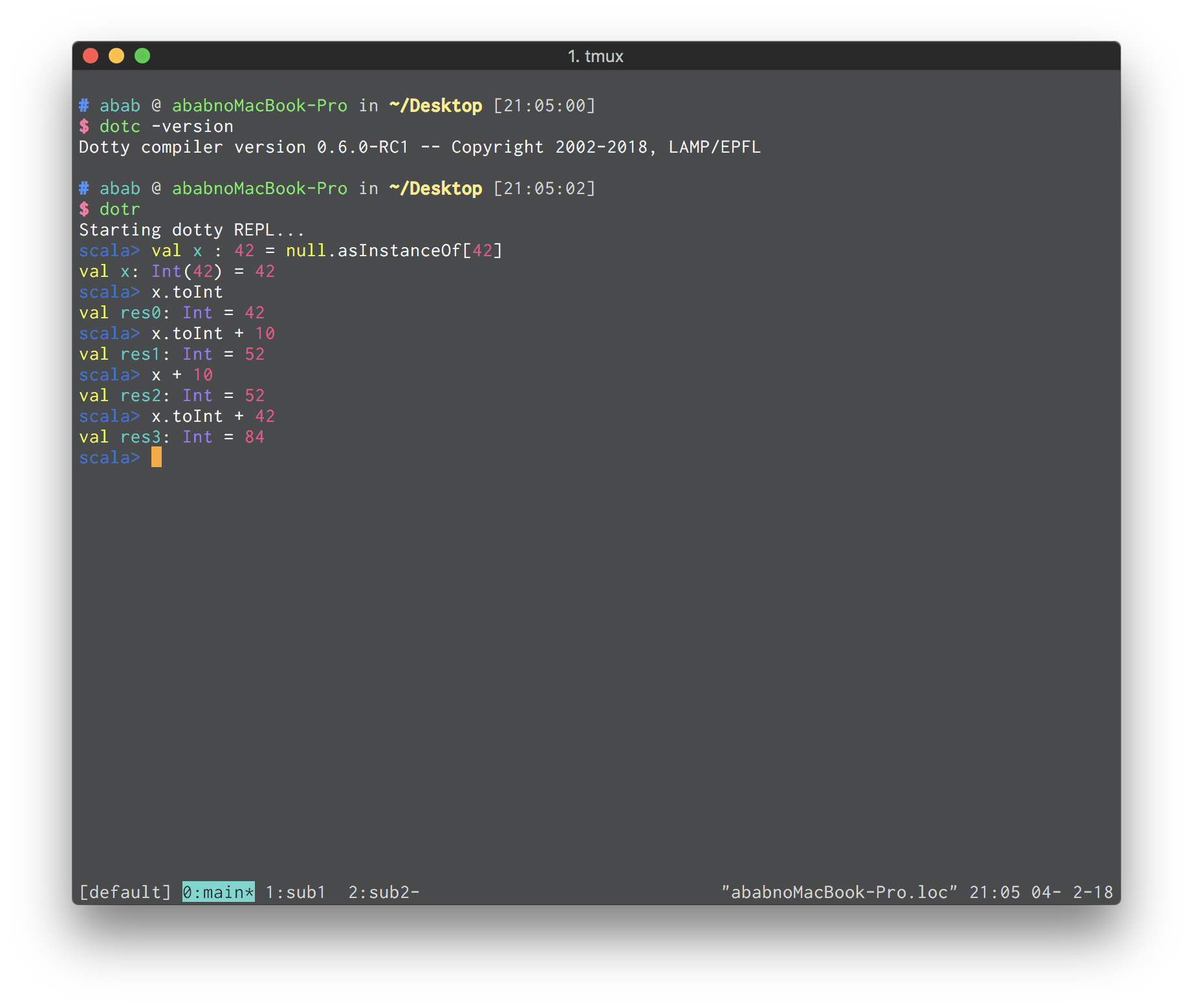
I report it.
 ababup1192
All 16 comments
What would you expect to be happen here?
 propensive
on 4 Feb 2018
propensive
on 4 Feb 2018
That's cool. Looks more like a feature than a bug to me. I guess throwing an Exception would also be an option.
 Jasper-M
on 4 Feb 2018
Jasper-M
on 4 Feb 2018
It is as designed. When we have a reference to a literal value, the value of that type is used instead of the reference. It is kind of an inline optimization.
 nicolasstucki
on 11 Feb 2018
nicolasstucki
on 11 Feb 2018
We could have a warning for val x: 42 = null.asinstanceOf[42] as the value will never actually be null.
nicolasstucki
on 15 Feb 2018
Makes sense to me: doing an illegal cast produces unexpected results, though not an Exception as usual. Is there any documentation to update? Otherwise the issue can IMHO be closed.
 Blaisorblade
on 15 Feb 2018
Blaisorblade
on 15 Feb 2018
If we use a def we do produce buggy code.
object Foo {
  def x: 42 = null.asInstanceOf[42]
  val y: 42 = null.asInstanceOf[42]
  def main(args: Array[String]): Unit = {
    println(x)
    println(y)
  }
}
prints
0
42
String literal types do not preserve null
Similar code with String literal type does not require asInstanceOf.
object StrLitNull{
  def main(a: Array[String]) = {
    val x: "constant" = null
    println(x)
  }
}
Or just println(null:"constant").
Output (dotty):
constant
Output (scalac):
null
The question is, is null a valid value of a string literal type?
I'd say yes, but it is optimized away like in the Int case above.
 panacekcz
on 11 Oct 2018
panacekcz
on 11 Oct 2018
null should not be a valid value of type "constant". The code println(x:"constant") is corrrectly constant folded to println("constant") as the only inhabitant of the type "constant" is the value "constant".
Currently Null is a subtype of all references. Which lets us use null as a constant String. With the planed null safty this will not be the case and this will not be an issue anymore.
nicolasstucki
on 11 Oct 2018
If this is about null safety, what do you think @liufengyun?
Blaisorblade
on 11 Oct 2018
nullshould not be a valid value of type "constant"
Arguably. However the SIP committed decided otherwise, at least for Scala 2 ... all reference types, string literal types included, have null as an inhabitant.
 milessabin
on 11 Oct 2018
milessabin
on 11 Oct 2018
Maybe this should be revised that if we change the way we handle null in the future. It would be much better to have to use "constant" | Null to avoid surprises.
nicolasstucki
on 11 Oct 2018
I think it would actually be cool to be able to write val x: 42 and have it be automatically initialized.
 joroKr21
on 11 Oct 2018
joroKr21
on 11 Oct 2018
The latest Dotty version gets 0. Inline happens as before. Both seem to be reasonable to me.
➜  dotty git:(safe-init) ✗ dotc -version
Dotty compiler version 0.10.0-RC1 -- Copyright 2002-2018, LAMP/EPFL

➜  dotty git:(safe-init) ✗ dotr
Starting dotty REPL...
scala> val x: 42 = null.asInstanceOf[42]
val x: Int(42) = 0
I don't think null-safety can help much here if programmers use asInstanceOf explicitly, which exploits/abuses feature of run-time platform.
cc @abeln .
 liufengyun
on 11 Oct 2018
liufengyun
on 11 Oct 2018
The point of null safety would to not make null an instance of 42.
On the other hand casting can always produce wrong programs. But programs without casts should not have surprises.
nicolasstucki
on 12 Oct 2018
By the way, null and string literal types make one more way of getting a value of Nothing,
which explicit nulls should easily solve.
trait A { def const:"A" }
trait B { def const:"B" }
object GetNothing {
  def check(n:Nothing) = println("Got nothing")
  def main(a: Array[String]) = {
    val nothing = (new A with B{override def const:Null = null}).const
    check(nothing)
  }
}
null.asInstanceOf defines the "default value".
scala> var x: 42 = _
var x: 42 = 0
I don't know if asking for a 42 should distinguish stable values, and maybe I should not witness the zero, the same way unboxing an Int will give me zero and not NPE.
 som-snytt
on 4 Sep 2020
som-snytt
on 4 Sep 2020
Related issues
 noti0na1
·
3Comments
noti0na1
·
3Comments
 deusaquilus
·
3Comments
deusaquilus
·
3Comments
 smarter
·
3Comments
liufengyun
·
3Comments
smarter
·
3Comments
liufengyun
·
3Comments
 NightMachinary
·
3Comments
NightMachinary
·
3Comments
Most helpful comment
We could have a warning for
val x: 42 = null.asinstanceOf[42]as the value will never actually benull.