Djangorestframework-simplejwt: error dict key `detail`
Resume
Every response error related to django-rest-framework-simplejwt returns a dict in the following format:
{
    'detail': 'some error',
    'code': some_http_code
}
Why use hardcoded detail key?
The DRF framework has the default NON_FIELD_ERROR_KEY which can be configured by the user.
My front-end now has to handle non_field_errors and detail keys to look for errors!
If it was used the settings from DRF this wouldn't be hardcoded!
Use example
from rest_framework.settings import api_settings

data = {api_settings.NON_FIELD_ERRORS_KEY: str(exc)}
Refs
I linked every reference to detail hardecoded on the lib as of now.
 rodrigondec
All 8 comments
Perhaps getting rest_framework settings and getting the non_field_errors in place of detail will work. PR welcome! make sure the settings.py in the tests folder sets the non_field_errors as "default." My only concern is that this will be a breaking change in the few repositories that externally test SimpleJWT, but it shouldn't be too big of a breaking change.
 Andrew-Chen-Wang
on 18 Aug 2020
Andrew-Chen-Wang
on 18 Aug 2020
@Andrew-Chen-Wang could you elaborate on the part where you mentioned to make changes in the settings.py of the test folder?
I tried to make some changes for a PR but exceptions caught by the InvalidToken are producing outputs like this:
{'non_field_errors': 'Token is invalid or expired', 'code': 'token_not_valid', 'detail': 'Given token not valid for any token type', 'messages': [{'token_class': 'AccessToken', 'token_type': 'access', 'message': 'Token is invalid or expired'}]}
 Alig1493
on 23 Aug 2020
Alig1493
on 23 Aug 2020
@Alig1493 Changing the settings in the test folder specified by rodrigondec as seen by his link to a random value ensures that whatever your PR is trying to accomplish actually works. Simply using the defaults wouldn't be testing if a dev deliberately changed the setting for their environment.
My front-end now has to handle non_field_errors and detail keys to look for errors!
This is what you're trying to fix, so having some random value in place can weed out any problems. Hope that makes sense and thanks for working on a PR!
Andrew-Chen-Wang
on 23 Aug 2020
so is it safe to say the the error response output will contain both the details key (which is present in almost all of the APIException classes by the DRF ) ad well as the default NON_FIELD_ERRORS_KEY set in the project?
Alig1493
on 23 Aug 2020
Uh not quite. The problem right now is that if you get an error response, you'll get something like this:
{'detail': ErrorDetail(string='Authentication credentials were not provided.', code='not_authenticated')}
The problem at hand is that "detail" is hard coded. The point of the PR is to utilize non_field_errors_key.
Although your point about "which is present in almost all of the APIException classes by the DRF" is true I think. That's what made we wonder the first time around reading this why this change is necessary. Do you mind looking for some examples of "detail" being returned instead of non-field-errors? I'm just not sure if the change here is truly necessary.
Andrew-Chen-Wang
on 23 Aug 2020
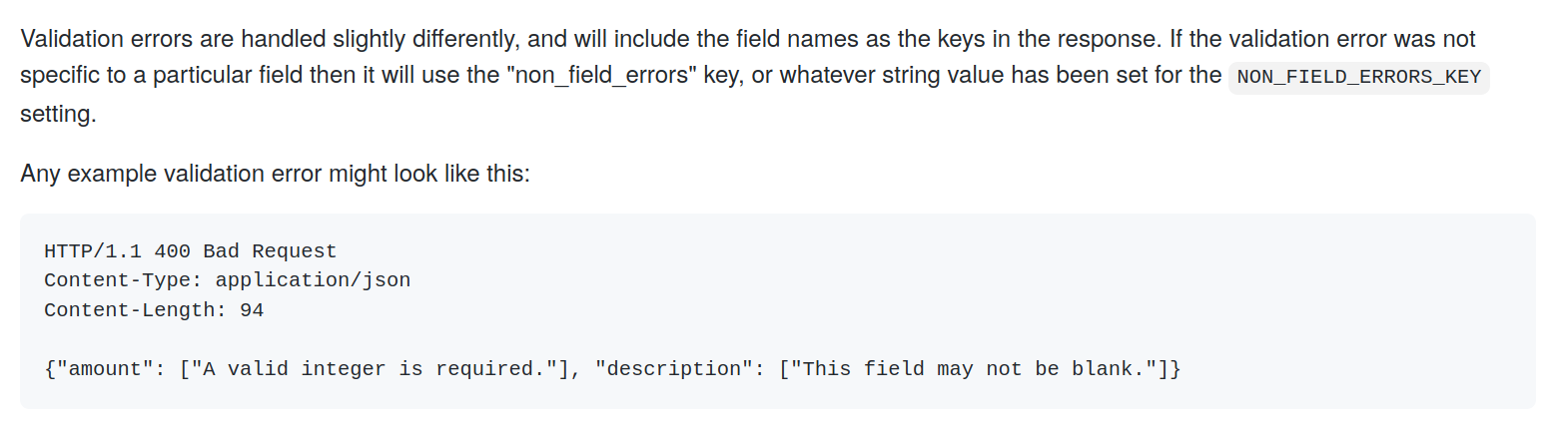
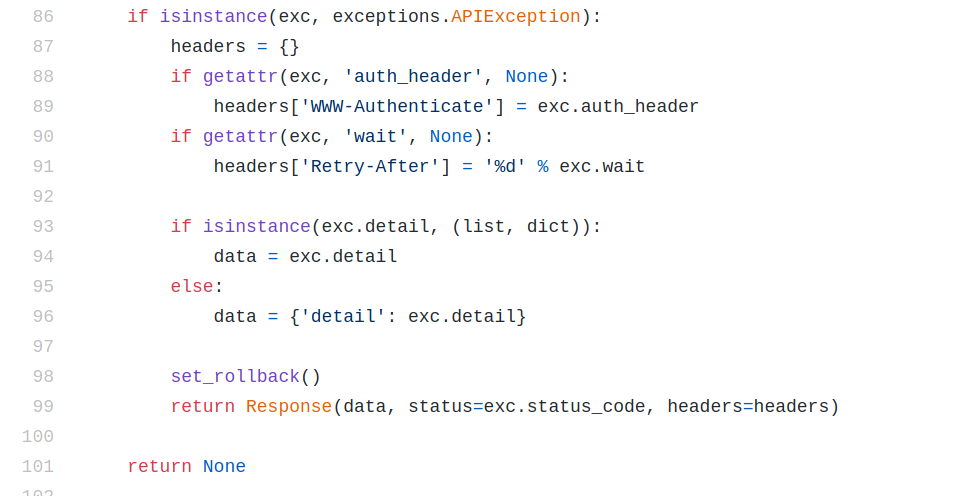
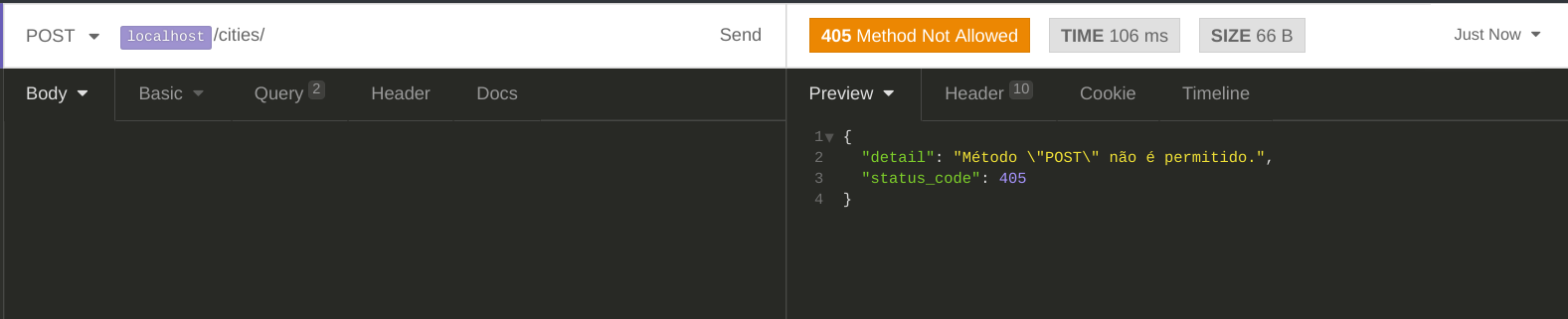
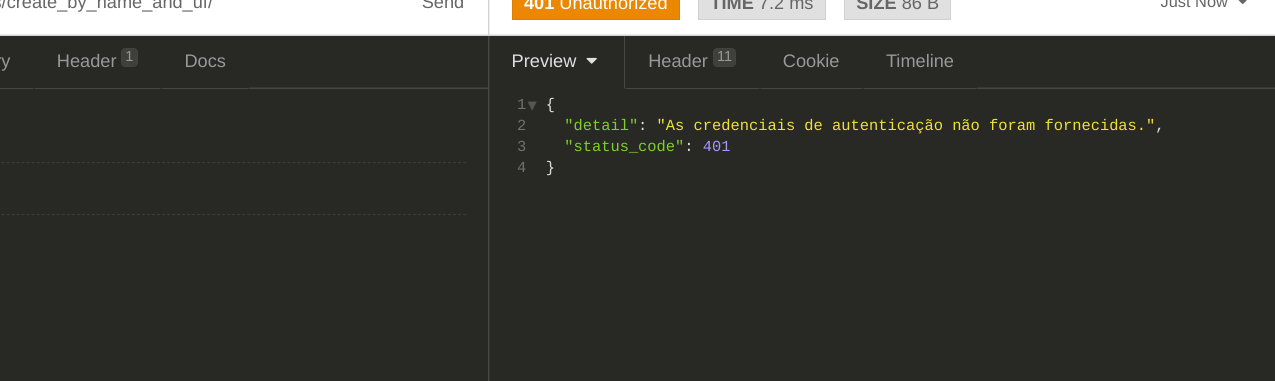
DRF uses the 'detail' keyword for API errors and DEFAULT_NON_FIELDERRORS_KEY for ValidationErorrs on the serializers (ONLY).
DRF Exceptions guide
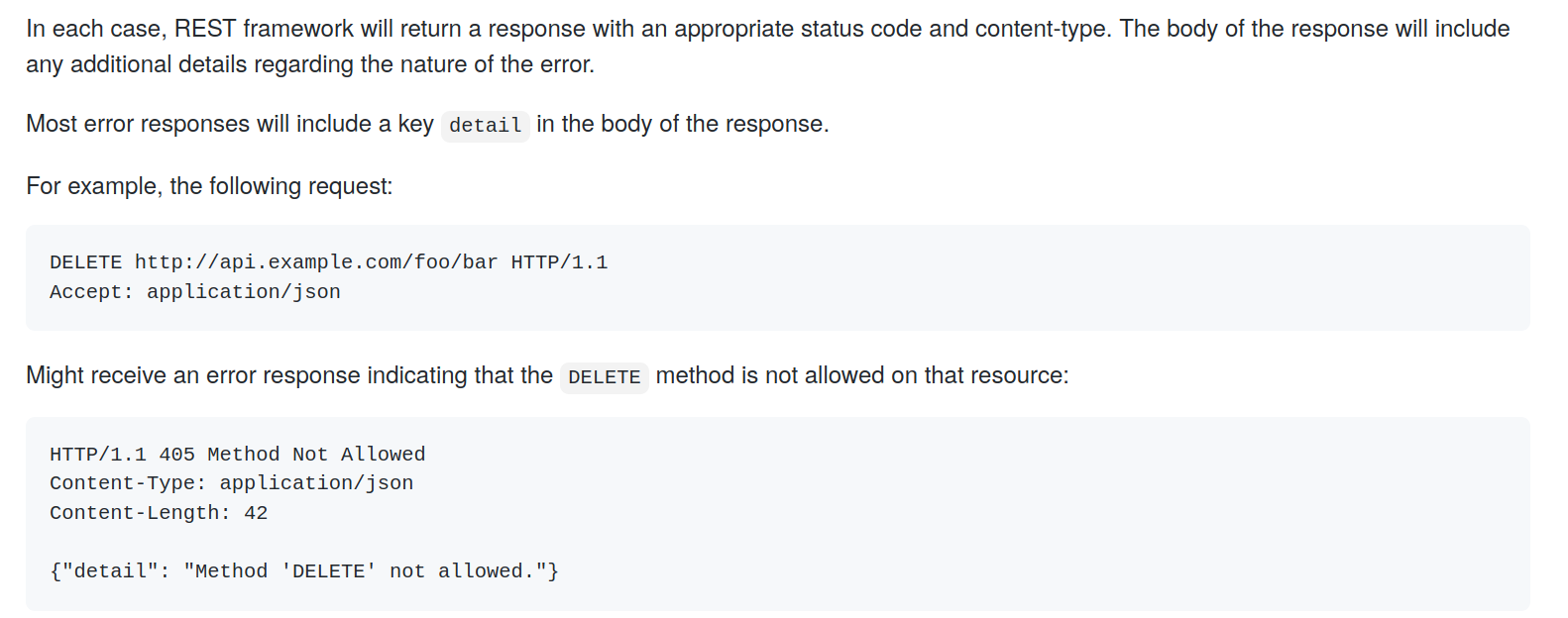
rest_framework.views.exception_handler.py
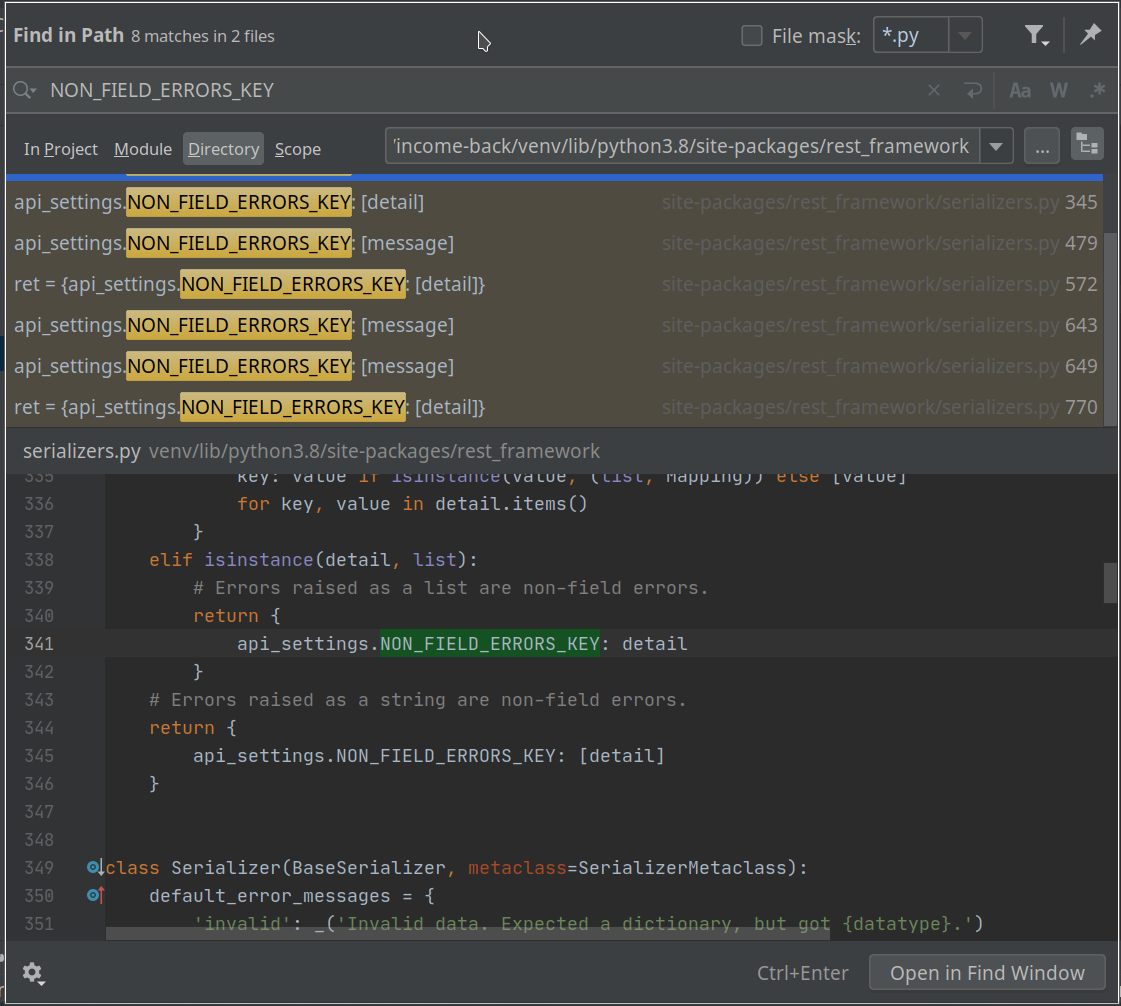
All errors from serialization return a dict with 'field': 'detail value' or 'api_settings.DEFAULT_NON_FIELD_ERRORS_KEY': 'detail value'
'api_settings.DEFAULT_NON_FIELD_ERRORS_KEY' is not used in any file except the serializers files!
Refs
- https://github.com/encode/django-rest-framework/blob/82c2b5c3e75debe047eebd8a17b50c1e17594663/docs/api-guide/exceptions.md
- https://github.com/encode/django-rest-framework/blob/335054a5d36b352a58286b303b608b6bf48152f8/rest_framework/exceptions.py
- https://github.com/encode/django-rest-framework/blob/3f19e66d9f2569895af6e91455e5cf53b8ce5640/rest_framework/views.py#L96
My api return examples
rodrigondec
on 23 Aug 2020
Although your point about "which is present in almost all of the APIException classes by the DRF" is true I think. That's what made we wonder the first time around reading this why this change is necessary. Do you mind looking for some examples of "detail" being returned instead of non-field-errors? I'm just not sure if the change here is truly necessary.
@Andrew-Chen-Wang With this in mind I agree with you. The lib is actually 'drf compliant'.
My fault for not understanding the use of 'detail' in DRF. Sorry guys :sweat_smile:
rodrigondec
on 23 Aug 2020
It's good. I'm gonna close this on a note that the serializers employed here don't use non_default_errors like regular serializers since we're not serializing anything which can result in that kind of error. When validating the token, it's more of an authentication process hence why, at least for me, it should remain as "detail."
Andrew-Chen-Wang
on 23 Aug 2020
Related issues
 jesusjiib
·
7Comments
jesusjiib
·
7Comments
 ethanjahn
·
7Comments
ethanjahn
·
7Comments
 laurent-brisbois
·
3Comments
laurent-brisbois
·
3Comments
 regzon
·
6Comments
regzon
·
6Comments
 naelmusleh
·
4Comments
naelmusleh
·
4Comments
Most helpful comment
It's good. I'm gonna close this on a note that the serializers employed here don't use non_default_errors like regular serializers since we're not serializing anything which can result in that kind of error. When validating the token, it's more of an authentication process hence why, at least for me, it should remain as "detail."