Django-rest-framework: OneToOneField should be PrimaryKeyRelatedField, not ModelField, raises exception
Checklist
- [ ] I have verified that that issue exists against the
masterbranch of Django REST framework. - [x] I have searched for similar issues in both open and closed tickets and cannot find a duplicate.
- [x] This is not a usage question. (Those should be directed to the discussion group instead.)
- [x] This cannot be dealt with as a third party library. (We prefer new functionality to be in the form of third party libraries where possible.)
- [x] I have reduced the issue to the simplest possible case.
- [x] I have included a failing test as a pull request. (If you are unable to do so we can still accept the issue.)
Steps to reproduce
create a model with a OneToOneField
class SpecialUser(models.Model):
    special_user = models.OneToOneField(
    User,
    on_delete=models.CASCADE,
    primary_key=True,
    related_name="+")
Then create a mode serializer.
class SpecialUserSerializer(ModelSerializer):
    class Meta:
        model = SpecialUser
        fields = '__all__'
Now view the serializer
SpecialUserSerializer():
    special_user = ModelField(
        model_field=<django.db.models.fields.related.OneToOneField: special_user>,
        validators=[<UniqueValidator(queryset=SpecialUser.objects.all())>]
    )
Now try to serialize a new user:
s = SpecialUserSerializer(data={'special_user': 2})
s.is_valid()  # True
s.save()
ValueError: Cannot assign "2": "SpecialUser.special_user" must be a "User" instance.
for full stacktrace see pastebin
Expected behavior
I would expect that the model serializer would treat the one-to-one field same as a foreign key and create a PrimaryKeyRelatedField instead of the model field. If I do this explicitly then the serializer works as expected:
class SpecialUserSerializer(ModelSerializer):
    special_user = PrimaryKeyRelatedField(queryset=User.objects.all())
    class Meta:
        model = SpecialUser
        fields = '__all__'
Actual behavior
If you don't explicitly create the primary key related field in the serializer then you cannot use the primary key to serialize the object because Django complains that you must use a model not an integer, nor can you use a nested serialization of the one-to-one related model because then DRF complains that you must use an integer.
I would like to post a pull request to fix this myself, but it will take a little time. I don't think this is so urgent, since the work around is so easy. In fact, maybe I'm missing something totally obvious and this works as intended?
 mikofski
All 8 comments
First thing to do is probably to double check which versions you see this behavior against.
I'm surprised to see a breakage in such a typical relationship, so it's possible that it's either been broken in our latest release, or it's something that's since been fixed that's breaking for you in an older release.
It's also possible that this...
primary_key=True,
Could be the source of the issue - perhaps this only fails for 1:1 relationships that also happen to be the primary key on a model.
 tomchristie
on 15 May 2017
tomchristie
on 15 May 2017
- I ran this test in a fresh virtualenv with the latest versions of Django (1.11.1) and DRF (3.6.3).
- I originally discovered this behavior (
OneToOneField<->ModelFieldinstead ofPrimaryKeyRelatedField) on Django-1.10 and DRF-3.5. @tomchristie your intuition was correct re:
primary_key=True- if I set this toFalsethen the serializer is created with aPrimaryKeyRelatedFieldfor theOneToOneFieldand a separate primary key as an integer field called "ID".SpecialUserSerializer(): id = IntegerField(label='ID', read_only=True) special_user = PrimaryKeyRelatedField( queryset=User.objects.all(), validators=[<UniqueValidator(queryset=SpecialUser.objects.all())>] )
So is this the expected behavior then? My concern then is that the Django documentation on OneToOneField seem to suggest that One-To-One relations are most often used as a primary key:
This is most useful as the primary key of a model which “extends” another model in some way; ...
I left out the next sentence on MTI as an example of one-to-one relations to avoid confusion, since AFAICT that is working fine.
Is this a non-issue then? Perhaps I can add something to the documentation to explain that if primary_key=True in the OneToOneField then explicitly bind the field to a PrimaryKeyRelatedField in the associated serializer.
mikofski
on 15 May 2017
No we should deal with this case automatically. Nice work on pinpointing it.
tomchristie
on 16 May 2017
You can assign this to me, I started working on determining the fix but I have a test harness that demos the issue so I will work on it from that angle.
 matteius
on 23 May 2017
matteius
on 23 May 2017
Thanks @matteius
mikofski
on 24 May 2017
@mikofski I have a Pull Request out that should solve the issue you are describing.
matteius
on 31 May 2017
@matteius it works! I just tried it with the example I originally gave above.
I installed your branch using
pip install -e git+https://github.com/matteius/django-rest-framework@DRF-5135-one-to-one-pk#egg=djangorestframework`
then in django shell:
import SpecialUserSerializer
s = SpecialUserSerializer(data={'special_user': 2})
s.is_valid()
s.save()
s.instance.special_user
# returns special user #2 YAY!
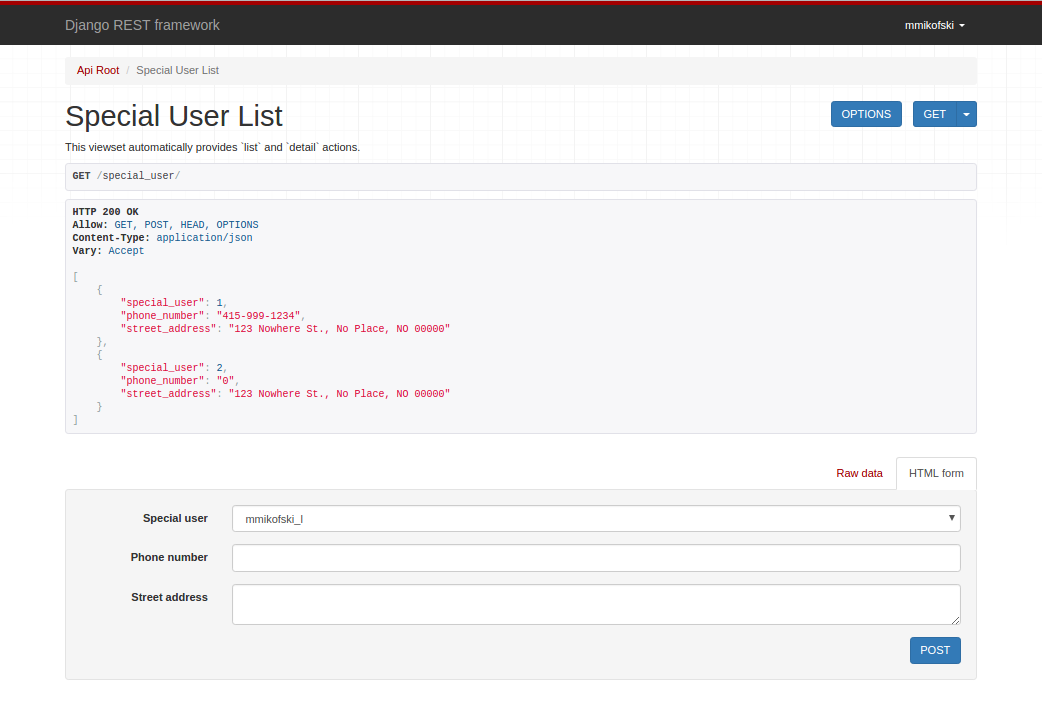
Also just tested the browsable API and it also works, first time, nothing fancy!
in urls.py
from django.conf.urls import include, url
import views
from rest_framework.routers import DefaultRouter

# Create a router and register our viewsets with it.
router = DefaultRouter()
router.register(r'special_user', views.SpecialUserViewSet)

# The API URLs are now determined automatically by the router.
# Additionally, we include the login URLs for the browsable API.
urlpatterns = [
    url(r'^', include(router.urls)),
    url(r'^api-auth/', include('rest_framework.urls',
                           namespace='rest_framework'))
]
and in views.py
class SpecialUserViewSet(viewsets.ModelViewSet):
    """
    This viewset automatically provides `list` and `detail` actions.
    """
    queryset = SpecialUser.objects.all()
    serializer_class = SpecialUserSerializer
just works!
mikofski
on 13 Jun 2017
Related issues
 MadWombat
·
4Comments
MadWombat
·
4Comments
 macropin
·
4Comments
macropin
·
4Comments
 aidanlister
·
4Comments
aidanlister
·
4Comments
 kdzxiaoli
·
3Comments
kdzxiaoli
·
3Comments
 gabn88
·
3Comments
gabn88
·
3Comments