Detr: ablation study of intermediate supervision
Can you share the influence of intermediate supervision on the final performance for DETR?
 gaopengcuhk
All 3 comments
Hi,
The numbers I have are with an older version of the code, so I'm re-running this ablation with latest implementation and will update the issue once I get the results.
 fmassa
on 20 Jun 2020
fmassa
on 20 Jun 2020
Hi,
I've re-run the ablations using --no_aux_loss to compare against the baseline in the current state of the codebase.
Without using auxiliary classifiers, the mAP after 300 epochs is only 35.5, compared to 40.8 if you use auxiliary classifiers.
- Orange: baseline
- Blue:
--no_aux_loss
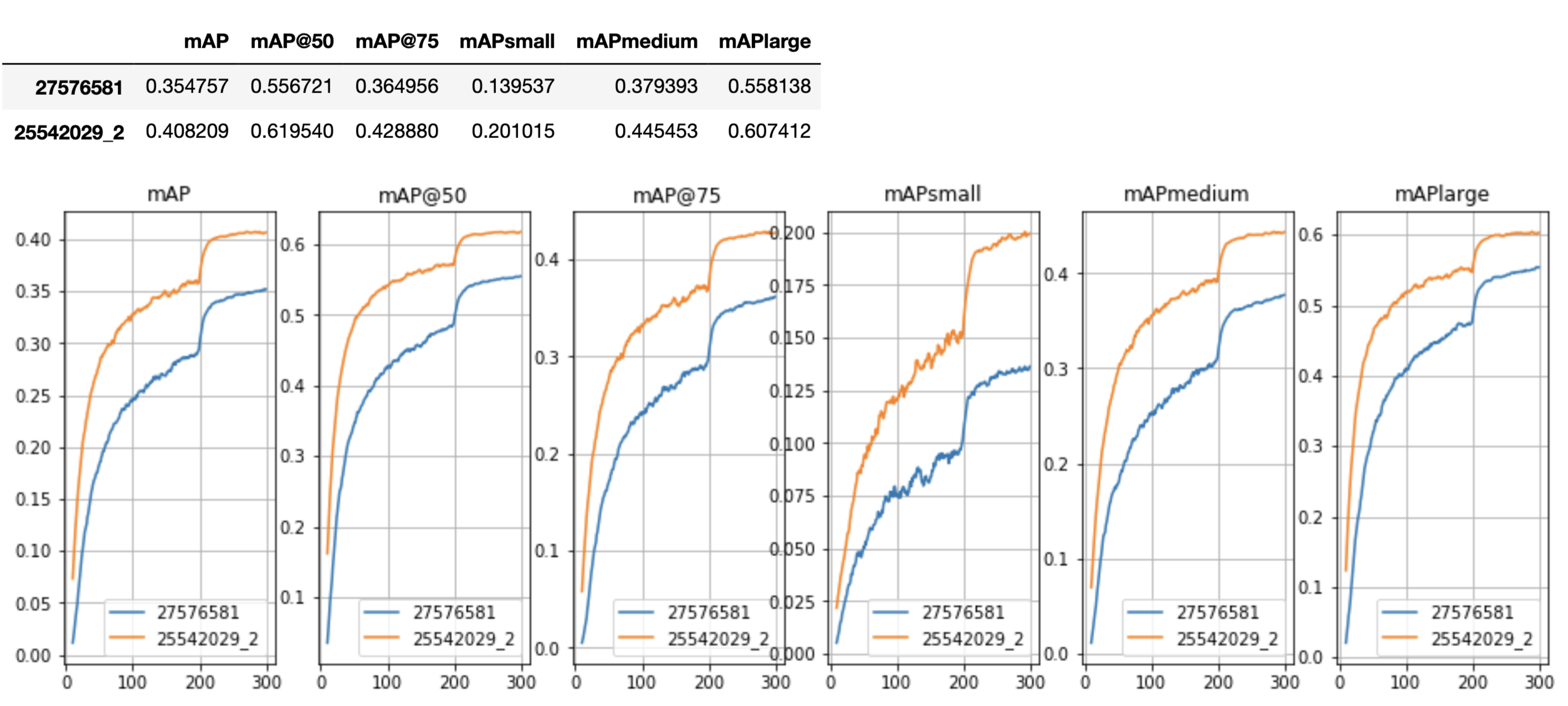
which, if we compare to Fig 4 in the paper, shows that without auxiliary losses, adding more than 1 decoder layer seems to bring marginal gains.
I believe I've answered your question, and as such I'm closing this issue, but let us know if you have further questions.
fmassa
on 22 Jun 2020
@fmassa Great explanation! I am wondering about the loss weights on the supervision over intermediate predictions. It would be great if could share with me how does the choice of the loss weights influence the final performance.
Besides, I found that the initial learning rate of DETR is much smaller compared to Faster-RCNN or FPN. It would be great if you could also share more results on the choices of the initial learning rate.
 PkuRainBow
on 22 Oct 2020
PkuRainBow
on 22 Oct 2020
Related issues
 dvd42
·
7Comments
dvd42
·
7Comments
 woctezuma
·
5Comments
woctezuma
·
5Comments
 debparth
·
7Comments
debparth
·
7Comments
 jinyeom
·
3Comments
gaopengcuhk
·
8Comments
jinyeom
·
3Comments
gaopengcuhk
·
8Comments
Most helpful comment
Hi,
I've re-run the ablations using
--no_aux_lossto compare against the baseline in the current state of the codebase.Without using auxiliary classifiers, the mAP after 300 epochs is only 35.5, compared to 40.8 if you use auxiliary classifiers.
--no_aux_losswhich, if we compare to Fig 4 in the paper, shows that without auxiliary losses, adding more than 1 decoder layer seems to bring marginal gains.
I believe I've answered your question, and as such I'm closing this issue, but let us know if you have further questions.