Dataverse: As a researcher, I want to know what dataset/dataverse a contact email is referring to so that I can follow up
I tried to contact dataset contacts and received the emails as expected. I just wanted to raise that there was no context info given: which dataset/dataverse, who wrote (I was logged in) etc. Thought that might be helpful for potential recipients.


 suenjedt
All 28 comments
Great suggestion @suenjedt we should do what we do for notifications where we include links to the dataset and dataverses they are referencing.
 eaquigley
on 21 Apr 2015
eaquigley
on 21 Apr 2015
who wrote (I was logged in)
This part is mentioned in #3545.
 pdurbin
on 6 Jan 2017
pdurbin
on 6 Jan 2017
2882 seems related as well.
pdurbin
on 6 Jan 2017
At @pdurbin 's request; if this includes username (for authenticated users), than #3545 is a duplicate of this one.
 pameyer
on 6 Jan 2017
pameyer
on 6 Jan 2017
- The focus of this is that a contact button is being pressed on a dataverse/dataset/file(?) page and the dataset information (context) does not make it to the recipient.
 djbrooke
on 4 Apr 2018
djbrooke
on 4 Apr 2018
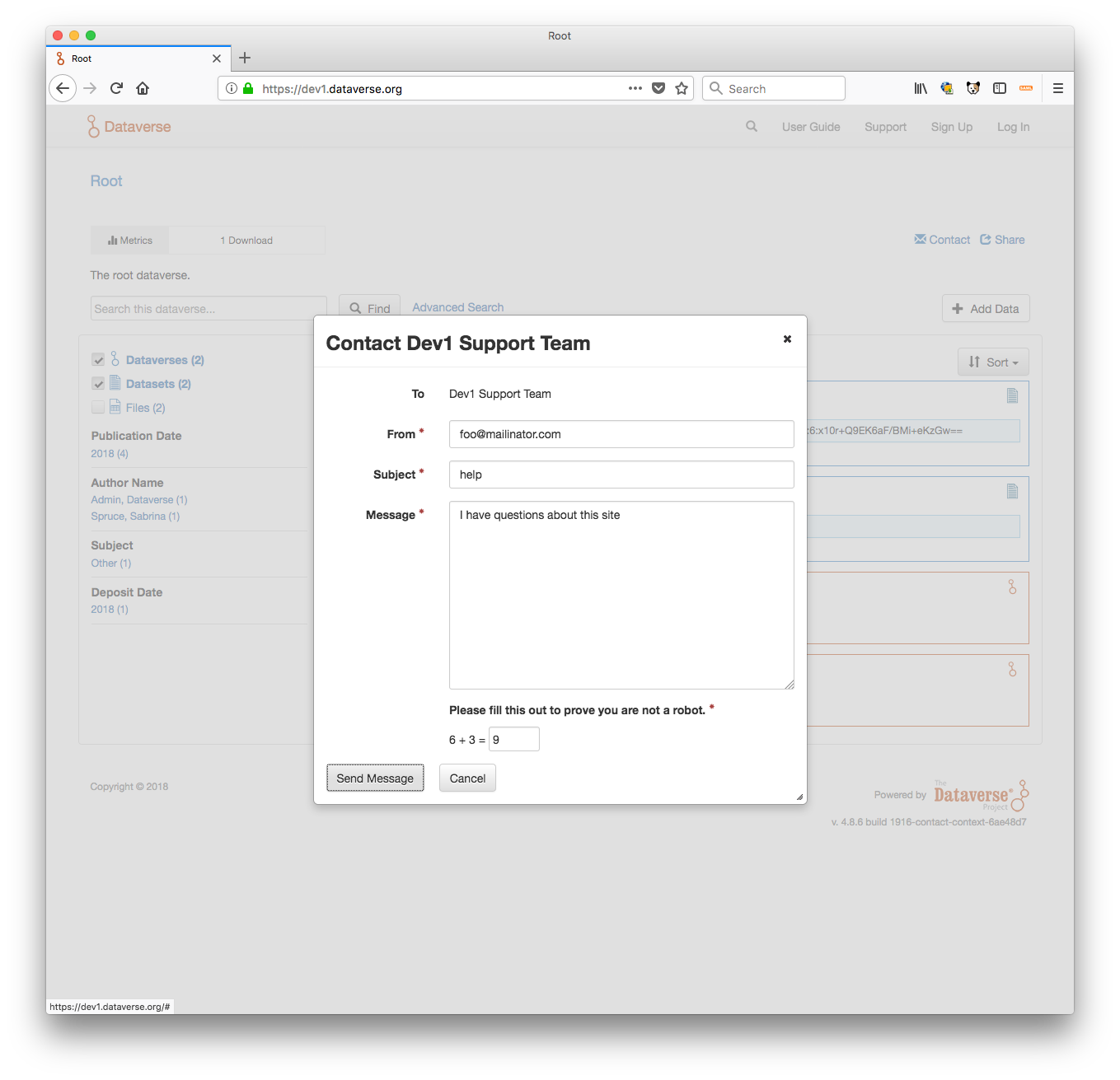
Here's the "before" picture... I went to https://doi.org/10.7910/DVN/TJCLKP (a dataset of mine) and filled in the form like this:
Dataset Contact
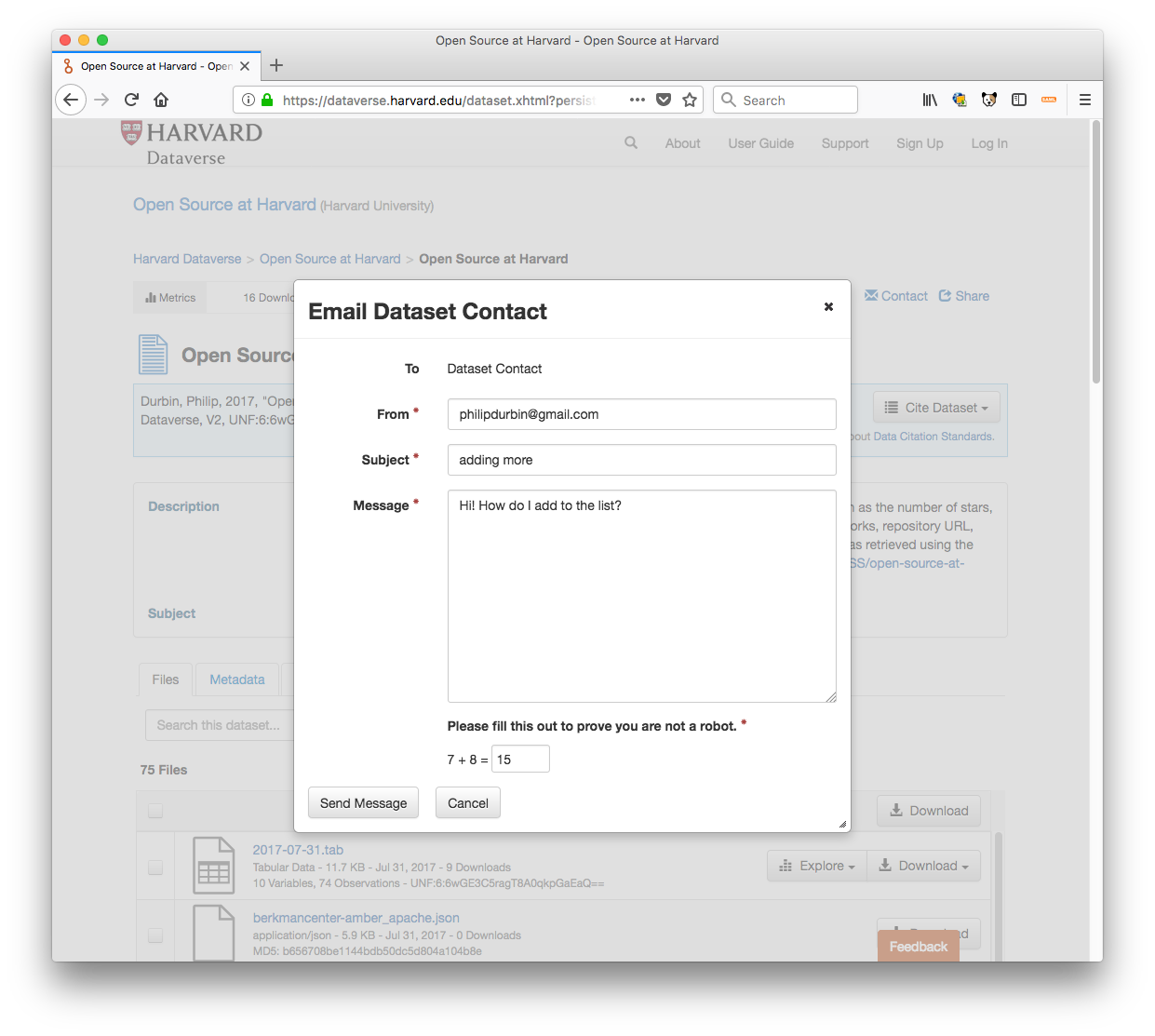
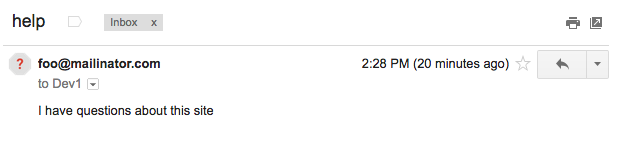
Here's the email I got as the contact for the dataset:
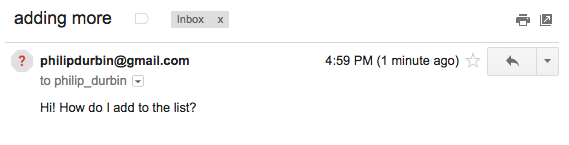
I agree that some more context would be appreciated! I did this test on version 4.8.6.
pdurbin
on 4 Apr 2018
In 8652ffa I started making the "Contact" button code testable and added context to the message based on if you are on a dataverse, dataset or file. Next steps:
- [x] Delete old/existing untestable code. Done in 6ae48d7.
- [x] Figure out why context for file ends up being context for dataset. I suspect when the "Contact" button was introduced, there was not yet a landing page for individual files. Fixed in 132e5be such that the dataset contact now is told that the context was a specific file landing page.
pdurbin
on 5 Apr 2018
I just made pull request #4571 and moved this issue to code review at https://waffle.io/IQSS/dataverse
pdurbin
on 6 Apr 2018
As I mentioned to @djbrooke I'm making some somewhat arbitrary decisions about what context to include in the email. I figured the main thing is to provide a URL to the dataverse, dataset, or file, which I did at the top. Here are some examples:
Dataverse Contact
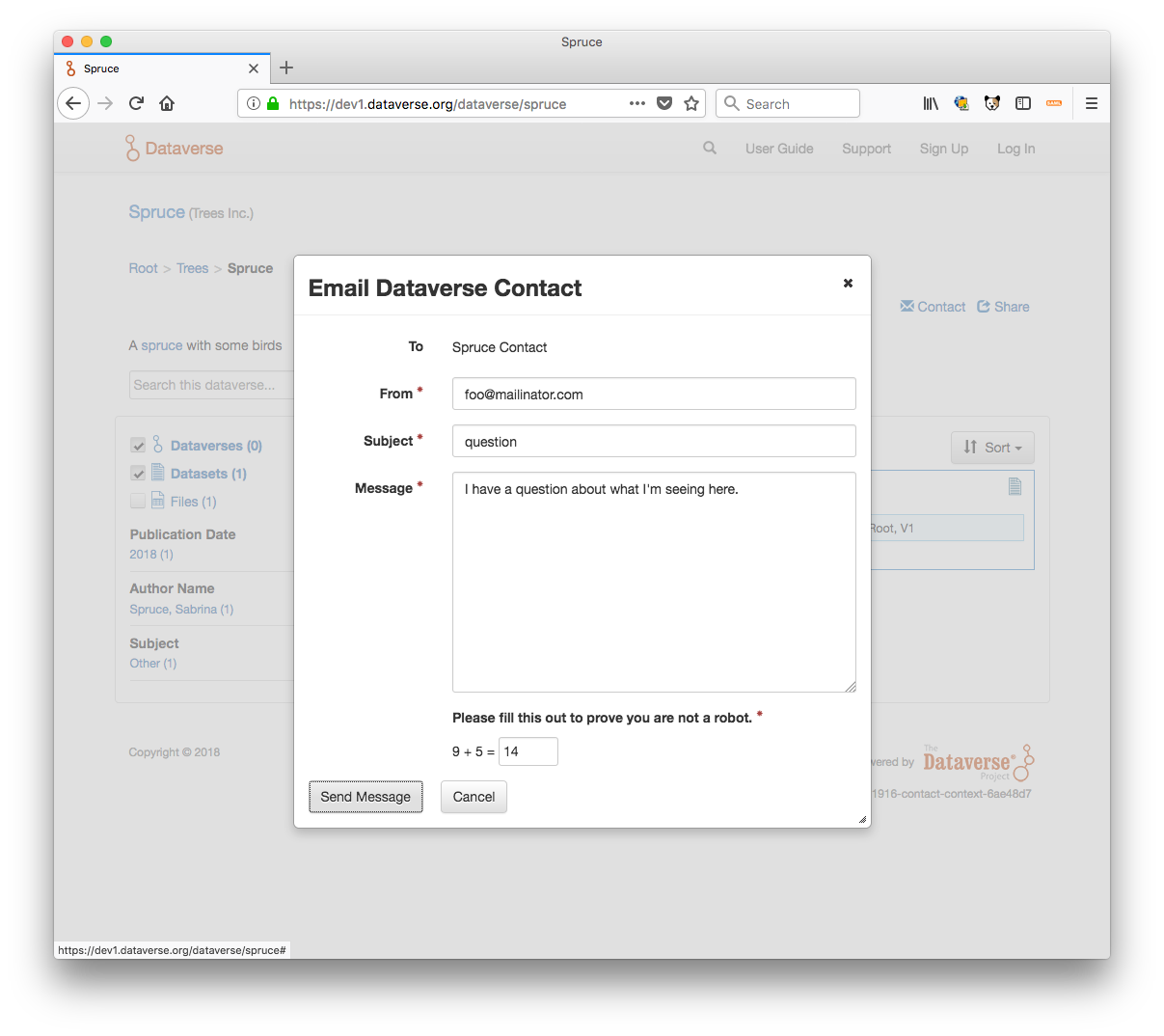
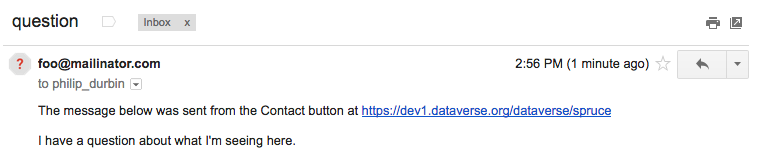
Dataset Contact
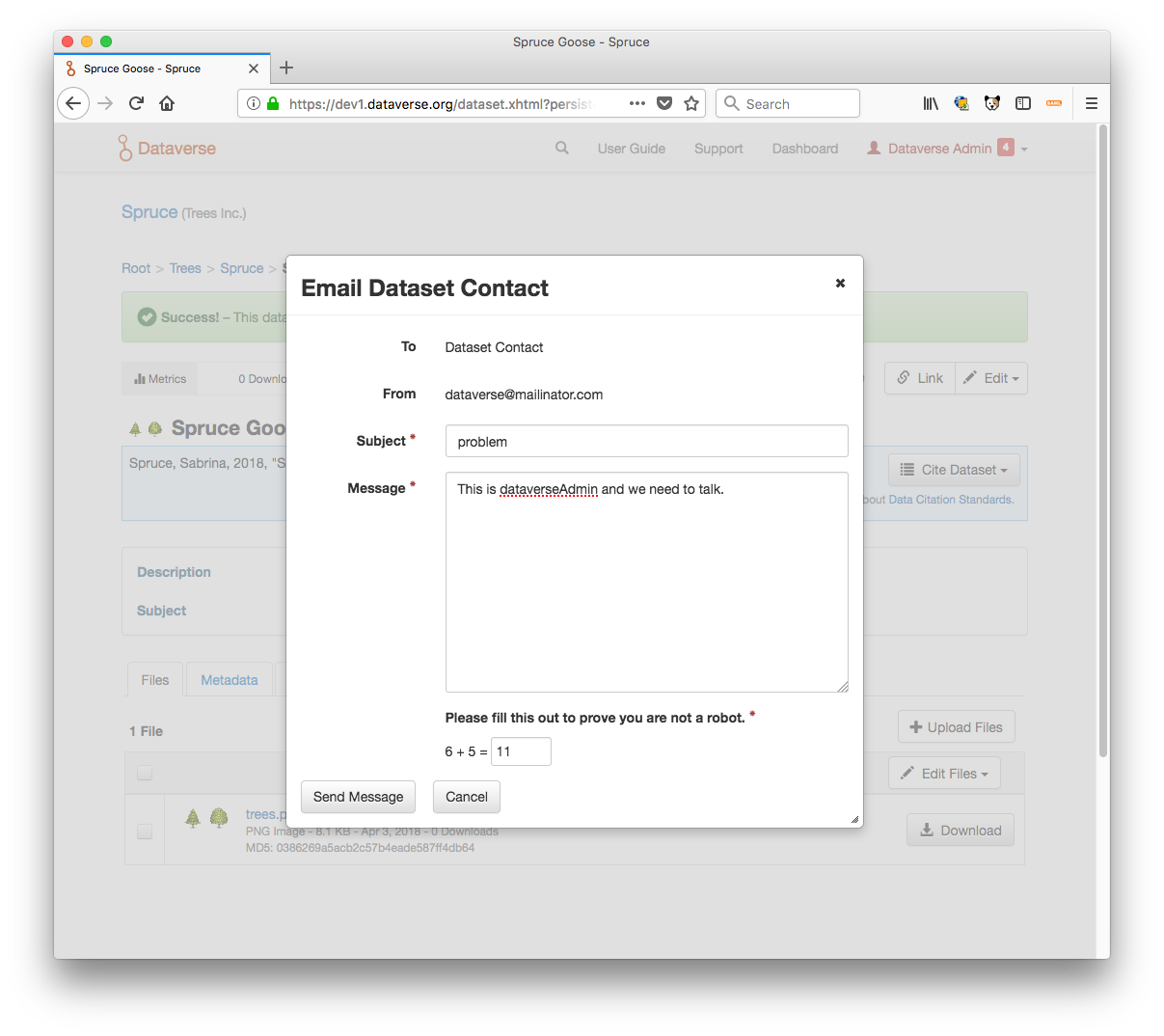
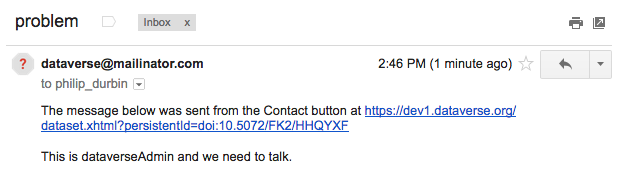
File (Dataset) Contact
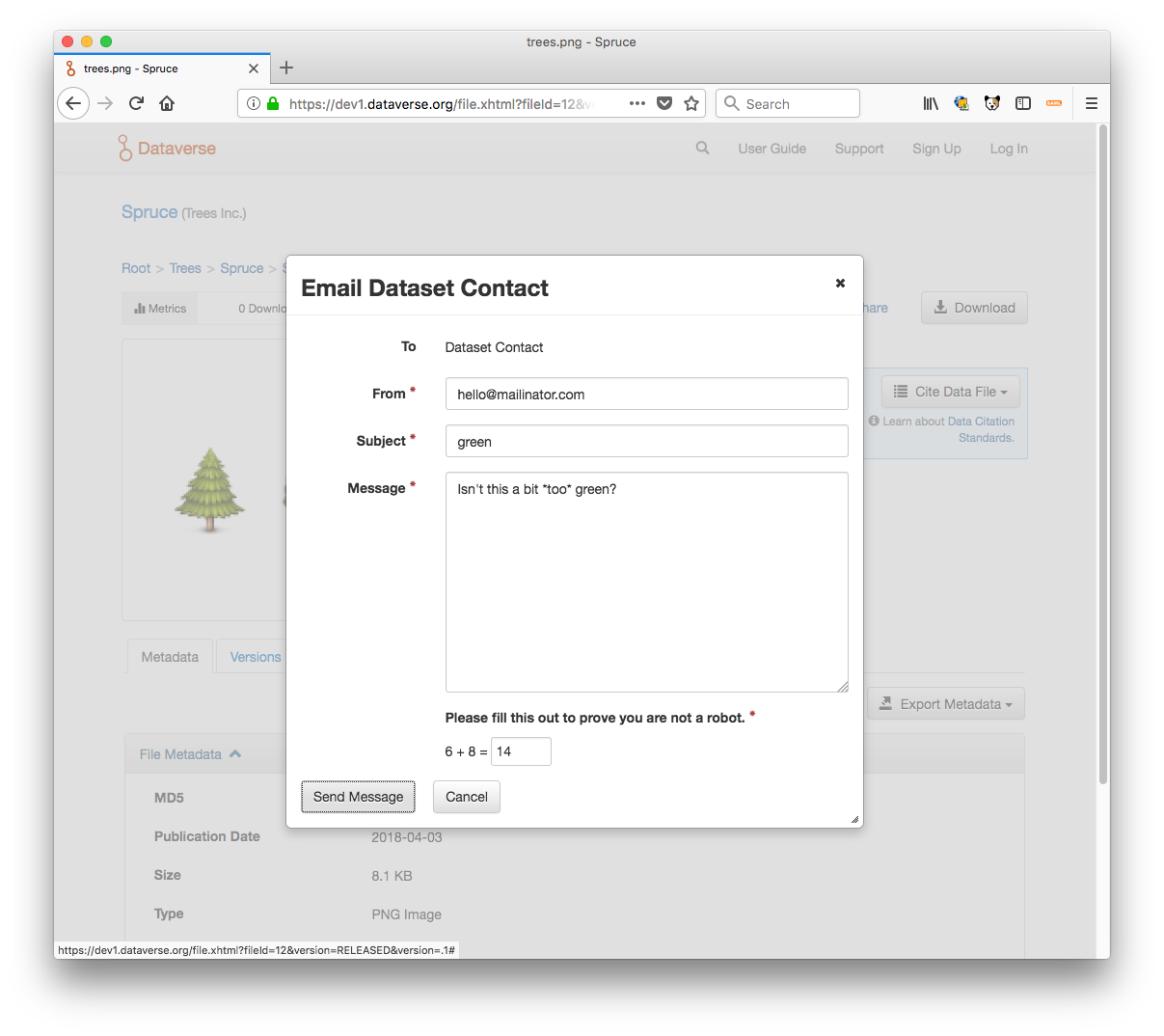
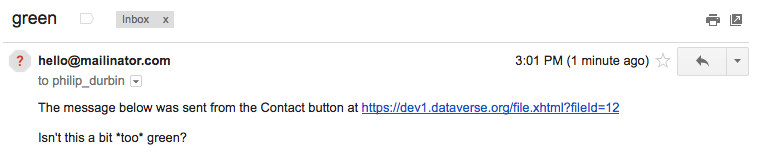
Contact Support
Feedback from anyone is welcome!
pdurbin
on 6 Apr 2018
This is a marked improvement over the old email format! I have a few thoughts on potential other improvements we could make:
- Subject line: It might be nice to indicate somehow that this email comes from a Dataverse user. It's a bit long, but perhaps the subject line could be something like:
_Message from Dataverse User: "[user-entered subject line]"_
- Message body: It might be nice to include the name of the dataset or file in the body of the message. Perhaps it could be something like:
The following message was sent from the contact button of [_dataset or file name, in italics_] at [url of dataset or file]
Message: [body of message]
- For the support form, maybe the subject line could read
Support Request: [user-entered subject line]
 dlmurphy
on 6 Apr 2018
dlmurphy
on 6 Apr 2018
One slightly less extensive suggestion would be to move the "context" part of the message after the user-generated part. Aka -
Have you looked to see if this is too green in light of the recent paper?

Best,
Bob the Post-Doc

You're receiving this message from the contact button of The Spruce Dataset ($url)
@pdurbin Thanks, Phil. Is it possible to get the dataset DOI to show up in the contact dialogue box? Dataverse name is fine, if that is the contact point, but for datasets it would make send to just use the DOI
 sbarbosadataverse
on 8 Apr 2018
sbarbosadataverse
on 8 Apr 2018
Closed duplicate issue Email Dataset Contact - Email needs more information when authors replyto a user #2882. In that issue @sbarbosadataverse commented on on Jan 21, 2016.
I've been using the email icon to contact authors and when they reply I get no indication which dataset/dataverse they are replying from. Would be more helpful to have this info attached to the email dialogue box in some way.
 mheppler
on 10 Apr 2018
mheppler
on 10 Apr 2018
mheppler
on 11 Apr 2018
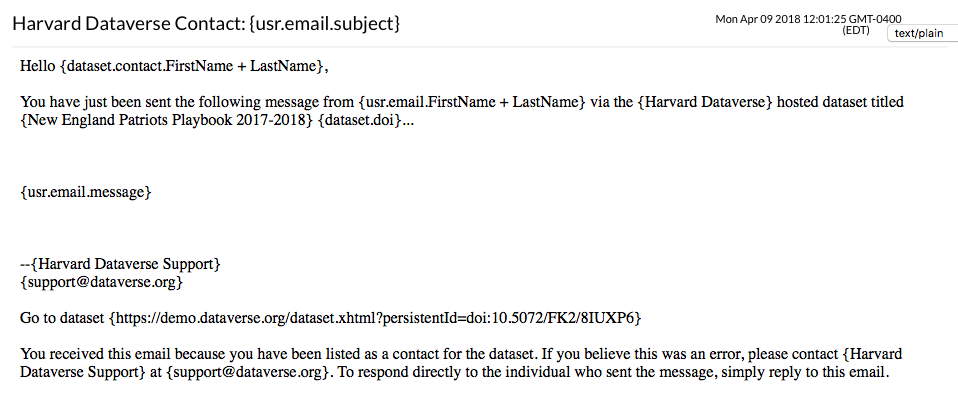
@mheppler one of the challenges with Hello {dataset.contact.FirstName + LastName}, is that Contact Name is freeform. Also, we suggest the form "LastName, FirstName" (i.e. "Brady, Tom") like this:

pdurbin
on 11 Apr 2018
Just a quick update that I'm working away on the code and I think YAML-style separators (---) look better. Like this:
Hello Tom Brady,
You have just been sent the following message from [email protected] via the LibraScholar hosted dataset titled "Darwin's Finches" (doi:10.7910/DVN/TJCLKP):
---Let's talk!
---LibraScholar SWAT Team
[email protected]Go to dataset https://dataverse.librascholar.edu/dataset.xhtml?persistentId=doi:10.7910/DVN/TJCLKP
You received this email because you have been listed as a contact for the dataset. If you believe this was an error, please contact LibraScholar SWAT Team at [email protected]. To respond directly to the individual who sent the message, simply reply to this email.
I also made a couple other small tweaks. Note that the contact form doesn't let you say your name so above you just see the email address but I guess I'll be adding that.
Finally, at standup this morning we decided that #4580 is out of scope for now but it's highly related and sounds like a real issue based on my reading of https://help.hmdc.harvard.edu/Ticket/Display.html?id=260778
pdurbin
on 12 Apr 2018
9c56a0f has some of the progress I've made. Note that at the dataverse level, we do not persist the contact name. We only persist the email address. Here's a screenshot:
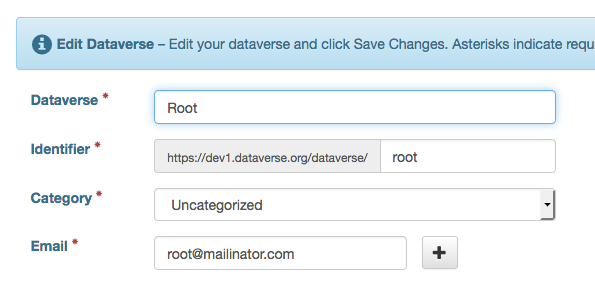
So, I'll try to come up a reasonable alternative to "Hello Tom Brady," for the greeting.
pdurbin
on 12 Apr 2018
Since we don't have a contact name for Dataverses and dataset contact is (potentially) in "Last Name, First Name" format, can we just from that from the greeting? "Hello," should be just as effective and should get this moved along.
Any objections?
 scolapasta
on 12 Apr 2018
scolapasta
on 12 Apr 2018
@mheppler @scolapasta @dlmurphy and anyone else who's interested in what text appears in the "bundle", I think I'm mostly done messing with the text as of 6c22b9e if you'd like to take a look at the "diff" in Bundle.properties at https://github.com/IQSS/dataverse/pull/4571/files
Please note that since I've been focused on providing more context for dataverses, datasets, and files, I haven't thought much about adding more context to the generic "Support" emails but if someone wants to suggest something I can probably work it in without too much trouble since it's the same code.
I'm staying on this issue to do some testing to make sure I didn't break anything with all my refactoring to make the code testable.
Ok, also, @qqmyers popped in IRC this morning and he's going to take a look at related issue #4580. I explained that we're working on the content first but then we'll want to address how in some cases these emails aren't being delivered, which is what that other issue is about.
pdurbin
on 13 Apr 2018
Thanks, @pdurbin. Bundle text looks good in the PR diff!
For the support emails, I think we can go a little more generic. I've cut down the template to something a little more streamline since we don't need to pass any dataverse, dataset, file info.
{Harvard Dataverse Support}<br>
<br>
The following message from {usr.contact.email}...<br>
<br>
----<br>
<br>
{usr.contact.message}<br>
<br>
----<br>
<br>
To respond directly to the individual who sent the message, simply reply to this email.
The bundle text looks good to me, thanks! Also, Mike's change to the support emails looks good to me too.
dlmurphy
on 13 Apr 2018
Bah. The content is better but the code itself is buggy and needs work. I'm pounding on it.
pdurbin
on 13 Apr 2018
Ok, as of 197c57d I think the pull request is in pretty good shape for code review.
We could keep doing more on this branch, including:
- [x] add more context to the support emails (see suggestion from @mheppler above) done in 038d5a3
- update the form to ask for the user's name (instead of just their email address. DEFERRED.
I'll keep myself on this issue for now but developers are welcome to give me feedback on the code.
pdurbin
on 13 Apr 2018
In 038d5a3 I went ahead and added more context to the support emails, with minor tweaks approved by @mheppler
@mheppler and I are on the same page that at this time I am not going to pursue adding a field for "full name" or whatever we call it. The main reason for this is that I'd have to touch a lot of files and this isn't a high priority. Here's a screnshot of the files we'd need to modify:

In addition to the files above the change would need to be made in contactFormFragment.xhtml. The benefits of making this change in the future are two-fold. First, "From" in the current form is somewhat ambiguous in that it could mean "email address" or "name". Here's a screenshot:

If or when we add "full name" we should decide how to label it. Perhaps we could write "Your Name" and "Your Email" like this:

The second benefit of having the second field is that we'll be able populate {usr.contact.FirstName + LastName} in the desired design above, which says "You have just been sent the following message from {usr.contact.FirstName + LastName}". Right now the code just always puts the email address there instead.
Since I think I'm done hacking on the code (barring any bugs I introduced), I'm taking myself off this issue and I'm ready for code review.
pdurbin
on 16 Apr 2018
Reviewed, moved into QA.
 landreev
on 17 Apr 2018
landreev
on 17 Apr 2018
Tested new context email works as described with the exception of
Support email says, "To respond directly to the individual who sent the message, simply reply to this email." but this does not currently work this way according to @pdurbin
 kcondon
on 17 Apr 2018
kcondon
on 17 Apr 2018
@kcondon sorry, I believe we have a misunderstanding. It does work that way, or it should. Support emails are sent from the email address provided in the support form. That's the "from" address. So replying to that from address should reach the individual who provided an email address in the support form.
Of course, if you're logged in, when you fill the the support form, you shouldn't be asked for an email address. The email on file for your account will be used.
I hope this all makes sense!
pdurbin
on 18 Apr 2018
Updated support email template text to remove inaccurate reply instructions.
contact.context.support.ending=\n\n---\n\nMessage sent from Support contact form.
The issue for Contact Us Email: Set the reply to address to be from the user, from address from dataverse. Otherwise email blocked. #4580 should address existing issues with the reply address. I will add a comment on that issue as well. There will need to be consideration for how our RT system works when we change the from and reply fields in the support emails.
mheppler
on 18 Apr 2018
Related issues
 jggautier
·
4Comments
djbrooke
·
3Comments
jggautier
·
3Comments
jggautier
·
3Comments
jggautier
·
4Comments
djbrooke
·
3Comments
jggautier
·
3Comments
jggautier
·
3Comments
 BPeuch
·
3Comments
BPeuch
·
3Comments
Most helpful comment
Just a quick update that I'm working away on the code and I think YAML-style separators (
---) look better. Like this:I also made a couple other small tweaks. Note that the contact form doesn't let you say your name so above you just see the email address but I guess I'll be adding that.
Finally, at standup this morning we decided that #4580 is out of scope for now but it's highly related and sounds like a real issue based on my reading of https://help.hmdc.harvard.edu/Ticket/Display.html?id=260778