Dart-code: Add a "Wrap with builder" assist that works like "Wrap with widget"
Use case
The refactor menu in VSCode has basic widgets.
I want to be able to wrap my widget in a BlocBuilder widget directly or any other widget other than the default widgets
Proposal
I think there should a JSON format or similar way for adding more widgets to the refactor menu and asks for an array of parameters like bloc state class, bloc event class, etc.

 amreniouinnovent
All 15 comments
Is the request here just to be able to run Wrap with new widget but replace the placeholder widget text with a specific widgets name, or are you trying to also customise the code that is inserted?
 DanTup
on 24 Jul 2019
DanTup
on 24 Jul 2019
@DanTup Here is a sample of what I need is having a JSON snippet which has a placeholder like {child}
Theme(
      data:""
          return **{child}**;
        );
BlocBuilder<LoginBloc, LoginState>(
            builder: (BuildContext context, LoginState loginState) {
          return **{child}**;
        });
Ok, I think that complicates things.. When we do "Wrap with new widget" in VS Code, we don't really understand which parts of the code are the child widget - we just send the command off to the analysis server (which ships in the Dart SDK) and it provides us with the edits to apply to the file that will do the wrapping. To achieve what you want, we'd need to know how to extract exactly the child widget in order to merge it with your template (or, we'd need to some potentially brittle string manipulation).
How often do you need to wrap existing code with BlocBuilder, versus writing it from the start? Would a snippet work better?
DanTup
on 24 Jul 2019
@DanTup Yes using snippets could do the trick too.
You have used the right term "Template".
If you feel this proposal is too complex you could close the issue... I don't know a lot about the Dart SDK.
I don't often use it to BlocBuilder but it could be a better solution than snippets solution.
Thank you for hardworking in Dart support to VSCode.
amreniouinnovent
on 24 Jul 2019
I don't often use it to BlocBuilder but it could be a better solution than snippets solution.
What I meant, was would it be more useful to have a snippet that inserts the template you gave above, rather than a refactor? I'm not sure which is more common - writing new code that uses BlocBuilder, or trying to wrap it around existing code. It seems like wrapping it might only be done when converting a project to use Bloc, whereas writing new code you'd probably write it using the BlocBuilder in the first place? (I'm not familiar with Bloc, so I might not understand correctly).
If so, snippets may add more value, and the complexity of this might be less worthwhile. I don't have a good enough understanding to have a solid opinion of that yet though :-)
DanTup
on 24 Jul 2019
@DanTup wrapping is more common than snippets
when you work on a page you focus on the UI then you add the business logic later
So once the login button is created I will wrap it in a BlocBuilder.
so the sequence is building UI >then wrapping the required parts into builders >then business logic
this solution will work for a lot of cases like:
StreamBuilders "used for firebase wrapping", FutureBuilder, etc builders
Builders are for rendering a specific widget only when an event occurs so it improves the performance.
Sample for the stream builder:
https://api.flutter.dev/flutter/widgets/StreamBuilder-class.html
Sample for the future builder:
https://api.flutter.dev/flutter/widgets/FutureBuilder-class.html
amreniouinnovent
on 24 Jul 2019
when you work on a page you focus on the UI then you add the business logic later
Right, makes more sense now :-)
It's possible the Flutter Outline data gives us enough to be able to do this on the client reliably, though it'd need some experimenting to be sure we can do it in a fairly generic way. I'll leave this open in the backlog so people can add 👍's to it (or if someone wants to have a go as a PR) and maybe have a look when I have a little time.
DanTup
on 24 Jul 2019
@DanTup Actually wrapping with a StreamBuilder is already exist I think any other builder will be the same functionality.
amreniouinnovent
on 25 Jul 2019
I'm not sure what that means - do you mean you don't need this, or do you just mean there's one that's similar?
These refactors are done in the server, and it just gives us raw edits back. Customising the text that comes back is tricky because we don't know which part of the text corresponds to things like the class name (StreamBuilder) versus is the child.
I can't say for sure that we have enough info in the client to handle this reliable, it'd need a little investigation.
DanTup
on 25 Jul 2019
@DanTup I mean a similar implementation..Take your time.
amreniouinnovent
on 25 Jul 2019
I have a related proposal but not sure how complex (or possible) such an implementation would be. I constantly find myself wrapping/unwrapping widgets in my workflow. Would be interesting to allow arbitrary wrapping.
Idea:
- Build an index of all widgets that extend
Widgetand have aWidget childorList<Widget> childrenproperty - Expose a "wrap widget" refactor which prompts the user with an auto-complete list to type the name of a widget. The available items in the list would only widgets that can wrap other widgets.
- When the widget is selected, wrap the widget using the
childorchildrenproperty.
Thoughts?
 venkatd
on 20 Aug 2019
venkatd
on 20 Aug 2019
@venkatd Making dynamic autocomplete is a good suggestion
Also having widgets to wrap a list of widgets in children:[inner widget] is a good suggestion too.
amreniouinnovent
on 20 Aug 2019
That's an interesting idea, though the VS Code extension doesn't have all the information required to build such an index, so it'd need support in the server.
That said, it doesn't feel like the experience today is that far off. If you use "Wrap with new Widget", it nested inside a widget and selects the word widget for you to type the name of the widget you want. That code-completion filters as you type, so if you start typing the widget you want it should be quickly selectable. Is this not working that way for you?
You can also keybind refactors like "Wrap in new widget" - see https://github.com/Dart-Code/Dart-Code/issues/1931#issue-482362026 (though it's broken in the current stable release, and fixed for the next one :-))
DanTup
on 20 Aug 2019
@DanTup I think the situation was not explained clear enough yet here so I'll try again:
The generic option "Wrap with widget..." works really good for wrapping a widget as a child with any arbitrary widget.
Another class of use cases is where you want to wrap a widget with some sort of builder, where the widget is not just going to be a regular child but part of a builder function.
There are a lot of different custom types of builders (LayoutBuilder, FutureBuilder, BlocBuilder etc.). For these we only have the specific option to generate a StreamBuilder, but not a generic option.
The generic "Wrap with widget..." is great for a custom widget, because from there you only need to _add_ stuff manually in order to turn the generated generic output into something "custom".
For a builder you only have the very specific "Wrap with StreamBuilder" option, so you need to _remove_ stuff first to turn the generated StreamBuilder into a generic form and then you can add your custom stuff (add/change the generic type, add a child or any other field, change the signature of the builder function etc.).
This extra step for a builder does not sound like much, but it quickly start to get annoying if you have to do this a lot every day :)
One option to solve this would be to add a generic "Wrap with builder..." option to dart code and the analysis server, that maybe outputs something like
Builder<Object> {
    builder: (context) {
        return SomeWidgetThatWasAlreadyPreviouslyThere(
        ...
        )
    }
}
with Builder or Object being selected.
Another option that is mentioned here would be to invent some type of template format, which could be defined once somewhere and then would show up in the refactor context menu. In the template you could then define where the widget, on which this menu was opened, would be placed and which parts of the generated code snippet would be selected after running the option to quickly make changes.
I hope explanation makes it more clear.
 jagmit
on 19 Apr 2021
jagmit
on 19 Apr 2021
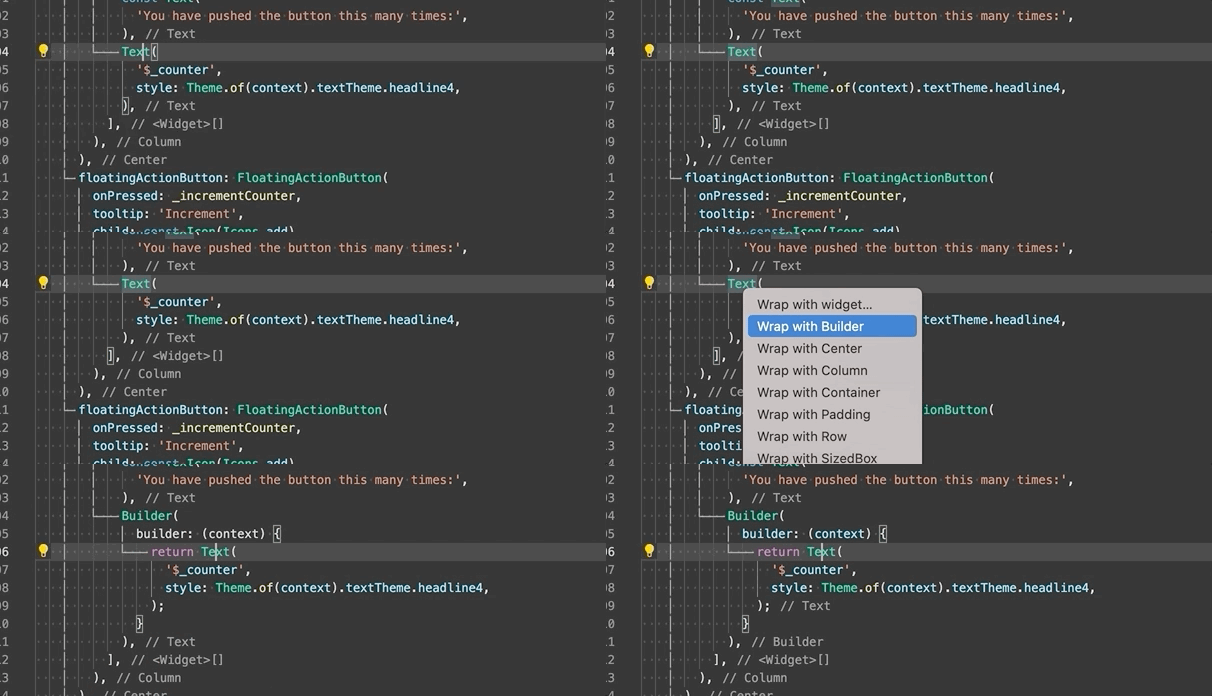
Looks like this was implemented by @b-stime in https://github.com/dart-lang/sdk/pull/45656 and will be available in a future SDK release :-)
DanTup
on 13 May 2021
Related issues
 agmcleod
·
3Comments
agmcleod
·
3Comments
 lukepighetti
·
4Comments
lukepighetti
·
4Comments
 mccadi
·
3Comments
mccadi
·
3Comments
 kinex
·
3Comments
kinex
·
3Comments
 ifredom
·
3Comments
ifredom
·
3Comments
Most helpful comment
Right, makes more sense now :-)
It's possible the Flutter Outline data gives us enough to be able to do this on the client reliably, though it'd need some experimenting to be sure we can do it in a fairly generic way. I'll leave this open in the backlog so people can add 👍's to it (or if someone wants to have a go as a PR) and maybe have a look when I have a little time.