Darknet: Implemented weighted-multi_input-[shortcut] layer with weights-normalization
Implemented weighted-multi_input-[shortcut] layer with weights-normalization, added:
New [shortcut] can:
- can take more than 2 input layers for adding:
from = -2, -3(and -1 by default)
can multiply by weights:
- the different input layers: weight
per_feature(per_layer) - or the different input layers and channels: weight
per_channel
- the different input layers: weight
can normalize weights by using:
avg_reluorsoftmax
The simplest example: yolov3-tiny_3l_shortcut_multilayer_per_feature_softmax.cfg.txt
- Fusion-layer for BiFPN for EfficientDet network: https://github.com/AlexeyAB/darknet/issues/4346
[shortcut]
from= -2, -3, 6            # means: -1, -2, -3, 6 - relative/absolute indexes of input layers
weights_type= per_feature  # none (default), per_feature, per_channel
weights_normalizion= relu  # none (default), relu, softmax
activation= linear         # linear (default), leaky, rely, logistic, swish, mish, ...
- Original residual-connection:
[shortcut]
from= -5           # means: -1, -5 - relative indexes of input layers
activation= linear

https://arxiv.org/abs/1911.09070v1

https://arxiv.org/abs/1911.09070v1

 AlexeyAB
All 91 comments
@AlexeyAB @WongKinYiu I made a network has 3 BiFPN blocks with P3~P5, just take a look for sure,
darknet53-bifpn3.cfg.txt
but even set input size to 320*320 and subdivision=32will get this error
CUDA Error Prev: an illegal memory access was encountered
CUDA Error Prev: an illegal memory access was encountered: Resource temporarily unavailable
darknet: ./src/utils.c:297: error: Assertion `0` failed.
Aborted (core dumped)
 Kyuuki93
on 10 Jan 2020
Kyuuki93
on 10 Jan 2020
@Kyuuki93 Try to use the latest commit. I set
batch=64
subdivisions=16
width=320
height=320
and trained your cfg-file for 100 iterations successfully.
AlexeyAB
on 10 Jan 2020
@Kyuuki93
There is bug in your cfg:
use weights_type=per_feature instead of weights_type=per_feture
AlexeyAB
on 10 Jan 2020
@Kyuuki93
Also you should not specify -1 layer, since it is set by default for all [shortcut] layers.
Just use
[shortcut]
from=61
weights_type=per_feature
weights_normalizion=relu
activation=leaky
instead of
[shortcut]
from=-1,61
weights_type=per_feature
weights_normalizion=relu
activation=leaky
@AlexeyAB cuda error was lead by weights_type=per_feture, my mistake.
Modified .cfg is here darknet53-bifpn3.cfg.txt which look like this

Kyuuki93
on 11 Jan 2020
Comparison on my dataset, all cases with same training settings and used MS COCO detector pre-trained weights, only different in backbone
| Model | [email protected]| [email protected]| precision(.7) | recall(.7)| inference time(416x416)|
| --- | --- | --- | --- | --- | --- |
|yolov3| 91.79%| 63.09% |0.95| 0.71| 13.25ms|
|csresnext50-panet|92.80%|64.16%|0.96|0.67|15.61ms |
|darknet53-bifpn3(P3-5)|91.74%|63.48%|0.95|0.71|15.25ms|
ALL network has SPP-layer, inference time test on RTX 2080Ti, BiFPN block use
weights_type=per_feature
weights_normalizion=relu
darkenet53-bifpn3-spp got very similar performance with yolov3-spp, I think the reason could be
- ability of BiFPN*3(P3-5) was very close to FPN in
yolov3-spp - my dataset was too small to show different of two FPN
the option of next step could be
- darknet53-bifpn*N(P3-5)
- darknet53-bifpn*N(P2-5)
- darknet53-bifpn*N(P3-7)
- csresnext50-panet-bifpn*N(Px-Px)
but recently my machines was occupied by other task, I will try further experiment when GPUs got free
Kyuuki93
on 11 Jan 2020
@Kyuuki93
Yes,
- Try to use more than 3xP
- Also try to use 3-5 BiFPN blocks
since BiFPN is not very expensive
AlexeyAB
on 11 Jan 2020
@Kyuuki93 @WongKinYiu I just fixed weights_normalizion=softmax for [shortcut] layer. https://github.com/AlexeyAB/darknet/commit/14172d42b68cf9c81ca1150020475f3e79c82fab#diff-0c461530f46c81f7013a6eaec297ebcfR135
weights_normalizion=relu remains the same as earlier.
AlexeyAB
on 13 Jan 2020
@AlexeyAB
Start re-train ASFF models now.
 WongKinYiu
on 14 Jan 2020
WongKinYiu
on 14 Jan 2020
@WongKinYiu
[shortcut] doesn't affect ASFF.
And [shortcut] weights_normalizion=softmax even doesn't affect BiFPN.
- default ASFF uses
[scale_channels] scale_wh=1 - default BiFPN uses
[shortcut] weights_normalizion=relu
AlexeyAB
on 14 Jan 2020
@Kyuuki93 @WongKinYiu
Also I don't know what result of BiFPN (weights_normalizion=softmax) will be better, with max_val=0 or without it, between these 2 lines in these 2 places:
- https://github.com/AlexeyAB/darknet/blob/14172d42b68cf9c81ca1150020475f3e79c82fab/src/blas_kernels.cu#L705-L706
- https://github.com/AlexeyAB/darknet/blob/14172d42b68cf9c81ca1150020475f3e79c82fab/src/blas_kernels.cu#L781-L782
So you can test both cases on two small datasets.
AlexeyAB
on 14 Jan 2020
@Kyuuki93 Hi,
Do you get any progress in BiFPN and BiFPN+ASFF?
AlexeyAB
on 22 Jan 2020
Do you get any progress in BiFPN and BiFPN+ASFF?
Sorry, can't work this days because new year and new virus in china ...
Kyuuki93
on 31 Jan 2020
@Kyuuki93 @AlexeyAB I'm interested in implementing a BiFPN head on top of darknet in https://github.com/ultralytics/yolov3 using https://github.com/AlexeyAB/darknet/files/4048909/darknet53-bifpn3.cfg.txt and benchmarking on COCO.
EfficientDet paper https://arxiv.org/pdf/1911.09070.pdf mentions 3 summation methods: "scalar (per-feature), a vector (per-channel), or a multi-dimensional tensor (per-pixel)". It seems they select scalar/per-feature for their implementation. Then I assume to add multiple 4D tensors, say of shape 16x256x13x13, would we have 2 scalar weights if done 'per_feature', and 2 vector weights of shape 1x256x1x1 if done 'per_channel'?
Also, I'm surprised softmax on the weights imparts such a slowdown (1.3X) in their paper, have you guys also observed this?
 glenn-jocher
on 17 Feb 2020
glenn-jocher
on 17 Feb 2020
@glenn-jocher
Then I assume to add multiple 4D tensors, say of shape 16x256x13x13, would we have 2 scalar weights if done 'per_feature', and 2 vector weights of shape 1x256x1x1 if done 'per_channel'?
Yes.
- per_feature (per input layer) - 1 float value for each input layer
- per_channel - 1 float value per each channel from each layer
Also, I'm surprised softmax on the weights imparts such a slowdown (1.3X) in their paper, have you guys also observed this?
Only for training. And only for weighted-shortcut-layer.
As result:
- for training ~1-10%
- for detection == 0% (since normalization can be done during initialization) https://github.com/AlexeyAB/darknet/blob/653eceb1a72641cf978734dc15257f8273f1ac94/src/network.c#L1112-L1162
Did you write a paper for Mosaic data augmentation?
AlexeyAB
on 17 Feb 2020
@AlexeyAB ah I see. Actually no, I haven't had time to write a mosaic paper. It's too bad, because the results are pretty clear that it helps significantly.
Another thing I was wondering is I see in the BiFPN cfg only the head used weighted shortcuts, while the darknet53 backbone does not. If it helps the head then it may help the backbone as well no? Though to keep expectations in check, the EfficientDet paper only shows a pretty small +0.45 mAP bump from weighted vs non-weighted head.
One difference though is that currently the regular non-weighted shortcut layers effectively have weights=1 that sum to 2, 3 etc depending on the number of inputs. Isn't this a bit strange then that the head must be constrained to sum the weights to 1?

glenn-jocher
on 17 Feb 2020
@glenn-jocher
If it helps the head then it may help the backbone as well no?
I have the same thoughts.
We can replace each shortcut with a weighted-shortcut. May be it will get another +0.5 AP.
Isn't this a bit strange then that the head must be constrained to sum the weights to 1?
Batch-normalization try to do the same - moves the most values to range [0 - 1] - it increases mAP, speeds up the training, makes training more stable...
https://medium.com/@ilango100/batch-normalization-speed-up-neural-network-training-245e39a62f85

AlexeyAB
on 18 Feb 2020
@AlexeyAB ah of course, the BN after the Conv2d() following a shortcut will do this automatically, it completely slipped my mind. Good example. Ok, then I've taken @Kyuuki93's cfg, touched it up a bit (fixed the 'normalization' typo, reverted it to yolov3-spp.cfg default anchors and 80-class configuration, and implemented weighted shortcuts for all shortcut layers.)
I will experiment with a few different weighting techniques using my typical 27 epoch coco results and post the results later on this week hopefully. I suppose the tests should be:
- yolov3-spp.cfg results (default)
- yolov3-spp.cfg (all shortcuts = weighted shortcuts)
- darknet53-bifpn3.cfg (all shortcuts in backbone and head = weighted shortcuts)
glenn-jocher
on 18 Feb 2020
@glenn-jocher Also try to use this cfg-file that is made more similar to https://github.com/xuannianz/EfficientDet/blob/ccc795781fa173b32a6785765c8a7105ba702d0b/model.py
- csresnext50-bifpn-optimal.cfg.txt
(or try to use BiFPN-head from this cfg-file with darknet53 backbone)
Just for fair comparison, set all parameters in [net] and [yolo] to the same values in all 4 models.
AlexeyAB
on 18 Feb 2020
@AlexeyAB thanks for the cfg! I've been having some problems with the route layers on these csresnext50 cfgs, maybe I can just copy the BiFPN part and attach it to darknet53, ah but the shortcut layer numbers will be different... ok maybe I'll just try and use it directly. Let's see...
glenn-jocher
on 18 Feb 2020
@glenn-jocher Yes, you should change route layers and the first from= in weighted [shortcut] layers. Tomorow I will attach csdarknet53-bifpn-optimal.cfg
AlexeyAB
on 18 Feb 2020
@AlexeyAB @glenn-jocher
I will get some free gpus in about 2~4 days.
If you want to try weighted shortcut in backbone, i can train it on imagenet.
WongKinYiu
on 18 Feb 2020
@WongKinYiu @glenn-jocher
Yes, it will be nice.
Try to train 2 Classifiers with weighted-shortcut layers:
- csdarknet53-ws.cfg.txt (relu)
csresnext50-ws.cfg.txt (relu)
csresnext50-ws-mi2.cfg.txt (softmax) - preferably for training (multi-input weighted shortcut-layers with softmax normalization)
Which are similar to https://github.com/WongKinYiu/CrossStagePartialNetworks/blob/master/imagenet/results.md with mosaic, cutmix, mish, label smooth
Try to train these 2 models 416x416 with my BiFPN module which is more like a module by reference: https://github.com/xuannianz/EfficientDet/blob/ccc795781fa173b32a6785765c8a7105ba702d0b/model.py
For comparison with: https://github.com/ultralytics/yolov3/issues/698#issuecomment-587378576
Can you add
AP | AP50 | AP75for CSPResNeXt-50 optimal without any features?What is the Generic in this table?
Also what is the difference between RFB and RFBN? https://github.com/WongKinYiu/CrossStagePartialNetworks/blob/master/coco/results.md#cspresnext-50-optimal
- And why RFB degrades AP? Is it because RFB without batch-normalization, while RFBN with one?
Model | Size | fps | AP | AP50 | AP75 | APS | APM | APL | cfg | weight
-- | -- | -- | -- | -- | -- | -- | -- | -- | -- | --
PANet-(SPP, CIoU) | 512×512 | 44 | 42.4 | 64.4 | 45.9 | 23.2 | 45.5 | 55.3 | - | -
PANet-(SPP, RFB, CIoU) | 512×512 | - | 41.8 | 62.7 | 45.1 | 22.7 | 44.3 | 55.0 | - | -
AlexeyAB
on 18 Feb 2020
Can you add AP | AP50 | AP75 for CSPResNeXt-50 optimal without any features?
still training.What is the Generic in this table?
it means apply learning rate, momentum... which is searched by generic algorithm. https://github.com/ultralytics/yolov3/issues/392Also what is the difference between RFB and RFBN? https://github.com/WongKinYiu/CrossStagePartialNetworks/blob/master/coco/results.md#cspresnext-50-optimal
And why RFB degrades AP? Is it because RFB without batch-normalization, while RFBN with one?
yes.
WongKinYiu
on 18 Feb 2020
What is the Generic in this table?
it means apply learning rate, momentum... which is searched by generic algorithm. https://github.com/ultralytics/yolov3/issues/392
So it is about the optimal Hyperparameters that are obtained by the Genetic algorithm.
AlexeyAB
on 19 Feb 2020
yes
WongKinYiu
on 19 Feb 2020
@AlexeyAB @WongKinYiu ah yes, this is a "Genetic Algorithm", not "Generic". The current hyperparameters I found with it are tuned for yolov3-spp.cfg though, and it's unclear to me how well they generalize to other architectures/datasets. This could be one of the reasons why yolov3-spp trains well on ultralytics/yolov3 in comparison to others like csresnext-panet etc.
I completed the 3 runs (27 COCO epochs). Weighted shortcut only helped very slightly, and BiFPN actually worsened my results slightly. In general all 3 were extremely similar.
| Name | mAP
@0.5 | mAP
@0.5:0.95 | Comments
-- | -- | -- | -- | --
64 | yolov3-spp.cfg | 50.2 | 30.9 | baseline 63M
65 | yolov3-spp.cfg | 50.3 | 31.0 | weighted shortcuts 63M
66 | darknet53-bifpn3.cfg | 49.7 | 30.8 | weighted shortcuts 70M
67 | csdarknet53-bifpn-optimal.cfg | | | results pending 53M

I created a PyTorch weighted shortcut layer for this test. I did not normalize my shortcut weights with softmax or the "fast fusion" method from the paper, instead I used a simple sigmoid method to address the possible instability. I don't know if this difference affects things significantly or not. I suppose I should have just done a strict softmax. I can do that in the future.
class weightedFeatureFusion(nn.Module):  # weighted sum of 2 or more layers https://arxiv.org/abs/1911.09070
    def __init__(self, layers):
        super(weightedFeatureFusion, self).__init__()
        self.n = len(layers) + 1 # number of layers
        self.layers = layers  # layer indices
        self.w = torch.nn.Parameter(torch.zeros(self.n))  # layer weights

    def forward(self, x, outputs):
        w = torch.sigmoid(self.w) * (2 / self.n)  # sigmoid weights (0-1)
        if self.n == 2:
            return x * w[0] + outputs[self.layers[0]] * w[1]
        elif self.n == 3:
            return x * w[0] + outputs[self.layers[0]] * w[1] + outputs[self.layers[1]] * w[2]
        else:
            raise ValueError('weightedFeatureFusion() supports up to 3 layer inputs, %g attempted' % self.n)
UPDATE: @AlexeyAB I will run csdarknet53-bifpn-optimal.cfg to compare with above. I can't run csresnext50-bifpn-optimal.cfg yet due to the resnext bug with the grouped convolutions in my repo, but I'll try to get that sorted out this week or next week as well.
glenn-jocher
on 19 Feb 2020
I looked at the actual fusion weights for yolov3-spp.cfg using the above process, and nothing seems out of the ordinary. They don't quite sum to 1 but not sure if it really matters.
    for x in list(model.parameters()):
        if len(x) == 2:
            print(torch.sigmoid(x).detach())

tensor([0.68042, 0.24355])
tensor([0.43275, 0.43802])
tensor([0.63490, 0.33800])
tensor([0.38976, 0.61641])
tensor([0.45976, 0.52418])
tensor([0.49271, 0.47769])
tensor([0.48430, 0.46104])
tensor([0.48992, 0.43543])
tensor([0.48655, 0.41508])
tensor([0.47568, 0.38939])
tensor([0.42831, 0.35085])
tensor([0.40784, 0.60700])
tensor([0.45018, 0.53021])
tensor([0.46398, 0.47831])
tensor([0.48237, 0.43581])
tensor([0.49701, 0.41102])
tensor([0.49047, 0.40242])
tensor([0.47470, 0.38543])
tensor([0.47063, 0.34986])
tensor([0.42593, 0.57570])
tensor([0.46498, 0.51103])
tensor([0.49873, 0.47298])
tensor([0.53441, 0.46724])
@AlexeyAB I tried csdarknet53-bifpn-optimal.cfg.txt, but I'm getting the same error related to the channel sizes as I saw in resnext. I don't think this a bug, I think I simply need to update my code per https://github.com/ultralytics/yolov3/issues/698#issuecomment-570427687, which I still haven't done yet.
Also there is a typo in 'weights_normalizion'. I also saw the new model is reduced in size, 53M params vs I think 63M for yolov3-spp.cfg, which is more in line with the efficientdet paper, as the old darknet53-bifpn cfg I used actually increased the parameter count.
UPDATE: I realized the error message is actually about the shortcut layers. When shortcutting layers -1 to 85 I get these shapes:
-1, torch.Size([16, 1024, 26, 26])
85, torch.Size([16, 512, 26, 26])
This error is coming from line 835 in your cfg:

glenn-jocher
on 19 Feb 2020
Also there is a typo in 'weights_normalizion'.
maybe it becuz it is defined as weights_normalizion in parser.c and blas.c.
WongKinYiu
on 19 Feb 2020
@glenn-jocher
Also there is a typo in 'weights_normalizion'.
What do you mean?
I did not normalize my shortcut weights with softmax or the "fast fusion" method from the paper, instead I used a simple sigmoid method to address the possible instability.
In ASFF the Softmax works much better than ReLU/Logistic, so may be we can try to train weights_normalizion=softmax in BiFPN too, since it doesn't affect on inference speed
https://github.com/AlexeyAB/darknet/issues/4382#issuecomment-564823931
But logically, softmax should give a greater advantage to ASFF than to BiFPN (since in ASFF the multipliers are different for each inference and the sum of multipliers is different every time, so they should be normalized dynamically). So this is not a priority.
Weighted shortcut only helped very slightly
Since new shortcut-layer not only weighted, but also multi-input, then we can fuse all shortcut outputs with the same resolution before each subsambling.
I will try to make such model and compare FPS:

I also saw the new model is reduced in size, 53M params vs I think 63M for yolov3-spp.cfg
I will run csdarknet53-bifpn-optimal.cfg to compare with above. I can't run csresnext50-bifpn-optimal.cfg yet due to the resnext bug with the grouped convolutions in my repo, but I'll try to get that sorted out this week or next week as well.
I used grouped-conv in the csdarknet53-bifpn-optimal.cfg model.
UPDATE: I realized the error message is actually about the shortcut layers. When shortcutting layers -1 to 85 I get these shapes:
-1, torch.Size([16, 1024, 26, 26])
85, torch.Size([16, 512, 26, 26])This error is coming from line 835 in your cfg:
This is a PRN (partial residual connections) when two tensors with different number of channels are added elementwise.

AlexeyAB
on 19 Feb 2020
@WongKinYiu
About my suggestion:
Since new shortcut-layer not only weighted, but also multi-input, then we can fuse all shortcut outputs with the same resolution
I added csresnext50-ws-mi2.cfg.txt - preferably for training (multi-input weighted shortcut-layers with softmax normalization)
There: https://github.com/AlexeyAB/darknet/issues/4662#issuecomment-587490873
So may be better to train:
csresnext50-ws.cfg.txt
and
csresnext50-ws-mi2.cfg.txt
whitout 1. csdarknet53-ws.cfg.txt if you don't have enough GPUs.
On RTX 2070
csresnext50.cfg.txt- 68.0 FPScsresnext50-ws.cfg.txt- 67.5 FPScsresnext50-ws-mi2.cfg.txt- 67.5 FPS
AlexeyAB
on 19 Feb 2020
@AlexeyAB
OK.
WongKinYiu
on 19 Feb 2020
This is a PRN (partial residual connections) when two tensors with different number of channels are added elementwise.
@AlexeyAB ah I see, PRN. Output always matches input shape. Ok perfect, if I can fix this then cspresnext and your new darknet53 cfgs will both work. For the 3 cases:
- Case A larger 'from' should be maxpooled to fit? Or perhaps downsampled using nearest value? Or we could also simply slice the feature from 0 to the same size and input (we lose some data this way).
- Case B @WongKinYiu already explained this to me, the solution is to zero pad (all zeros on the right side, following the existing features) the smaller 'from' feature to match the larger one right?
- Case C is already handled correctly.
glenn-jocher
on 19 Feb 2020
@glenn-jocher
Case A larger 'from' should be maxpooled to fit? Or perhaps downsampled using nearest value? Or we could also simply slice the feature from 0 to the same size and input (we lose some data this way).
There is no maxpool/downsampling. Just take the first C channels.
Or we could also simply slice the feature from 0 to the same size and input (we lose some data this way).
Yes.
AlexeyAB
on 19 Feb 2020
@AlexeyAB @WongKinYiu I've updated my shortcut layer now to correctly handle all new situations: weighted and non-weighted, from smaller features (by zero pad right) and from larger features (by slicing), for any number of input layers.
I should be able to train the 2 new cfg files now. Do these parameter and layer counts seem correct?
- yolov3-spp.cfg (for reference): 225 layers, 6.29987e+07 parameters
- csdarknet53-bifpn-optimal.cfg: 338 layers, 4.99935e+07 parameters
- csresnext50-bifpn-optimal.cfg: 299 layers, 4.25729e+07 parameters
glenn-jocher
on 20 Feb 2020
@glenn-jocher great!
WongKinYiu
on 20 Feb 2020
I noticed that the shortcut zeropad operations in my implementation are slower (about 100X slower on CPU) than the slicing operations. The times (seconds) below are for 1000 shortcut operations for darknet53-bifpn (for different shortcut layers). I tried a different method: instead of padding the smaller 'from' feature, I added the 'from' feature to a sliced input, which should be mathematically equivalent. I didn't see any GPU speedup though, so this looks like its not a primary cause of slowdown with these new models, but the change did help reduce GPU RAM usage a bit.
zeropad 0.2164621353149414
zeropad 0.6748669147491455
zeropad 2.6399528980255127
slice 0.0072019100189208984
slice 0.006873130798339844
slice 0.006844043731689453
slice 0.006783962249755859
slice 0.007230997085571289
zeropad 0.1068871021270752
zeropad 0.6746640205383301
slice 0.0068128108978271484
zeropad 0.1016230583190918
The new models are training now, should be done in a day or two. Unfortunately they are quite a bit slower than yolov3-spp, about 2.5X slower (22 min epoch vs 50-60 min epoch) with multi-scale. My command is here.
python3 train.py --data coco2014.data --img-size 416 608 --epochs 27 --batch 12 --accum 6 --weights '' --device 0 --cfg csdarknet53-bifpn-optimal.cfg --nosave --name 67 --multi
Do these parameter and layer counts seem correct?
Yes.
AlexeyAB
on 20 Feb 2020
@AlexeyAB I'm seeing poor results here after 15 epochs for csresnext50-bifpn-optimal.cfg (results67 below), so I've cancelled the training.
You have the anchor order for both csresnext50-bifpn-optimal.cfg and csdarknet53-bifpn-optimal.cfg the same as yolov3-spp.cfg, with mask=0,1,2 for the last output layer. Perhaps this order should be reversed as in darknet53-bifpn3.cfg?
I've also seperately confirmed that the majority of the slowdown is due to the grouped convolutions. When I set groups=1 for all convolutions in csdarknet53-bifpn-optimal.cfg my parameter count increases (from 50M to 57M), but the training speeds improves from 51min/epoch to 31min/epoch.
ID | Name | mAP@
0.5 | mAP@
0.5:0.95 | Comments
-- | -- | -- | -- | --
64 | yolov3-spp.cfg | 50.2 | 30.9 | baseline 63M
65 | yolov3-spp.cfg | 50.3 | 31.0 | weighted shortcuts 63M
66 | darknet53-bifpn3.cfg | 49.7 | 30.8 | weighted shortcuts 70M
67 | csdarknet53-bifpn-optimal.cfg | - | - | cancelled 50M
69 | csdarknet53-bifpn-optimal.cfg | 41.5 | 23.8 | groups=1 57M
70 | csresnext50-bifpn-optimal.cfg | 44.0 | 25.9 | groups=1 94M

glenn-jocher
on 20 Feb 2020
@glenn-jocher
I'm seeing poor results here after 15 epochs for csresnext50-bifpn-optimal.cfg (results67 below), so I've cancelled the training.
Is it better than darknet53-bifpn3.cfg ?
It would be nice to compare with darknet53-bifpn3.cfg so we will understand whether we are moving in the right direction.
What does it mean result64 - 67 on your charts?
I've also seperately confirmed that the majority of the slowdown is due to the grouped convolutions. When I set groups=1 for all convolutions in csdarknet53-bifpn-optimal.cfg my parameter count increases (from 50M to 57M), but the training speeds improves from 51min/epoch to 31min/epoch.
Try to train csresnext50-bifpn-optimal.cfg with groups=1
You have the anchor order for both csresnext50-bifpn-optimal.cfg and csdarknet53-bifpn-optimal.cfg the same as yolov3-spp.cfg, with mask=0,1,2 for the last output layer.
Yes.
Perhaps this order should be reversed as in darknet53-bifpn3.cfg?
No.
AlexeyAB
on 20 Feb 2020
@AlexeyAB I've added a table to https://github.com/AlexeyAB/darknet/issues/4662#issuecomment-589316861 to explain the run numbers. darknet53-bifpn3.cfg is there as run 66.
Ok, yes I will re-run csdarknet53-bifpn-optimal.cfg with groups=1 for all convolutions, and I will try csresnext50-bifpn-optimal.cfg with groups=1 after that.
glenn-jocher
on 20 Feb 2020
@glenn-jocher
Case A larger 'from' should be maxpooled to fit? Or perhaps downsampled using nearest value? Or we could also simply slice the feature from 0 to the same size and input (we lose some data this way).
We do not get all the information from the from=
But in the main path we don't lose any information.
So actually we dont lose any information.
I tried a different method: instead of padding the smaller 'from' feature, I added the 'from' feature to a sliced input, which should be mathematically equivalent.
You should not crop layer -1 otherwise you will lose information and the accuracy will drop dramatically.
Just note that A and B are not equivalent:
AlexeyAB
on 20 Feb 2020
@AlexeyAB yes don't worry, I'm 99% sure I'm handling the new shortcuts correctly. The change I made was to Case B. Rather than zero-pad from as we first talked about, I add from to a sliced input. Only the sliced values in input are affected, the rest of input remains unchanged (same as adding zeros to it).
The original pad pseudocode would be:
output = input * weight0 + [from , zero_padding] * weight1
And the updated pseudocode that avoids padding looks this for ch from channels.
output = input * weight0
output[:, 0:ch] = output[:, 0:ch] + from * weight1
The actual code looks like this.
```python
# Fusion
nc = x.shape[1] # input channels
for i in range(self.n - 1):
a = outputs[self.layers[i]] # feature to add
ac = a.shape[1] # feature channels
dc = nc - ac # delta channels
        # Adjust channels
        if dc > 0:  # slice input
            x[:, :ac] = x[:, :ac] + (a * w[i + 1] if self.weight else a)
        elif dc < 0:  # slice feature
            x = x + (a[:, :nc] * w[i + 1] if self.weight else a[:, :nc])
        else:  # same shape
            x = x + (a * w[i + 1] if self.weight else a)
```
glenn-jocher
on 21 Feb 2020
@AlexeyAB @WongKinYiu runs are all done. None of the updates helped the results unfortunately. The higher the groupings the fewer parameters, but also the worse the results apparently.
I only did 10% coco training here, so its possible full training might return a different results, but typically 10% training results correlate fairly well with full training results. As a reference, run 64 acheives 50.2 [email protected] at 10% of training (table below), and 61.[email protected] mAP with full training.
I'm pretty confused then. If the bifpn cfgs are correct, then we are unable to replicate the improvement in the literature, at least on the ultralytics repo. But with this darknet repo, grouped convolutions _do_ show improvement?
ID | Name | mAP@
0.5 | mAP@
0.5:0.95 | Comments
-- | -- | -- | -- | --
64 | yolov3-spp.cfg | 50.2 | 30.9 | baseline 63M
65 | yolov3-spp.cfg | 50.3 | 31.0 | weighted shortcuts 63M
66 | darknet53-bifpn3.cfg | 49.7 | 30.8 | weighted shortcuts 70M
67 | csdarknet53-bifpn-optimal.cfg | - | - | cancelled 50M
69 | csdarknet53-bifpn-optimal.cfg | 41.5 | 23.8 | groups=1 57M
70 | csresnext50-bifpn-optimal.cfg | 44.0 | 25.9 | groups=1 94M
glenn-jocher
on 22 Feb 2020
@glenn-jocher Hello,
I start training them few days ago, will get results after 4 weeks.
WongKinYiu
on 22 Feb 2020
@glenn-jocher @WongKinYiu
If the bifpn cfgs are correct, then we are unable to replicate the improvement in the literature, at least on the ultralytics repo.
Perhaps automatic differentiation in Ultralytics/Pytorch incorrectly performs back propagation for normalization in your weighted-shortcut layers.
I used the same gradient as in the ASFF: https://arxiv.org/pdf/1911.09516v2.pdf

https://github.com/AlexeyAB/darknet/blob/6fb817f68b471da21c04f8bd5ffef0d3c4d67c30/src/blas.c#L181-L187
Then it performs such back propagation:
https://github.com/AlexeyAB/darknet/blob/6fb817f68b471da21c04f8bd5ffef0d3c4d67c30/src/blas.c#L216-L217
Also will waiting for results of ASFF(softmax), that shows improvement for small custom datasets: https://github.com/AlexeyAB/darknet/issues/3874#issuecomment-561064425
(just this is strange that ASFF + RFB(batchnorm=0) shows the best AP75 accuracy, while RFB(batchnorm=1) degrades AP75)
But on MSCOCO the ASFF(softmax) leads to Nan: https://github.com/AlexeyAB/darknet/issues/3772#issuecomment-580518150
AlexeyAB
on 22 Feb 2020
@AlexeyAB I forgot you were coding gradients yourself, that's very impressive!
Incorrect gradients can always be an issue. I've seen problems arise with in-place operations (pytorch can't backprop these properly), but I made sure to avoid these in my shortcut module, and I also tested the new setup with anomaly detection once to check, by setting torch.autograd.set_detect_anomaly(True) before running (no anomalies were found). But the new shortcut operations actually help a bit on yolov3-spp.cfg (see table below), so at least for _same shape weighted shortcut_ operations everything is going well.
ID | Name | mAP@
0.5 | mAP@
0.5:0.95 | Comments
-- | -- | -- | -- | --
64 | yolov3-spp.cfg | 50.2 | 30.9 | baseline 63M
65 | yolov3-spp.cfg | 50.3 | 31.0 | weighted shortcuts 63M
The main mAP decreases appear to come from groups>1 in the convolutions, but also from the new heads. I suppose a simple test would be for me to take yolov3-spp.cfg, and change all the convolutions to groups=2, groups=4, groups=8 and add these results to the table? That would isolate the effect of increased groups.
glenn-jocher
on 22 Feb 2020
@WongKinYiu
I fixed gradient for BiFPN and weighted-shortcut.
So try to re-run training of these models with new code: https://github.com/AlexeyAB/darknet/issues/4662#issuecomment-587490873
AlexeyAB
on 24 Feb 2020
@WongKinYiu
- 3 fixes for BiFPN / weighted-[shortcut]: https://github.com/AlexeyAB/darknet/commit/cfa40fe890d0fc7d100cfec2ee4976bf9838cb30 and https://github.com/AlexeyAB/darknet/commit/3cb9125b95a860694cfafa5b3408aa6123749e1e and https://github.com/AlexeyAB/darknet/commit/f6baa62c9b6151b9f615a1e56434d237553fd4af
@glenn-jocher Did you try to use ASFF on ultralytics/Pytorch? https://github.com/ruinmessi/ASFF
AlexeyAB
on 24 Feb 2020
The latest fix accelerates the backpropagation of BiFPN.
AlexeyAB
on 24 Feb 2020
@AlexeyAB no, I have not tried YOLOv3-ASFF. I went tho the https://github.com/ruinmessi/ASFF repo but couldn't find a cfg. Do you have one?
glenn-jocher
on 3 Mar 2020
@glenn-jocher
As in the most Pytorch projects, the model is hardcoded in Python: https://github.com/ruinmessi/ASFF/blob/master/models/yolov3_asff.py
There is cfg file for Darknet with ASFF and RFB: yolov3-spp-asff-rfb.cfg.txt
More: https://github.com/AlexeyAB/darknet/issues/4382#issuecomment-567010280
AlexeyAB
on 3 Mar 2020
@AlexeyAB
csresnext50-ws.cfg.txt: 78.7% top-1, 94.7% top-5.
WongKinYiu
on 19 Mar 2020
@WongKinYiu Thanks! So this is lower than csresnext50-omega.cfg 79.8% | 95.2%
AlexeyAB
on 19 Mar 2020
@AlexeyAB yes, but it seems you add some constraint of weighted shortcut in new version, maybe it would get better results.
WongKinYiu
on 19 Mar 2020
@WongKinYiu Yes, may be. But the main difference, limiting weight_updates makes training more stable at the very beginning, then it has almost no effect.
Please, share weights-file of csresnext50-ws.cfg.txt, I will check the weights of shortcut-layers.
AlexeyAB
on 19 Mar 2020
@AlexeyAB here you are.
WongKinYiu
on 19 Mar 2020
@WongKinYiu
@AlexeyAB yes, but it seems you add some constraint of weighted shortcut in new version, maybe it would get better results.
About bad acccuracy of csresnext50-ws.cfg.txt
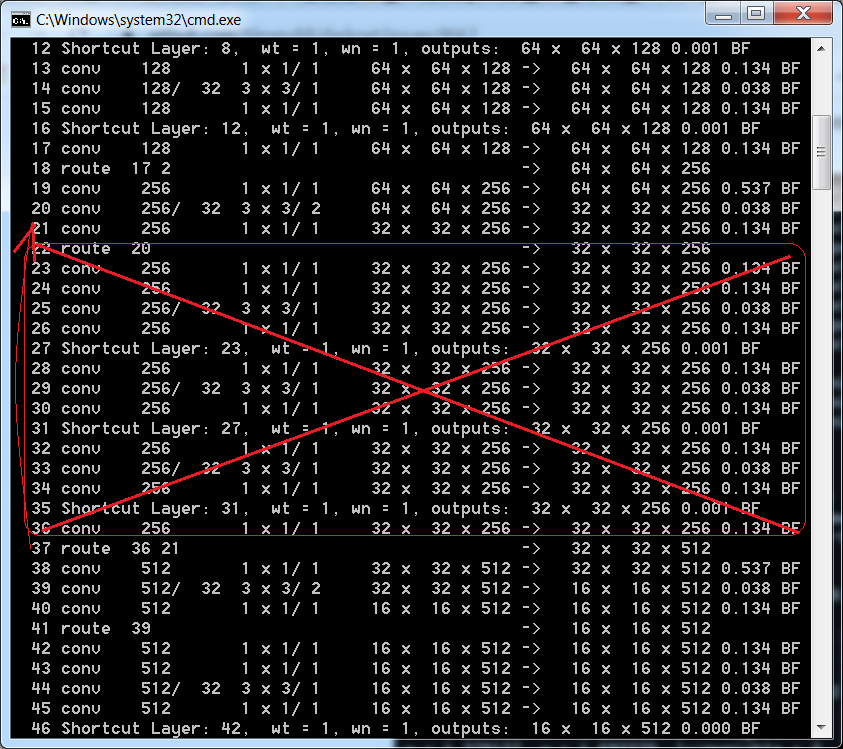
Yes, before Commits on Mar 14, 2020 https://github.com/AlexeyAB/darknet/commit/fb4da5ce5fe8339255a09974ed983fa44c3afbe9 instability and too high delta at the very beginning of training spoiled weights of shortcut, so [shortcut] layer-27 is disabled and doesn't work at all.
Only the CSP-connection saved the situation, otherwise the accuracy would be 0.
So with new Darknet code training should be much better.

So this part of code doesn't work at all.
AlexeyAB
on 19 Mar 2020
It is interesting to see what the results will be for csresnext50-ws-mi2.cfg.txt
Is this model still training?
AlexeyAB
on 19 Mar 2020
yes, currently 1173k iterations.
WongKinYiu
on 19 Mar 2020
@AlexeyAB
csresnext50-ws-mi2.cfg.txt: 79.9 top-1, 95.3 top-5.
WongKinYiu
on 20 Mar 2020
@WongKinYiu It seems this is the new top-result: https://github.com/WongKinYiu/CrossStagePartialNetworks/blob/master/imagenet/results.md
Can you share weights file? I will check weights of shortcut.
AlexeyAB
on 20 Mar 2020
@AlexeyAB
of course, csresnext50-ws-mi2-omega_final.weights
WongKinYiu
on 20 Mar 2020
@WongKinYiu I think we can combine csresnext50-ws-mi2 + csresnext50sub and train with the new repo.
AlexeyAB
on 20 Mar 2020
@WongKinYiu
csresnext50-ws-mi2.cfg.txt: 79.9 top-1, 95.3 top-5.
Some of weights are negative, but I just looked, this model uses softmax normalization, so negative values for it are not a problem

AlexeyAB
on 20 Mar 2020
@WongKinYiu
I created 2 new models:
- 40 FPS (618x618)
csresnext50sub + csresnext50-ws-mi2- csresnext50sub-mi2.cfg.txt
- 34 FPS (618x618) the same, just it uses
route+maxoutinstead ofweighted-shortcutcsresnext50sub-mo.cfg.txt
AlexeyAB
on 20 Mar 2020
csdarknet53-ws: 65.6 top-1, 87.3 top-5.
WongKinYiu
on 21 Mar 2020
@AlexeyAB
I created 2 new models:
- 40 FPS (618x618)
csresnext50sub + csresnext50-ws-mi2- csresnext50sub-mi2.cfg.txt- 34 FPS (618x618) the same, just it uses
route+maxoutinstead ofweighted-shortcutcsresnext50sub-mo.cfg.txt
Do you mean train with width=608 and height=608?
WongKinYiu
on 21 Mar 2020
@WongKinYiu No, train as usual 256x256.
608x608 it's just to know the final speed of the backbone of detector.
PS,
look at: https://github.com/AlexeyAB/darknet/issues/5079
AlexeyAB
on 21 Mar 2020
OK, start training.
WongKinYiu
on 21 Mar 2020
@AlexeyAB Hello,
i use 27 Feb repo for training bifpn model. 10a586140c99a905a504e6813b7cc629ff50ea42
but if i use latest code to test the performance, it gets totally wrong result.
is it because new repo use leaky relu instead of relu? d11caf486da34a562347db53c140900aef42140f
also, the inference speed of bifpn seems become very slow in latest repo.
update: csresnext50-bifpngamma: 512x512, 36.8/58.2/39.4.
WongKinYiu
on 26 Mar 2020
@WongKinYiu Hi,
It seems - yes, this is the reason, if there are negative or vely low weights. Try to set relu istead of lrelu temporary for testing.
(also I found that I missed fix relu to lrelu in these places: https://github.com/AlexeyAB/darknet/commit/d6181c67cd72468a3b8c658586452a5c6fa8fcbf and https://github.com/AlexeyAB/darknet/commit/2614a231f06894c1a89de0023735deb846958343 )
update: csresnext50-bifpngamma: 512x512, 36.8/58.2/39.4.
Can you share cfg/weights, I will check negative weights and speed?
Also try to check training time of lrelu and softmax if training speed is ~ the same, then may be better to use softmax, since during inference (Detection) weights normalization will be applied once at the initialization step https://github.com/AlexeyAB/darknet/blob/2614a231f06894c1a89de0023735deb846958343/src/network.c#L1101-L1194
so detection will have the same speed non vs relu vs softmax
For example, models csresnext50-ws-mi2.cfg.txt and csresnext50sub-mi2.cfg.txt from this topic use softmax weights normalization
AlexeyAB
on 26 Mar 2020
@WongKinYiu
Yes, the BiFPN module in this weights-file is totaly broken, since the most of weights are negative, i.e. them don't pass any information through weighted-[shortcut] layers.
But network wors because there are pass-through [route] layers before [yolo] layers.
Ways to solve this problem:
- for
weights_normalizion=reluuse the latest commit, which useslreluinstead ofrelu, constrains deltas by[-1;+1]and you should addburnin_update=2for each weighted-[shortcut]layer in cfg-file
- just use
weights_normalizion=softmax


AlexeyAB
on 26 Mar 2020
@WongKinYiu Hi,
Can you show ~ remaining time for models?
efficientnet-lite3.cfghttps://github.com/AlexeyAB/darknet/issues/4447#issuecomment-602907153- BiFPN-ASFF
csresnext50sub-spp-asff-bifpn-rfb-db.cfg.txthttps://github.com/WongKinYiu/CrossStagePartialNetworks/issues/6#issuecomment-601886281 - csresnext50sub-mi2.cfg.txt https://github.com/AlexeyAB/darknet/issues/4662#issuecomment-601973917
- csresnext50sub-mo.cfg.txt https://github.com/AlexeyAB/darknet/issues/4662#issuecomment-601973917
- csdarknet53-omega-mi.cfg.txt https://github.com/AlexeyAB/darknet/issues/5117#issuecomment-605460850
- csdarknet53-omega-mi-db.cfg.txt https://github.com/AlexeyAB/darknet/issues/5117#issuecomment-605460850
AlexeyAB
on 1 Apr 2020
@AlexeyAB
efficientnet-lite3: ~470 (459k/1200k)csresnext50sub-spp-asff-bifpn-rfb-db: no info (21 March repo, 49k/550k)csresnext50sub-mi2: no info (21 March repo, 480k/1200k)csresnext50sub-mo: no info (21 March repo, 440k/1200k)csdarknet53-omega-mi: ~480 (194k/1200k)csdarknet53-omega-mi-db: ~500 (190k/1200k)
WongKinYiu
on 2 Apr 2020
@WongKinYiu Thanks!
Can you check intermediate Top1/5 accuracy of models csdarknet53-omega-mi and csdarknet53-omega-mi-db ?
Depending on which model shows the accuracy higher, you can train one of these model (without or with DropBlock) - I implemented two Classification models with Input Pyramid (for fusion Spatial and Semantic information):
They may degrade the accuracy of the classifier, but should improve the accuracy of the detector.
Only -2.5% FPS.
https://arxiv.org/abs/1912.00632v2
The image pyramid is obtained by downsampling(linear interpolate) the input image into four levels with a factor of 2.
In these models: The image pyramid is obtained by downsampling(linear interpolate) the input image into five levels with a factor of 2.
AlexeyAB
on 2 Apr 2020
@AlexeyAB input pyramid looks very interesting. I just had an idea. Instead of downsampling by a linear interpolation, perhaps one could simply reshape the pyramid inputs by moving pixels around.
For example instead of downsampling (3,512,512) - > (3,256,256) we might be able to reshape (3,512,512) -> (12, 256, 256) with no information loss. I suppose the order would be (rgb,512,512) -> (rrrrggggbbbb,256,256), and it might generalize to any downsampling operation, perhaps in place of the maxpool layers for example in yolov3-tiny or the stride-2 convolutions in yolov3.
I'm not aware of any op that does this currently so it would have to be custom built somehow. What do you think?
glenn-jocher
on 2 Apr 2020
@glenn-jocher
About loosing information:
- It’s not definitely proven what is better: maxpool-stride=2, conv3x3-stride=2, reshape-stride=2, ... for Subsampling for Semantic information.
reshape-stride=2+conv1x1is very similar toconv3x3-stride=2- information is not lost in both cases due to 3x3 kernel-size. So we already useconv3x3-stride=2in all our networks.- in
maxpool-stride=2we lose some information, but to get coordinates we shouldn't lose spatial information, but to get objectness/classes we should lose spatial information to achieve shift-invariance. So in thecsresnext50sub-mi2.cfg.txtwe already use 2 branches withconv3x3-stride=2and withmaxpool-stride=2https://github.com/AlexeyAB/darknet/issues/4662#issuecomment-601908931
Yes, there are 2 reshape layers in the Darknet:
[reorg](pjreddie's version - it is broken https://github.com/opencv/opencv/pull/9705#discussion_r141268864 ) and new[reorg3d](slightly fixed version - but I'm not sure that it is correct for all input parameters, it is better to implement it from scratch) that was used in Yolo v2
I think reshape is more suitable for Semantic information rather than for Spatial information, but you can check it by training 2 models with Input Pyramid using [local_avgpool] and [reorg3d]Input Pyramid performs other task than to save information about details. The Input Pyramid is used to bring more Spatial information (even with local avgpool truncation) than is contained in Semantic information.

AlexeyAB
on 2 Apr 2020
@AlexeyAB
csdarknet53-omega-mi: 240k epoch, 34.4 top-1, 60.9 top-5.
csdarknet53-omega-mi-db: 240k epoch, 32.3 top-1, 58.1 top-5.
WongKinYiu
on 3 Apr 2020
@WongKinYiu If you want you can train csdarknet53-omega-mi-ip.cfg.txt
AlexeyAB
on 3 Apr 2020
@AlexeyAB currently 24k epoch.
WongKinYiu
on 3 Apr 2020
@WongKinYiu
csdarknet53-omega-mi: 240k epoch, 34.4 top-1, 60.9 top-5.
csdarknet53-omega-mi-db: 240k epoch, 32.3 top-1, 58.1 top-5.
Try to train this model
csdarknet53-omega-mi-db(with DropBlock) from the begining with the latest Darknet version, I fixed and checked DropBlock: https://github.com/AlexeyAB/darknet/commit/a9bae4f0326b4a841756d5b1a6ed37821f6a9467Also try to stop training of
csresnext50sub-spp-asff-bifpn-rfb-db.cfg.txtand resume it with the new code: https://github.com/WongKinYiu/CrossStagePartialNetworks/issues/6#issuecomment-601886281

AlexeyAB
on 3 Apr 2020
@AlexeyAB that's a very good point about reshaping layers that the regression may be more sensitive to small positional changes of the data than the obj/cls. I've always been worried about the loss of small spatial information as the image downsizes, especially for the smallest objects in P3.
That's also a very good point that downsampling operations are all 3x3 kernels, so they overlap enough that not much information should be lost. I'll try to experiment a bit with injecting the input pyramid in different areas.
One interesting thing about the samung paper was that they used a 7x7 kernel for the first convolution layer. I see this does not significantly affect the parameter count nor the FLOPS, but I also see the mixnet/efficientnet guys do not do this (they have 3x3 on conv0 like dn53), and I'm sure they must have experimented with it.
glenn-jocher
on 3 Apr 2020
@glenn-jocher
One interesting thing about the samung paper was that they used a 7x7 kernel for the first convolution layer.
conv 5x5-7x7-9x9 should be used for stride=2 rather than for the 1st layer.
mixnet guys said - for layers with stride 2, a larger kernel can significantly improve the accuracy.: https://arxiv.org/pdf/1907.09595v3.pdf
As shown in the figure, large kernel size has
different impact on different layers: for most of layers, the accuracy doesn’t change much,
but for certain layers with stride 2, a larger kernel can significantly improve the accuracy.
Notably, although MixConv3579 uses only half parameters and FLOPS than the vanilla
DepthwiseConv9x9, our MixConv achieves similar or slightly better performance for
most of the layers.
AlexeyAB
on 4 Apr 2020
@AlexeyAB @glenn-jocher
Hello,
Reshape (reorg) layer is usually used in the models of depth prediction and semantic segmentation. They usually called the process of "reorg/reversed reorg" as "spatial to depth (channel)/depth (channel) to spatial" tensorflow layer. I have changed the downsampling/upsampling layers to reorg/reversed reorg of Elastic, and it got a little bit accuracy improvement.
Also, there is a paper in CVPR 2020 use this technique, for your reference MuxConv.


WongKinYiu
on 4 Apr 2020
@WongKinYiu
I have changed the downsampling/upsampling layers to reorg/reversed reorg of Elastic, and it got a little bit accuracy improvement.
Did you use [reorg] or [reorg3d]?
Since original [reorg] layer has a bug: https://github.com/opencv/opencv/pull/9705#discussion_r143136536
AlexeyAB
on 4 Apr 2020
@AlexeyAB i used [reorg3d].
WongKinYiu
on 4 Apr 2020
@AlexeyAB
CSPResNeXt-50 default BoF+MISH : top-1 = 79.8%, top-5 = 95.2%
csresnext50-ws.cfg.txt top-1 = 78.7%, top-5 = 94.7% negative weights, should be used burnin_update=2 and may be weights_normalizion=softmax more about it
csresnext50-ws-mi2.cfg.txt : top-1 = 79.9%, top-5 = 95.3%
csresnext50morelayers.cfg.txt : top-1 = 79.4%, top-5 = 95.2% url
csresnext50sub.cfg.txt : top-1 = 79.5%, top-5 = 95.3% url
csresnext50sub-mi2.cfg.txt: top-1 = 79.4%, top-5 = 95.3%, weights
csresnext50sub-mo.cfg.txt: top-1 = 79.2%, top-5 = 95.1%, weights
CSPDarknet-53 default BoF+MISH : top-1 = 78.7%, top-5 = 94.8%
csdarknet53-ws.cfg.txt top-1 = 65.6%, top-5 = 87.3%
csdarknet53-omega-mi.cfg.txt: top-1 = 78.6%, top-5 = 94.7%, weights
csdarknet53-omega-mi-db.cfg.txt: top-1 = 78.4%, top-5 = 94.5%
csdarknet53-omega-mi-ip.cfg.txt: top-1 = 77.8%, top-5 = 94.3%
WongKinYiu
on 23 Apr 2020
@WongKinYiu
Can you add Top1/Top5 accuracy and attach weights-file for this model
csdarknet53-ws.cfg.txt
https://github.com/AlexeyAB/darknet/issues/4498#issuecomment-592191368
cfg files: https://github.com/AlexeyAB/darknet/issues/4662#issuecomment-587490873
AlexeyAB
on 1 May 2020
Related issues
 off99555
·
3Comments
off99555
·
3Comments
 qianyunw
·
3Comments
qianyunw
·
3Comments
 Yumin-Sun-00
·
3Comments
Yumin-Sun-00
·
3Comments
 Jacky3213
·
3Comments
Jacky3213
·
3Comments
 Greta-A
·
3Comments
Greta-A
·
3Comments
Most helpful comment
Comparison on my dataset, all cases with same training settings and used MS COCO detector pre-trained weights, only different in backbone
| Model | [email protected]| [email protected]| precision(.7) | recall(.7)| inference time(416x416)|
| --- | --- | --- | --- | --- | --- |
|yolov3| 91.79%| 63.09% |0.95| 0.71| 13.25ms|
|csresnext50-panet|92.80%|64.16%|0.96|0.67|15.61ms |
|darknet53-bifpn3(P3-5)|91.74%|63.48%|0.95|0.71|15.25ms|
ALL network has SPP-layer, inference time test on RTX 2080Ti, BiFPN block use
darkenet53-bifpn3-sppgot very similar performance withyolov3-spp, I think the reason could beyolov3-sppthe option of next step could be
but recently my machines was occupied by other task, I will try further experiment when GPUs got free