Dagger: How can I create only one instance of object for each sub component ?
How can I create only one instance of object for each sub component ?
I use dagger android, I have this scopes
AppScope
ActiivtyScope
FragmentScope
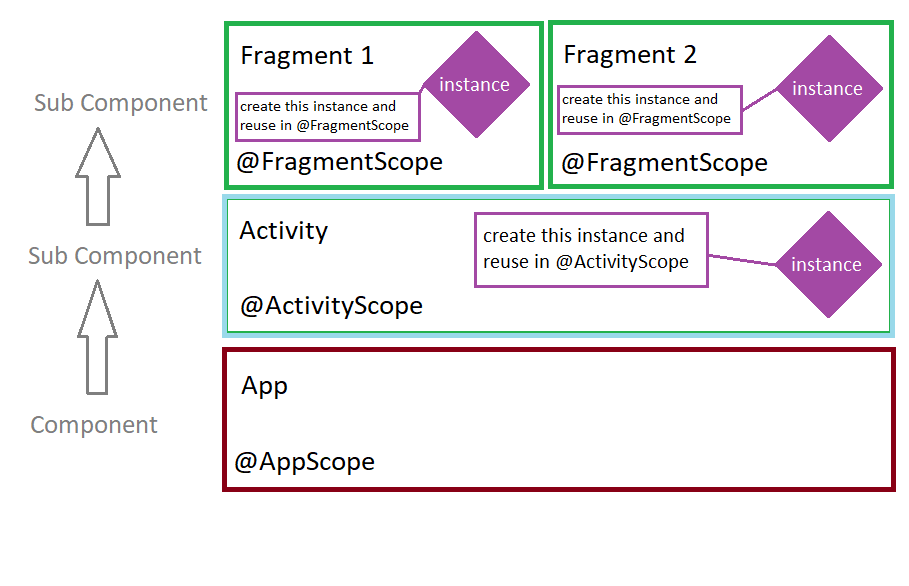
Lets say I have an activity with two fragments, how can I create a new instance of X object for my Activity and for each of fragments separately ?
 RobertApikyan
All 20 comments
I'm not familiar with them, but maybe @Reusable scope?
 tbroyer
on 15 Feb 2018
tbroyer
on 15 Feb 2018
The @Reusable scope will create instance of X object for @AppScope and provide the same instance for @ActivityScope and for @FragmentScope, seance they are Sub Component scopes ( AppComponent -> XActivitySubComponent -> XFragmentSubcomponent ), I mean the same instance will be injected for Activity and Fragment, @Reusable is not solve the problem, thanks for answer
RobertApikyan
on 15 Feb 2018
If you define your own scope and apply it to a subcomponent, any binding with that scope will achieve what you're searching to do.
Example:
@Scope
@interface RobertScope {}

@RobertScope
@Subcomponent(modules = RobertModule.class)
interface ActivitySubcomponent {
  ActivityScopedObject a();
}

@Module
class RobertModule {
  @Provides
  @RobertScope
  ActivityScopedObject a() {
   return ...
  }
}
@tbroyer @Reusable _may_ be shifted down the component tree if it is unused in the parent that defines it, but if you _need_ specific characteristics, a regular scope is the way to go.
 ronshapiro
on 15 Feb 2018
ronshapiro
on 15 Feb 2018
Thanks for answer
But I think you got my question wrong, let me formulate it in another way:
I want to create and reuse the created instances in each sub component, for more details please see attached image, thank you in advance for you feedback
RobertApikyan
on 15 Feb 2018
Yup, that's what happens. Every time a new instance of a component is created, it has it's own new set of scoped bindings.
ronshapiro
on 15 Feb 2018
But in this case what is my instance's scope ?
- if it is annotated with @FragmentScope the compilation will fail, because my activity is in the @ActivityScope but the instance I want to inject is annotates @FragmentScope).
- if the instance is annotated with @ActivityScope
, than it will be shared for Fragment1 and Fragment2, since they are sub components for activity component
RobertApikyan
on 15 Feb 2018
Oh, you want _one_ binding that will have a separate instance for each of them? There's no built-in way to do that.
You could probably hack something together with Map multibindings, i.e. Map<Class<? extends Annotation> /* scope class */, YourBinding> if you want.
ronshapiro
on 15 Feb 2018
Yes, you understand the issue correctly, I solve the issue, and put the fragmens and activities under one single scope, @Screen scope, and they are both subcomponents for the @AppScope
RobertApikyan
on 15 Feb 2018
@RobertApikyan
Have you tried composing your objects? Based on your scope hierarchy.
 JonathanMerritt
on 20 Feb 2018
JonathanMerritt
on 20 Feb 2018
Yes, Shure. But I need to bind a new object to every sub scope, this I think is an injection pattern
RobertApikyan
on 21 Feb 2018
Not sure if I understand totally...
This is what I mean, at least one way of doing it.
abstract class BaseType<T extends BaseType> {
  final T type;

  BaseType(T type){ this.type = type; }
}

@AppScope class AppType extends BaseType {
  @Inject AppType(){  super(null); }

  void appThing(){}
}

@ActivityScope class ActivityType extends BaseType<AppType> {
  @Inject ActivityType(AppType type){ super(type); }

  void appThing(){ type.appThing(); }

  void activityThing(){}
}

@FragmentScope class FragmentType extends BaseType<ActivityType> {
  @Inject FragmentType(ActivityType type){ super(type); }

  void appThing(){ type.appThing(); }

  void activityThing(){ type.activityThing(); }

  void fragmentThing(){}
}
Probably more then you would want to do. But it's not too bad as long as you don't have a large amount of scopes.
JonathanMerritt
on 21 Feb 2018
thanks for the example,
But I think you got my question wrong.
Imagine the situation when my activityComponent (@ActivityScope) is subcomponent for the appComponent(@AppScope) and the fragmentComponent(@FragmentScope) is the subComponent for the activityComponent.
I have an HomeActivity which contains two fragments, with specified scopes ( StatisticsFragment and the RequestsFragment)
Now I need to create a new instance of some object (lets call it X object) one for my HomeActivity, one for StatisticsFragment and one for RequestsFragment and reuse thins objects, I mean if I already have created this object for my RequestsFragment I want to reuse it for RequestsFragmentPresenter and for RequestsRepository, and the same behevior for HomeActivity and StatisticsFragment.
Now the problem is that when I create the instance of X object for my HomeActivity, it passes the same created object from HomeActiviy to RequestsFragment and StatisticsFragment.
- if X is annotated with @FragmentScope the compilation will fail, because my activity is in the @ActivityScope but the instance I want to inject is annotates @FragmentScope).
- if the X instance is annotated with @ActivityScope
, than it will be shared for Fragment1 and Fragment2, since they are sub components for activity component
You can see the diagram here
RobertApikyan
on 21 Feb 2018
Ah, I think I understand now. Actually sounds like it's more of an Activity/Fragment lifecycle issue, not injection.
I'm guessing you'd want the object cleared when its supplying activity or fragment is destroyed etc...
JonathanMerritt
on 21 Feb 2018
Not so close, the issue is to create new Instance of X object once for every sub scope, and reuse the instance in its scope, for HomeActivity and for 2 child fragments I need 3 new instances of X object
RobertApikyan
on 21 Feb 2018
Sorry I couldn't help.
I hope you get something figured out.
JonathanMerritt
on 21 Feb 2018
it's Ok,
Thank you
I solve the issue, and put the fragmens and activities under one single scope, @screen scope, and they are both subcomponents for the @AppScope
RobertApikyan
on 21 Feb 2018
@RobertApikyan Hello Robert, I'm stuck in the same problem you had before so please can you tell me in details how you managed it ?
 Badranh
on 30 Apr 2019
Badranh
on 30 Apr 2019
Hi, sorry for late answer ...
Вторник, 30 апреля 2019, 21:53 +04:00 от Hasan Badran notifications@github.com:
@RobertApikyan Hello Robert, I'm stuck in the same problem you had before so please can you tell me in details how you managed it ?
—
You are receiving this because you were mentioned.
Reply to this email directly, view it on GitHub , or mute the thread .
С уважением,
Robert Apikyan
[email protected]
RobertApikyan
on 2 May 2019
If you want to have different instances in the Component and in it's Sub-components, The problem can not be resolved, dagger do not support such a dependency schema,
I have crated the custom Scope ( @ScreenScope ) and applied it to my activity and to it's child fragments, so now the activity and it's child fragments do not share any objects,
not a perfect solution it, but this was the only one for that time ... To be honest now i'm trying to avoid using of dagger in my projects, overall it's a good library, but in this common case it does not provide valid solution ...
Четверг, 2 мая 2019, 13:19 +04:00 от Robert Apikyan robertapikyan@mail.ru:
Hi, sorry for late answer ...
Вторник, 30 апреля 2019, 21:53 +04:00 от Hasan Badran < [email protected] >:
@RobertApikyan Hello Robert, I'm stuck in the same problem you had before so please can you tell me in details how you managed it ?
—
You are receiving this because you were mentioned.
Reply to this email directly, view it on GitHub , or mute the thread .С уважением,
Robert Apikyan
[email protected]
С уважением,
Robert Apikyan
[email protected]
RobertApikyan
on 2 May 2019
@RobertApikyan Thanks man!
Badranh
on 2 May 2019
Related issues
 AdityaAnand1
·
36Comments
AdityaAnand1
·
36Comments
 ColtonIdle
·
29Comments
ColtonIdle
·
29Comments
 mnayef95
·
20Comments
mnayef95
·
20Comments
 consp1racy
·
37Comments
consp1racy
·
37Comments
 charbgr
·
27Comments
charbgr
·
27Comments
Most helpful comment
it's Ok,
Thank you
I solve the issue, and put the fragmens and activities under one single scope, @screen scope, and they are both subcomponents for the @AppScope