Describe the bug
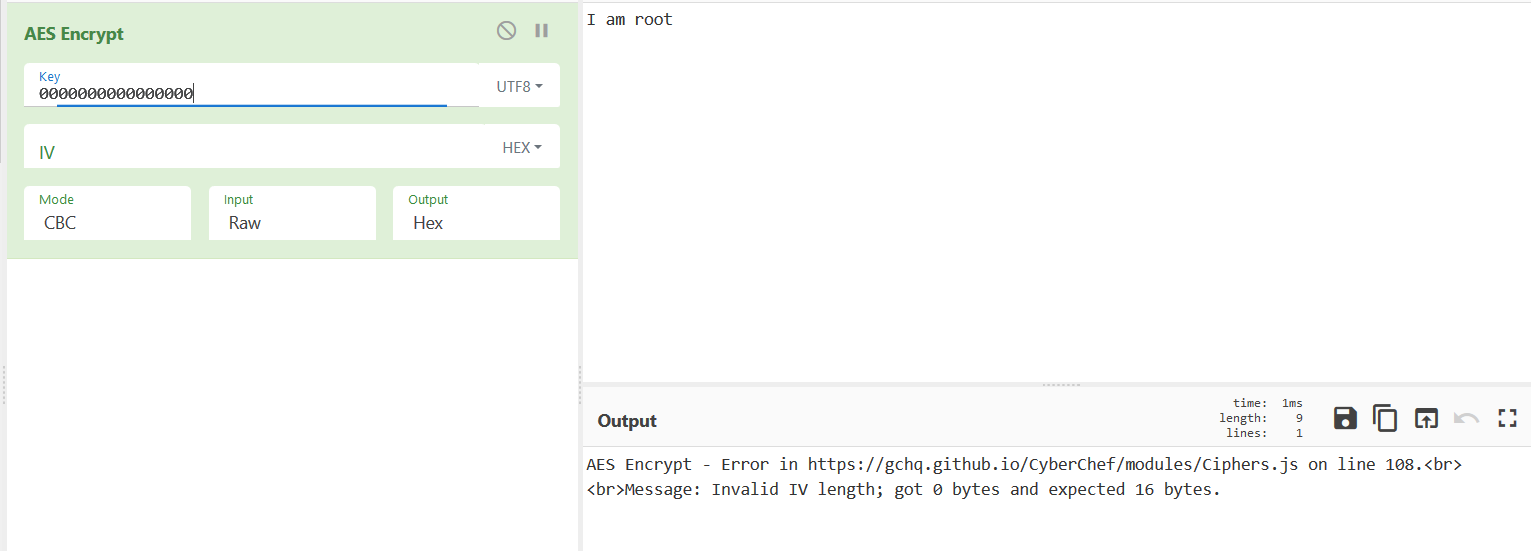
When trying to encrypt a string using AES Encrypt and adding a key (either 16, 24 or 32 bytes) it gives an error. You can see the image I will attach later.
To Reproduce
Steps to reproduce the behaviour or a link to the recipe / input used to cause the bug:
 thejoker3000
All 3 comments
Changing all the zeros for other characters makes the same error.
thejoker3000
on 15 Apr 2020
Most AES modes require a non-empty initialisation vector to be considered secure, the exception to that is ECB mode since it doesn't intermix the output of a block with the next plaintext block.
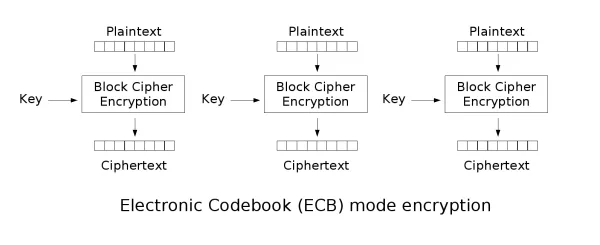
CBC(the mode in this case) does intermix the plaintext block with the output of the previous encrypted block. Hence, to initiate this process for the first plaintext block, an additional input value is required to be mixed with the first block, which is referred to as an initialisation vector(IV).

 n1073645
on 16 Apr 2020
n1073645
on 16 Apr 2020
Both AES encrypt and decrypt operations state the following;
The Initialization Vector should be 16 bytes long. If not entered, it will default to 16 null bytes.
Since it does not default to 16 bytes long when left empty the above text should be modified to reflect this updated requirement.
 dsmackie
on 28 Dec 2020
dsmackie
on 28 Dec 2020
Related issues
 danielzgtg
·
4Comments
danielzgtg
·
4Comments
 n1474335
·
4Comments
n1474335
·
4Comments
 nmantani
·
3Comments
n1474335
·
6Comments
nmantani
·
3Comments
n1474335
·
6Comments
 joshbarth
·
3Comments
joshbarth
·
3Comments
Most helpful comment
Most AES modes require a non-empty initialisation vector to be considered secure, the exception to that is ECB mode since it doesn't intermix the output of a block with the next plaintext block.
CBC(the mode in this case) does intermix the plaintext block with the output of the previous encrypted block. Hence, to initiate this process for the first plaintext block, an additional input value is required to be mixed with the first block, which is referred to as an initialisation vector(IV).