Cvxpy: DCPError : expr.is_dcp() returns False for expressions of the form w.T@w
Describe the bug
Any expression of the form x.T@P@x in cvxpy gives DCPError. When checked if the expression is DCP or not, expr.is_dcp() return False.
To Reproduce
import cvxpy as cp
import numpy as np

alphas = cp.Variable((2*NUM,1))
Cd = cp.Parameter()
Cd.value = 0.95

alphas_constraint_1 = [alphas[i] >=0 for i in range(2*NUM)]
alphas_constraint_2 = [alphas[i] <= Cd for i in range(2*NUM)]
alpha_y_constraint = [alphas.T@y == 0]

constraints = alphas_constraint_1 + alphas_constraint_2 + alpha_y_constraint

K = y[:,None]*x
K = np.dot(K,K.T)

objective_dual = cp.Minimize(-cp.sum(alphas)+alphas.T@K@alphas)

prob_dual = cp.Problem(objective_dual,constraints)
Expected behavior
As shown in various examples on the cvxpy tutorials, the above problem is expected to run without failure.
Version
- OS: Windows 10
- CVXPY Version: 1.1.0a3
Additional context
The problem I am trying to solve here is the dual form of SVM
Link to question posted on Stackoverflow
 sadimanna
All 3 comments
You need to use the quad_form atom, as in quad_form(x, P).
 SteveDiamond
on 10 Mar 2020
SteveDiamond
on 10 Mar 2020
@sadimanna , please read the documentation on DCP here: https://www.cvxpy.org/tutorial/dcp/index.html
DCP is a grammar for constructing convex expressions, using a simple composition rule. Once you learn this grammar (it's just one rule), you should be able to easily express essentially any convex expression in CVXPY.
 akshayka
on 10 Mar 2020
akshayka
on 10 Mar 2020
You need to use the
quad_formatom, as inquad_form(x, P).
@SteveDiamond @akshayka
I have tried using
-cp.sum(alphas)+0.5*cp.quad_form(alphas,K)
But I still get the same error
DCPError: Problem does not follow DCP rules. Specifically:
The objective is not DCP. Its following subexpressions are not:
QuadForm(var14052, [[ 1.83491803  1.75045974  2.28622267 ... -4.39732493 -5.00052443
  -3.77439719]
 [ 1.75045974  2.34203535  2.34179792 ... -5.44176538 -5.89979043
  -4.35890149]
 [ 2.28622267  2.34179792  2.8869991  ... -5.77716101 -6.50063002
  -4.88412578]
 ...
 [-4.39732493 -5.44176538 -5.77716101 ... 12.85096644 14.07871791
  10.45176273]
 [-5.00052443 -5.89979043 -6.50063002 ... 14.07871791 15.52527056
  11.56008668]
 [-3.77439719 -4.35890149 -4.88412578 ... 10.45176273 11.56008668
   8.61922173]])
I tried running this piece of code
 expr = cp.quad_form(alphas,K)
 print(expr.curvature)
I get output UNKNOWN
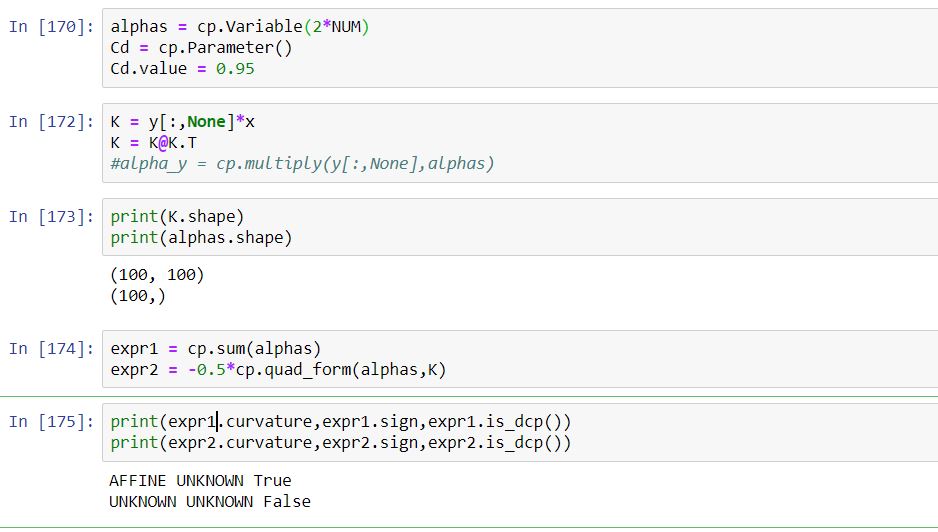
sadimanna
on 10 Mar 2020
Related issues
 aliirmak
·
5Comments
aliirmak
·
5Comments
 gabriel80808
·
4Comments
gabriel80808
·
4Comments
 rbf22
·
7Comments
rbf22
·
7Comments
 gbanjac
·
9Comments
gbanjac
·
9Comments
 wrossmorrow
·
5Comments
wrossmorrow
·
5Comments