Cosmos-sdk: State load issue when applying upgrades
Summary of Bug
Software upgrades are not happening, failing with following reason
BINARY UPDATED BEFORE TRIGGER! UPGRADE "test1" - in binary but not executed on chain module=main
Version
latest: 0.38+
Steps to Reproduce
I have used wasmd for testing as it is using latest release (Gaia doens't have a release for 0.38+)
- Start Testnet (Use voting period as minimal as possible, I have used 5min window)
- Create a software upgrade proposal, Deposit, Vote -- Ensure proposal is passed
Wait for the binary to stop at expected height
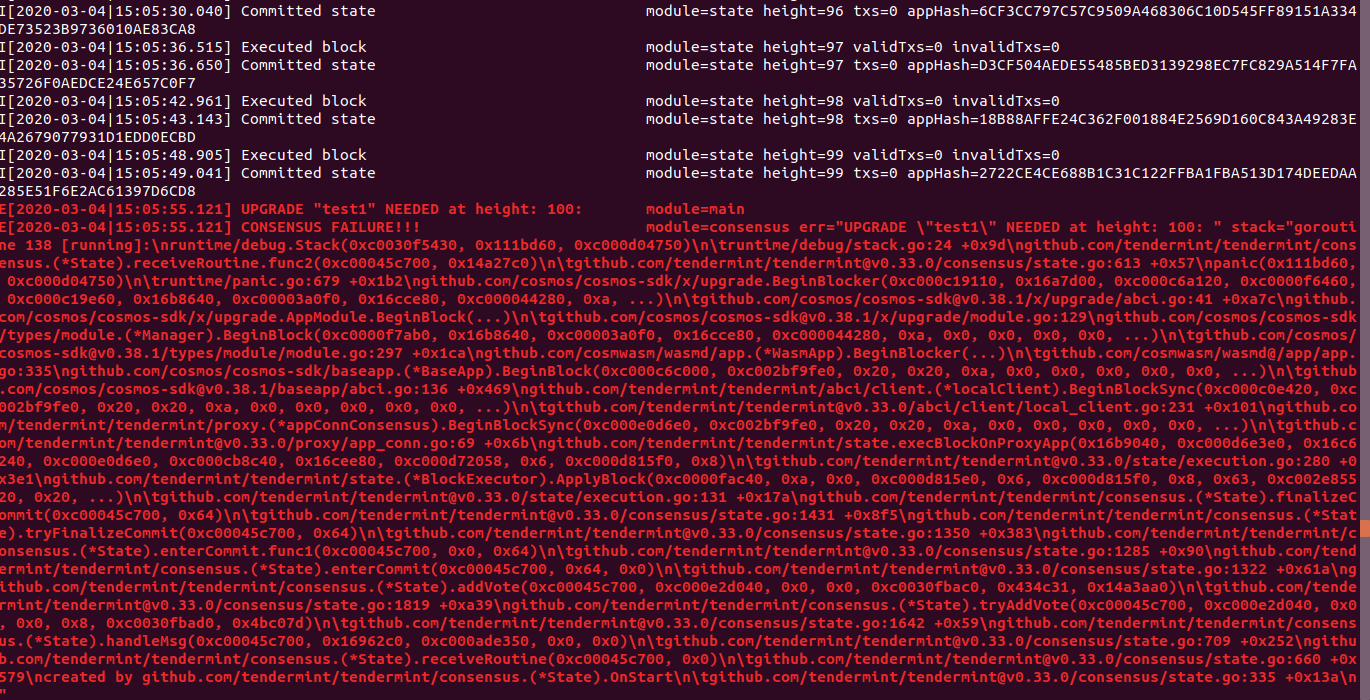
Add an upgrade handler and compile a new binary
        app.upgradeKeeper.SetUpgradeHandler("test1", func(ctx sdk.Context, plan upgrade.Plan) {

    })
- Run the binary
---- It fails here ----
I tried to add some debug logs here (https://github.com/confio/cosmos-sdk/compare/v0.38.6...vitwit:v_38_6_1?expand=1) and found this:

The state should have the last blockheight i.e., ctx.BlockHeight() as 100 in the example but it's coming as 80
P.S: This might be causing some issues (no strong evidence though): https://github.com/cosmos/cosmos-sdk/pull/5579/
/cc @aaronc @alexanderbez @AdityaSripal
For Admin Use
- [ ] Not duplicate issue
- [ ] Appropriate labels applied
- [ ] Appropriate contributors tagged
- [ ] Contributor assigned/self-assigned
 anilCSE
All 26 comments
I tried to compile old binary again with these logs enabled, here is what I have. upgrade#BeginBlocker executed from 80-100th block continuously, and panic'd again at 100th height.
ShouldExecute::: Plan.Height=100, ctx.BlockHeight()=80

 ShouldExecute:::p.Time.IsZero()=true, ctx.BlockTime().Before(p.Time)=false

 ShouldExecute::: Plan.Height=100, ctx.BlockHeight()=81

 ShouldExecute:::p.Time.IsZero()=true, ctx.BlockTime().Before(p.Time)=false

 ShouldExecute::: Plan.Height=100, ctx.BlockHeight()=82

 ShouldExecute:::p.Time.IsZero()=true, ctx.BlockTime().Before(p.Time)=false

 ShouldExecute::: Plan.Height=100, ctx.BlockHeight()=83

 ShouldExecute:::p.Time.IsZero()=true, ctx.BlockTime().Before(p.Time)=false

 ShouldExecute::: Plan.Height=100, ctx.BlockHeight()=84

 ShouldExecute:::p.Time.IsZero()=true, ctx.BlockTime().Before(p.Time)=false

 ShouldExecute::: Plan.Height=100, ctx.BlockHeight()=85

 ShouldExecute:::p.Time.IsZero()=true, ctx.BlockTime().Before(p.Time)=false

 ShouldExecute::: Plan.Height=100, ctx.BlockHeight()=86

 ShouldExecute:::p.Time.IsZero()=true, ctx.BlockTime().Before(p.Time)=false

 ShouldExecute::: Plan.Height=100, ctx.BlockHeight()=87

 ShouldExecute:::p.Time.IsZero()=true, ctx.BlockTime().Before(p.Time)=false

 ShouldExecute::: Plan.Height=100, ctx.BlockHeight()=88

 ShouldExecute:::p.Time.IsZero()=true, ctx.BlockTime().Before(p.Time)=false

 ShouldExecute::: Plan.Height=100, ctx.BlockHeight()=89

 ShouldExecute:::p.Time.IsZero()=true, ctx.BlockTime().Before(p.Time)=false

 ShouldExecute::: Plan.Height=100, ctx.BlockHeight()=90

 ShouldExecute:::p.Time.IsZero()=true, ctx.BlockTime().Before(p.Time)=false

 ShouldExecute::: Plan.Height=100, ctx.BlockHeight()=91

 ShouldExecute:::p.Time.IsZero()=true, ctx.BlockTime().Before(p.Time)=false

 ShouldExecute::: Plan.Height=100, ctx.BlockHeight()=92

 ShouldExecute:::p.Time.IsZero()=true, ctx.BlockTime().Before(p.Time)=false

 ShouldExecute::: Plan.Height=100, ctx.BlockHeight()=93

 ShouldExecute:::p.Time.IsZero()=true, ctx.BlockTime().Before(p.Time)=false

 ShouldExecute::: Plan.Height=100, ctx.BlockHeight()=94

 ShouldExecute:::p.Time.IsZero()=true, ctx.BlockTime().Before(p.Time)=false

 ShouldExecute::: Plan.Height=100, ctx.BlockHeight()=95

 ShouldExecute:::p.Time.IsZero()=true, ctx.BlockTime().Before(p.Time)=false

 ShouldExecute::: Plan.Height=100, ctx.BlockHeight()=96

 ShouldExecute:::p.Time.IsZero()=true, ctx.BlockTime().Before(p.Time)=false

 ShouldExecute::: Plan.Height=100, ctx.BlockHeight()=97

 ShouldExecute:::p.Time.IsZero()=true, ctx.BlockTime().Before(p.Time)=false

 ShouldExecute::: Plan.Height=100, ctx.BlockHeight()=98

 ShouldExecute:::p.Time.IsZero()=true, ctx.BlockTime().Before(p.Time)=false

 ShouldExecute::: Plan.Height=100, ctx.BlockHeight()=99

 ShouldExecute:::p.Time.IsZero()=true, ctx.BlockTime().Before(p.Time)=false

 ShouldExecute::: Plan.Height=100, ctx.BlockHeight()=100
 ShouldExecute:::p.Time.IsZero()=true, ctx.BlockTime().Before(p.Time)=false
E[2020-03-04|17:58:13.214] UPGRADE "test1" NEEDED at height: 100:       module=main
panic: UPGRADE "test1" NEEDED at height: 100:

goroutine 1 [running]:
github.com/cosmos/cosmos-sdk/x/upgrade.BeginBlocker(0xc000117140, 0x16a82c0, 0xc0001cd9e0, 0xc0001181c0, 0xc000198c90, 0x16b8c00, 0xc0000c8010, 0x16cd440, 0xc001008940, 0xa, ...)
    github.com/cosmos/[email protected]/x/upgrade/abci.go:41 +0xa7c
github.com/cosmos/cosmos-sdk/x/upgrade.AppModule.BeginBlock(...)
    github.com/cosmos/[email protected]/x/upgrade/module.go:129
github.com/cosmos/cosmos-sdk/types/module.(*Manager).BeginBlock(0xc000118e00, 0x16b8c00, 0xc0000c8010, 0x16cd440, 0xc001008940, 0xa, 0x0, 0x0, 0x0, 0x0, ...)
    github.com/cosmos/[email protected]/types/module/module.go:297 +0x1ca
github.com/cosmwasm/wasmd/app.(*WasmApp).BeginBlocker(...)
    github.com/cosmwasm/wasmd@/app/app.go:339
github.com/cosmos/cosmos-sdk/baseapp.(*BaseApp).BeginBlock(0xc000338780, 0xc0020ae0a0, 0x20, 0x20, 0xa, 0x0, 0x0, 0x0, 0x0, 0x0, ...)
    github.com/cosmos/[email protected]/baseapp/abci.go:136 +0x469
github.com/tendermint/tendermint/abci/client.(*localClient).BeginBlockSync(0xc000475380, 0xc0020ae0a0, 0x20, 0x20, 0xa, 0x0, 0x0, 0x0, 0x0, 0x0, ...)
    github.com/tendermint/[email protected]/abci/client/local_client.go:231 +0x101
github.com/tendermint/tendermint/proxy.(*appConnConsensus).BeginBlockSync(0xc000b59290, 0xc0020ae0a0, 0x20, 0x20, 0xa, 0x0, 0x0, 0x0, 0x0, 0x0, ...)
    github.com/tendermint/[email protected]/proxy/app_conn.go:69 +0x6b
github.com/tendermint/tendermint/state.execBlockOnProxyApp(0x16b9600, 0xc000eec3a0, 0x16c6800, 0xc000b59290, 0xc000e54e00, 0x16cf440, 0xc0000cc518, 0x6, 0xc000bd8ec8, 0x8)
    github.com/tendermint/[email protected]/state/execution.go:280 +0x3e1
github.com/tendermint/tendermint/state.(*BlockExecutor).ApplyBlock(0xc000304d90, 0xa, 0x0, 0xc000bd8eb6, 0x6, 0xc000bd8ec8, 0x8, 0x63, 0xc000b6c520, 0x20, ...)
    github.com/tendermint/[email protected]/state/execution.go:131 +0x17a
github.com/tendermint/tendermint/consensus.(*Handshaker).replayBlock(0xc0034ff0b0, 0xa, 0x0, 0xc000bd8eb6, 0x6, 0xc000bd8ec8, 0x8, 0x63, 0xc000b6c520, 0x20, ...)
    github.com/tendermint/[email protected]/consensus/replay.go:475 +0x233
github.com/tendermint/tendermint/consensus.(*Handshaker).replayBlocks(0xc0034ff0b0, 0xa, 0x0, 0xc000bd8eb6, 0x6, 0xc000bd8ec8, 0x8, 0x63, 0xc000b6c520, 0x20, ...)
    github.com/tendermint/[email protected]/consensus/replay.go:455 +0x3f3
github.com/tendermint/tendermint/consensus.(*Handshaker).ReplayBlocks(0xc000ed10b0, 0xa, 0x0, 0xc000bd8eb6, 0x6, 0xc000bd8ec8, 0x8, 0x63, 0xc000b6c520, 0x20, ...)
    github.com/tendermint/[email protected]/consensus/replay.go:386 +0xeef
github.com/tendermint/tendermint/consensus.(*Handshaker).Handshake(0xc0034ff0b0, 0x16d0140, 0xc0001ee7e0, 0x80, 0x11653e0)
    github.com/tendermint/[email protected]/consensus/replay.go:269 +0x485
github.com/tendermint/tendermint/node.doHandshake(0x16cf440, 0xc0000cc518, 0xa, 0x0, 0xc000bd8eb6, 0x6, 0xc000bd8ec8, 0x8, 0x63, 0xc000b6c520, ...)
    github.com/tendermint/[email protected]/node/node.go:281 +0x19a
github.com/tendermint/tendermint/node.NewNode(0xc000e8c780, 0x16b2f00, 0xc00017c000, 0xc0010135d0, 0x16969c0, 0xc000f22120, 0xc001013800, 0x14a2bb8, 0xc001013810, 0x16b9600, ...)
    github.com/tendermint/[email protected]/node/node.go:597 +0x343
github.com/cosmos/cosmos-sdk/server.startInProcess(0xc000e7e980, 0x14a33e0, 0x1d, 0x0, 0x0)
    github.com/cosmos/[email protected]/server/start.go:157 +0x4c1
github.com/cosmos/cosmos-sdk/server.StartCmd.func1(0xc000e9bb80, 0x21dab20, 0x0, 0x0, 0x0, 0x0)
    github.com/cosmos/[email protected]/server/start.go:67 +0xb4
github.com/spf13/cobra.(*Command).execute(0xc000e9bb80, 0x21dab20, 0x0, 0x0, 0xc000e9bb80, 0x21dab20)
    github.com/spf13/[email protected]/command.go:826 +0x460
github.com/spf13/cobra.(*Command).ExecuteC(0xc000b84c80, 0x133d5d5, 0xc0001ffe90, 0x58c992)
    github.com/spf13/[email protected]/command.go:914 +0x2fb
github.com/spf13/cobra.(*Command).Execute(...)
    github.com/spf13/[email protected]/command.go:864
github.com/tendermint/tendermint/libs/cli.Executor.Execute(0xc000b84c80, 0x14a3800, 0x1320600, 0x10)
    github.com/tendermint/[email protected]/libs/cli/setup.go:89 +0x3c
main.main()
    github.com/cosmwasm/wasmd@/cmd/wasmd/main.go:72 +0x849
The state load works fine when node is started with gaiad start --prune nothing, else it's unable to load height after restart
 sahith-narahari
on 4 Mar 2020
sahith-narahari
on 4 Mar 2020
Yes, wasmd start --pruning nothing is working
anilCSE
on 4 Mar 2020
This probably ties into some of the pruning changes @AdityaSripal worked on. IIRC, versions are only persisted to disk every snapshot-every interval. Correct me if I'm wrong @AdityaSripal.
 alexanderbez
on 4 Mar 2020
alexanderbez
on 4 Mar 2020
My initial thoughts are
The upgrade module should be able to programmatically interact with pruning so that a programmed upgrade block is always persisted to disk.
Let's figure out how to support this.
 zmanian
on 21 Mar 2020
zmanian
on 21 Mar 2020
Yeah so this is probably a 100% blocker for the next major release and should be addressed on the current 0.38 line too.
I'm having a hard time understanding the exact problem. Can the issue be stated more precisely?
In this example, the upgrade plan passed (at some height?) and was to be executed at block 100, right? When block 100 hit, the binary halted due to a consensus failure. Not sure why, but how would the ability (or lack thereof) to load previous state give a consensus failure?
alexanderbez
on 21 Mar 2020
Here is what I'm imagining happens.
You set the upgrade height. The blockchain halts.
The upgrade manager goes to export for-zero-height from the height. The height isn't persisted to disk. This fails and then the upgrade doesn't proceed.
Not sure exactly why the consensus failure happens though.
zmanian
on 21 Mar 2020
The panic is expected behavior I think.
To perform the actual halt of the blockchain, the upgrade keeper simply panics which prevents the ABCI state machine
from proceeding but doesn't actually exit the process. Exiting the process can cause issues for other nodes that start
to lose connectivity with the exiting nodes, thus this module prefers to just halt but not exit.
https://github.com/cosmos/cosmos-sdk/blob/master/x/upgrade/doc.go#L99-L101
zmanian
on 21 Mar 2020
Upgrade handler checks for anyof plan.Height and plan.Time to match with ctx block time/ block height.
Relevant code here:
https://github.com/cosmos/cosmos-sdk/blob/master/x/upgrade/abci.go#L25-L26
Since, ctx.BlockHeight() and ctx.BlockTime() returning the persisted block details, which is different than expected current block, the binary is panicing.
Relevant code here:
https://github.com/cosmos/cosmos-sdk/blob/master/x/upgrade/abci.go#L60-L64
anilCSE
on 21 Mar 2020
The panic is expected behavior I think.
To perform the actual halt of the blockchain, the upgrade keeper simply panics which prevents the ABCI state machine
from proceeding but doesn't actually exit the process. Exiting the process can cause issues for other nodes that start
to lose connectivity with the exiting nodes, thus this module prefers to just halt but not exit.https://github.com/cosmos/cosmos-sdk/blob/master/x/upgrade/doc.go#L99-L101
Yes, its because the upgrades should happen at exact height/time mentioned in the plan.
anilCSE
on 21 Mar 2020
My initial thoughts are
The upgrade module should be able to programmatically interact with pruning so that a programmed upgrade block is always persisted to disk.
Let's figure out how to support this.
+1
Before panic'ing the old binary, we can force this. Looks straight forward but not sure if there's a way to force persist data to disk. Haven't checked the details on this.
anilCSE
on 21 Mar 2020
Upgrade handler checks for anyof
plan.Heightandplan.Timeto match withctxblock time/ block height.Relevant code here:
https://github.com/cosmos/cosmos-sdk/blob/master/x/upgrade/abci.go#L25-L26Since,
ctx.BlockHeight()andctx.BlockTime()returning the persisted block details, which is different than expected current block, the binary is panicing.Relevant code here:
https://github.com/cosmos/cosmos-sdk/blob/master/x/upgrade/abci.go#L60-L64
Hmm does the process halt/panic before this code is reached and then it is only reached on restart?
zmanian
on 21 Mar 2020
Upgrade handler checks for anyof
plan.Heightandplan.Timeto match withctxblock time/ block height.
Relevant code here:
https://github.com/cosmos/cosmos-sdk/blob/master/x/upgrade/abci.go#L25-L26
and
https://github.com/cosmos/cosmos-sdk/blob/d6575137414caf80c140814b7386c269fd106605/x/upgrade/types/plan.go#L41-L47Since,
ctx.BlockHeight()andctx.BlockTime()returning the persisted block details, which is different than expected current block, the binary is panicing.
Relevant code here:
https://github.com/cosmos/cosmos-sdk/blob/master/x/upgrade/abci.go#L60-L64Hmm does the process halt/panic before this code is reached and then it is only reached on restart?
Not sure if you are asking about the new binary (upgrade release). There are two binaries (old and new).
Old binary panics as soon as it reaches the upgrade height (or time) mentioned in the plan.
https://github.com/cosmos/cosmos-sdk/blob/master/x/upgrade/abci.go#L37-L50
New binary panics if the upgrade height (or) doesn't match:
https://github.com/cosmos/cosmos-sdk/blob/master/x/upgrade/abci.go#L60-L64
I think, we should handle something here to ensure the latest block data is persisted to disk
anilCSE
on 21 Mar 2020
Ok, this makes sense now. When the new binary starts, it doesn't have the height persisted it expects to pick up from, hence the panic.
So in this case, the upgrade height is 100 and for this particular node and it's pruning strategy, when the new binary starts, it doesn't have 100 (99?).
So to summarize: For any given node, the upgrade height has to be a snapshot height, otherwise, when the new binary starts, it will not exist as it was not persisted to disk.
Nodes can run in archive mode (pruning: nothing), but this is obviously not a solution.
I think, we should handle something here to ensure the latest block data is persisted to disk
I don't think this is a viable strategy either as we should not be committing state during an end/begin blocker of a module. The semantics would cause further confusion and potential technical debt.
It really does seem like the best course of action is to revert the recent IAVL changes. It's caused more headache and confusion than the potential benefits IMHO.
alexanderbez
on 22 Mar 2020
Hmm, so either the upgrade height has to be a snapshot height OR as @zmanian mentioned, there needs to be a way for the upgrade height to be specially persisted.
The second approach would require some changes to the iAVL, the first one would be easier to implement and enforce
cc: @alexanderbez
 AdityaSripal
on 22 Mar 2020
AdityaSripal
on 22 Mar 2020
The second approach would require some changes to the iAVL
Can you think of a clean way of doing this?
alexanderbez
on 22 Mar 2020
Is there somewhere where I can track exactly what the IAVL changes were and the rationale behind them? I'm aware this has caused other issues and I assume the benefit is performance?
Likely there's some way to coordinate IAVL pruning and the upgrade height, but I wonder is there likely a larger security issue at play here? It seems like this potentially changes the block finality guarantees of cosmos chains. What if nodes operators were to all choose long persistence intervals and there was some sort of unexpected chain halt (besides just a planned upgrade), would potentially dozens or hundreds of "committed" blocks suddenly be lost?
 aaronc
on 24 Mar 2020
aaronc
on 24 Mar 2020
Is there somewhere where I can track exactly what the IAVL changes were and the rationale behind them? I'm aware this has caused other issues and I assume the benefit is performance?
https://github.com/tendermint/iavl/blob/master/docs/tree/PRUNING.md#nodedb
Likely there's some way to coordinate IAVL pruning and the upgrade height, but I wonder is there likely a larger security issue at play here?
No. I can't see any.
It seems like this potentially changes the block finality guarantees of cosmos chains.
It doesn't.
What if nodes operators were to all choose long persistence intervals and there was some sort of unexpected chain halt (besides just a planned upgrade), would potentially dozens or hundreds of "committed" blocks suddenly be lost?
No, blocks would just be replayed.
alexanderbez
on 24 Mar 2020
I see so it just affects the state store not the tendermint block history.
Is there a way to force a write to disk? Nodes should gracefully shutdown before performing an upgrade (I'll need to double-check that https://github.com/regen-network/cosmosd uses this behavior). So theoretically a SIGINT handler that forced a persist to disk would solve this.
aaronc
on 24 Mar 2020
I see so it just affects the state store not the tendermint block history.
Correct.
Is there a way to force a write to disk? Nodes should gracefully shutdown before performing an upgrade (I'll need to double-check that https://github.com/regen-network/cosmosd uses this behavior). So theoretically a SIGINT handler that forced a persist to disk would solve this.
No, this is the crux of the problem (this issue).
alexanderbez
on 24 Mar 2020
Somewhat orthogonal to the issue, but relevant: https://github.com/tendermint/spec/pull/84.
Note this would theoretically make it possible for the following to be true:
What if nodes operators were to all choose long persistence intervals and there was some sort of unexpected chain halt (besides just a planned upgrade), would potentially dozens or hundreds of "committed" blocks suddenly be lost?
I have a thought for an alternative design for fixing the issue with upgrades.
Right now the ABCI interface knows how to get Tendermint to replay blocks until it's caught up with a current height. This is why restarts are safe when pruning.
The export functionality is only able to export state committed to disk.
Is the solution to actually start the ABCI application before exporting so that we just reconstruct state to the target height?
zmanian
on 21 May 2020
@zmanian there's no exporting with the upgrade module. It's a different design.
The problem is with the new binary trying to replay blocks that should have had their state persisted by the old binary. Some way or another we need to get the old binary to commit to disk before shutting down.
aaronc
on 21 May 2020
I've already spent a great deal of time into supporting manually flushing a version in IAVL -- I propose we continue with this approach or completely revise how pruning actually works.
alexanderbez
on 21 May 2020
I haven't checked in on the progress of flushing. Just had an alternative approch pop into my head and wanted to document it.
zmanian
on 21 May 2020
Closing this as it should no longer be an issue due to IAVL reverting it's pruning behavior.
alexanderbez
on 26 Jun 2020
Related issues
 fedekunze
·
3Comments
fedekunze
·
3Comments
 cwgoes
·
3Comments
cwgoes
·
3Comments
 kevlubkcm
·
3Comments
kevlubkcm
·
3Comments
 hendrikhofstadt
·
3Comments
hendrikhofstadt
·
3Comments
 rigelrozanski
·
3Comments
rigelrozanski
·
3Comments
Most helpful comment
Closing this as it should no longer be an issue due to IAVL reverting it's pruning behavior.