Confluent-kafka-go: Slow Producer and huge memory leak
I am sending messages to Kafka using this code:
    deliveryChan := make(chan kafka.Event)
    topic:=viper.GetString("kafka.forwardtopic")
    kf.Producer.Produce(&kafka.Message{TopicPartition: kafka.TopicPartition{Topic: &topic, Partition: kafka.PartitionAny}, Value: []byte(bulk)}, deliveryChan)
    e := <-deliveryChan
    m := e.(*kafka.Message)

    if m.TopicPartition.Error != nil {
        logger.Errorf("Delivery failed: %v\n", m.TopicPartition.Error)
    }
    close(deliveryChan)
However this is extremely slow. Sometimes it takes a second or even 2. I guess it hangs on:
e := <-deliveryChan
Because it is waiting for Kafka acknowledge.
So I tried the same without the channel because I don't really need Kafka acknowledge:
    //deliveryChan := make(chan kafka.Event)
    topic:=viper.GetString("kafka.forwardtopic")
    kf.Producer.Produce(&kafka.Message{TopicPartition: kafka.TopicPartition{Topic: &topic, Partition: kafka.PartitionAny}, Value: []byte(bulk)}, nil)
    //e := <-deliveryChan
    //m := e.(*kafka.Message)

    //if m.TopicPartition.Error != nil {
    //  logger.Errorf("Delivery failed: %v\n", m.TopicPartition.Error)
    //}
    //close(deliveryChan)
But this creates a huge memory leak and my app crashes after few minutes:
 groyee
All 55 comments
In your first example you are effectively implementing a sync producer, it will send one message and wait for an ack (reply) from the broker.
This is a complete performance killer since the thruput is limited by the network round-trip-time plus broker processing.
It is also made worse by the default batching behaviour of the client, it will buffer messages for up to queue.buffering.max.ms before sending to the broker. This value defaults to 1000ms which seems in-line with what you are seeing.
What you typically do is Produce() and then move on to producing new messages, and you check the delivery results on your deliveryChan(s) through Go-routines or similar. This way thruput is not limited by broker round-trip-time.
In your second example you've cut out the return path / delivery chan completely, so this will work at full speed up until the default delivery channel gets full, and that is also the reason why you are seeing a "memory leak". There is no actual memory leak, but the client is expecting you to read off the default producer.Events channel to serve delivery reports.
If you are completely uninterested in delivery state (which you might want to reconsider) you need to disable the default delivery reports too by setting go.delivery.reports to false.
See the documentation here for more info: http://docs.confluent.io/3.1.2/clients/confluent-kafka-go/index.html#hdr-Producer
 edenhill
on 31 Jan 2017
edenhill
on 31 Jan 2017
Our server is currently running in production and it receives messages from Kafka, process them and then sends it back to Kafka.
The receive and process part is very fast and if the send part cannot have the same speed we have a growing backlog.
The code I showed above is executed in a go routine. I limit the number of go routines to 500 otherwise I can get to out of memory.
So yes, the code is done on go routine, but still I get to 500 very fast and then I am back to the same point where the send can't be as fast as receive.
Do I have any other option except disabling the acks?
Should this help?
producer, err:= kafka.NewProducer(&kafka.ConfigMap{
"bootstrap.servers": kf.broker,
"default.topic.config": kafka.ConfigMap{"acks": 1}})
If the default is "all" then i guess 1 should be faster and better than zero, right?
groyee
on 31 Jan 2017
Did you try lowering queue.buffering.max.ms?
(the default value of acks is 1, not all, see https://github.com/edenhill/librdkafka/blob/master/CONFIGURATION.md)
edenhill
on 31 Jan 2017
I will give it a try now
groyee
on 31 Jan 2017
Unfortunately the situation is even worse than I thought:
Here is my code:
func (kf *KafkaHelper)CreateProducer(concurrency int){
    producer, err:= kafka.NewProducer(&kafka.ConfigMap{
        "bootstrap.servers": kf.broker,
        "go.delivery.reports": false,
        "queue.buffering.max.ms": 10})

    if err != nil{
        logger.Errorf("Failed to create producer: %s\n", err)
        panic("Exiting")
    }
    kf.Producer = producer
}

func (kf *KafkaHelper)Produce(bulk string){
    go kf.produceAsync(bulk)
}

func (kf *KafkaHelper)produceAsync(bulk string){
    deliveryChan := make(chan kafka.Event)
    topic:=viper.GetString("kafka.forwardtopic")
    kf.Producer.Produce(&kafka.Message{TopicPartition: kafka.TopicPartition{Topic: &topic, Partition: kafka.PartitionAny}, Value: []byte(bulk)}, deliveryChan)
    e := <-deliveryChan
    m := e.(*kafka.Message)

    if m.TopicPartition.Error != nil {
        logger.Errorf("Delivery failed: %v\n", m.TopicPartition.Error)
    }
    close(deliveryChan)
}
Here is the output:

I removed the go routine limitation and as you can see from the log, the number of go routines grows constantly and indefinitely until it crashes. I added a log just after close(deliveryChan) to make sure we always get there and we are, but still this go routine stays in the memory even thought it finishes this function.
One thing to mention is that it happens only in our production while it works fine in the test system. The only difference is that in test we have 1 Kafka and in production we have a cluster of 3.
Currently the only thing that holds our production is the following code. This code handles all messages with just about 10 routines:
    //deliveryChan := make(chan kafka.Event)
    topic:=viper.GetString("kafka.forwardtopic")
    kf.Producer.Produce(&kafka.Message{TopicPartition: kafka.TopicPartition{Topic: &topic, Partition: kafka.PartitionAny}, Value: []byte(bulk)}, nil)
    //e := <-deliveryChan
    //m := e.(*kafka.Message)

    //if m.TopicPartition.Error != nil {
    //  logger.Errorf("Delivery failed: %v\n", m.TopicPartition.Error)
    //}
    //close(deliveryChan)
And after ~20 minutes I need to do restart because of out of memory (Because of what you explained earlier).
groyee
on 1 Feb 2017
Can you try making your deliveryChans buffered (a size of 1 is okay) to avoid the background poller to block waiting to enqueue the delivery report event?
edenhill
on 1 Feb 2017
I tried now with:
deliveryChan := make(chan kafka.Event, 1)
Same thing. These go routines never dies. It's not like it takes a second and then they die. They just never die.
Here is a good log that demonstrates the issue:

logsparser_1 is running with this code:
    //deliveryChan := make(chan kafka.Event)
    topic:=viper.GetString("kafka.forwardtopic")
    kf.Producer.Produce(&kafka.Message{TopicPartition: kafka.TopicPartition{Topic: &topic, Partition: kafka.PartitionAny}, Value: []byte(bulk)}, nil)
    //e := <-deliveryChan
    //m := e.(*kafka.Message)

    //if m.TopicPartition.Error != nil {
    //  logger.Errorf("Delivery failed: %v\n", m.TopicPartition.Error)
    //}
    //close(deliveryChan)
logsparser_2 is running with this code:
    deliveryChan := make(chan kafka.Event, 1)
    topic:=viper.GetString("kafka.forwardtopic")
    kf.Producer.Produce(&kafka.Message{TopicPartition: kafka.TopicPartition{Topic: &topic, Partition: kafka.PartitionAny}, Value: []byte(bulk)}, deliveryChan)
    e := <-deliveryChan
    m := e.(*kafka.Message)

    if m.TopicPartition.Error != nil {
        logger.Errorf("Delivery failed: %v\n", m.TopicPartition.Error)
    }
    close(deliveryChan)
The number of go routines in logsparser_1 is stable while logsparser_2 is growing rapidly.
groyee
on 1 Feb 2017
Do you think that channel creation might be too slow for this approach?
Can you try replacing the Produce() call with something simple to post a message to the dr channel so we can measure the throughput with the Kafka client?
edenhill
on 1 Feb 2017
I think I found the guilty code:
First I tried what you suggested:
//Declare once
var deliveryChan chan kafka.Event = make(chan kafka.Event, 100)

func (kf *KafkaHelper)produceAsync(bulk string){
    topic:=viper.GetString("kafka.forwardtopic")
    kf.Producer.Produce(&kafka.Message{TopicPartition: kafka.TopicPartition{Topic: &topic, Partition: kafka.PartitionAny}, Value: []byte(bulk)}, deliveryChan)
    <-deliveryChan
}
I got same results.
However, then I tried this:
//Declare once
var deliveryChan chan kafka.Event = make(chan kafka.Event, 100)

func (kf *KafkaHelper)produceAsync(bulk string){
    topic:=viper.GetString("kafka.forwardtopic")
    kf.Producer.Produce(&kafka.Message{TopicPartition: kafka.TopicPartition{Topic: &topic, Partition: kafka.PartitionAny}, Value: []byte(bulk)}, deliveryChan)

        start:=time.Now()
        <-deliveryChan
        elapsed := time.Since(start)
        logger.Infof("Pooling from channel took %s",  elapsed)}
To measure <-deliveryChan
I was shocked to see the results:

After a while it gets even worse and I get results over 10 seconds
I don't need anything from this channel. Is there anyway to skip this code?
groyee
on 1 Feb 2017
If you dont need delivery reports (which you might want to reconsider - how else will you know if things start failing to produce?) then you should pass null as deliveryChan to Produce()
edenhill
on 1 Feb 2017
100 messages of buffer in deliveryChan isn't much, I would play it say and up that to at least half a second worth of messages, whatever that is in your case.
It is hard to know how threads behave under heavy load, will it be the producer or consumer of a channel that is slow? That's why proper buffering will help as it takes the producer side of a channel out of the equation (hopefully).
edenhill
on 1 Feb 2017
You are right.
Let me rephrase it. It would be very nice to know if delivery succeeded but only if there is a doable option for that. It is not mandatory for us but still something that is nice to have.
I will try now to change the 100 to a bigger number.
groyee
on 1 Feb 2017
There is the delivery.report.only.error configuration property, but it isn't really that helpful because you wont know if no such reports means messages were succesfully delivered, or just haven't failed yet (
edenhill
on 1 Feb 2017
Just tried with:
var deliveryChan chan kafka.Event = make(chan kafka.Event, 10000)
Same results.
I just don't get it. We used to have this piece of code in Python which is way slower than GO and it handled this task with no issues.
What is the difference?
groyee
on 1 Feb 2017
What is your GOMAXPROCS?
edenhill
on 1 Feb 2017
2
groyee
on 1 Feb 2017
Seems a little low, can you try increasing it to, I don't know, max(numcores, 8)?
edenhill
on 1 Feb 2017
I will give it a try now although I have only 2 cores on this machine.
Where do you suspect the problem is?
I created the producer with:
"go.delivery.reports": false,
So what is taking so much time for <-deliveryChan?
groyee
on 1 Feb 2017
Same results :-(
So for now I deployed this code in production:
func (kf *KafkaHelper)produceAsync(bulk string){
    topic:=viper.GetString("kafka.forwardtopic")
    kf.Producer.Produce(&kafka.Message{TopicPartition: kafka.TopicPartition{Topic: &topic,
                                            Partition: kafka.PartitionAny}, Value: []byte(bulk)}, nil)

}
It works, no memory issues but as you said if something goes wrong with sending message to Kafka I won't know about that...
groyee
on 1 Feb 2017
It might be worth trying the/a global deliveryChan (either using producer.Events or your own) that you read from a single go-routine to see if you get performance degradations there as well, that could help finding the root cause of this.
edenhill
on 1 Feb 2017
I tried this now:
func (kf *KafkaHelper)Produce(bulk string){

     //Call directly with no go routine
     kf.produceAsync(bulk)
}

var deliveryChan chan kafka.Event = make(chan kafka.Event, 10000)

func (kf *KafkaHelper)produceAsync(bulk string){
    topic:=viper.GetString("kafka.forwardtopic")
    kf.Producer.Produce(&kafka.Message{TopicPartition: kafka.TopicPartition{Topic: &topic, Partition: kafka.PartitionAny}, Value: []byte(bulk)}, deliveryChan)

       start:=time.Now()
        <-deliveryChan
        elapsed := time.Since(start)
        logger.Infof("Pooling from channel took %s",  elapsed)}

}
The Produce functions calls directly produceAsync (with no go routine). As you can see the pooling from channel indeed much faster now but after a minute or so it just hangs. I guess some dead lock probably?

groyee
on 1 Feb 2017
I meant to put the deliveryChan reader in one single separate go-routine.
edenhill
on 1 Feb 2017
And no go-routine for the Produce either
edenhill
on 1 Feb 2017
Yeah, I can try that but still, sending everything on the main routine shouldn't make a deadlock, right?
groyee
on 1 Feb 2017
It is hard to say what is going on exactly when dry-debugging this through github :)
Another thing we want to try is using the batched channel producer, it should be more performant if you are sending a great number of small messages.
edenhill
on 1 Feb 2017
I just tried with 1 go routine. Same thing. A dead lock after a few seconds.
Yeah, could be interesting to try the batched channel producer. I tried to understand the code from:
But honestly I didn't understand it.
Is there another example somewhere?
groyee
on 1 Feb 2017
The dead-lock could be two things:
- an actual dead-lock, be it through channels, mutexes, whatever - i.e., a bug
- channel congestion, consumer not reading fast enough. This could be chained, e.g., one go-routine could be producing too slow for another go-routine to consume, which in turns causes that one to slow down another reader of some other associated channel. These things are hairy. A low core count (2) probably wont make this any better.
The channel producer is quite straight forward to use, just create a Message object and send it on the ProduceChannel() as so:
p.ProduceChannel() <- &kafka.Message{TopicPartition: kafka.TopicPartition{Topic: &topic, Partition: kafka.PartitionAny}, Value: []byte(value)}
This mode only supports the global/default p.Events delivery channel (which I think you should be using anyway). Make sure to create a single go-routine that reads delivery reports off the p.Events channel, as in the example you linked.
To enable batch producing (which is an internal implementation detail really) set go.batch.producer to true. This should improve performance.
edenhill
on 1 Feb 2017
Your second theory sounds interesting and I would bet on that option.
So the channel producer should be something like that?
doneChan := make(chan bool)

func (kf *KafkaHelper)CreateProducer(concurrency int){
    producer, err:= kafka.NewProducer(&kafka.ConfigMap{
        "bootstrap.servers": kf.broker,
                "go.batch.producer": true,
        "queue.buffering.max.ms": 10})

    if err != nil{
        logger.Errorf("Failed to create producer: %s\n", err)
        panic("Exiting")
    }
    kf.Producer = producer

        go kf.resultLoop()
}

func (kf *KafkaHelper)resultLoop(){
outer:
        for e := range kf.Producer.Events() {
            switch ev := e.(type) {
            case *kafka.Message:
                m := ev
                if m.TopicPartition.Error != nil {
                    fmt.Printf("Delivery failed: %v\n", m.TopicPartition.Error)
                } else {
                    fmt.Printf("Delivered message to topic %s [%d] at offset %v\n",
                        *m.TopicPartition.Topic, m.TopicPartition.Partition, m.TopicPartition.Offset)
                }
                break outer

            default:
                fmt.Printf("Ignored event: %s\n", ev)
            }
        }

        close(doneChan)

}

func (kf *KafkaHelper)Produce(bulk string){
    go kf.produceAsync(bulk)
}

func (kf *KafkaHelper)produceAsync(bulk string){
    topic:=viper.GetString("kafka.forwardtopic")

    kf.Producer.ProduceChannel() <- &kafka.Message{TopicPartition: kafka.TopicPartition{Topic: &topic, Partition: kafka.PartitionAny}, Value: []byte(bulk)}

       _ = <-doneChan
}
I probably need to remove the doneChan...
groyee
on 1 Feb 2017
Yep, remove doneChan.
configs are key:value, so should be "go.batch.producer":true"
edenhill
on 1 Feb 2017
Unless I did something wrong IT LOOKS LIKE IT'S WORKING GREAT NOW!!!
:-) Finally!
Here is the final code:
func (kf *KafkaHelper)CreateProducer(concurrency int){
    producer, err:= kafka.NewProducer(&kafka.ConfigMap{
        "bootstrap.servers": kf.broker,
        "go.batch.producer": true,
        "queue.buffering.max.ms": 10})

    if err != nil{
        logger.Errorf("Failed to create producer: %s\n", err)
        panic("Exiting")
    }
    kf.Producer = producer

    go kf.resultLoop()
}

func (kf *KafkaHelper)resultLoop(){

    run:=true

    //We probably don't need this outer loop
    for run == true {
        for e := range kf.Producer.Events() {
            switch ev := e.(type) {
            case *kafka.Message:
                m := ev
                if m.TopicPartition.Error != nil {
                    logger.Errorf("Delivery failed: %v\n", m.TopicPartition.Error)
                }
            default:
                logger.Errorf("Ignored event: %s\n", ev)
            }
        }
    }
}


func (kf *KafkaHelper)Produce(bulk string){
    go kf.produceAsync(bulk)
}

func (kf *KafkaHelper)produceAsync(bulk string){
    topic:=viper.GetString("kafka.forwardtopic")

    kf.Producer.ProduceChannel() <- &kafka.Message{TopicPartition: kafka.TopicPartition{Topic: &topic, Partition: kafka.PartitionAny}, Value: []byte(bulk)}

}
I wonder what made such a difference.
Thank You!
groyee
on 1 Feb 2017
Oh well... I might was happy to early.
It handles the load perfectly with just few go routines but the memory keeps rising... 800MB after about 10 minutes.
Unless it will stop at some point... but it doesn't look like it will stop.
groyee
on 1 Feb 2017
My guess is that we just moved the problem to a different place. Now, instead of blocking, it accumulates all those results...
Is there any way to clear it somehow? This way I can call the clear method once in a while and at least I will get kafka results for some of the message...
groyee
on 1 Feb 2017
That's great news!
Main reasons for speed-up are probably that this solution has far fewer channels, no creation&destruction of short-lived channels, fewer go-routines, and fewer C calls.
edenhill
on 1 Feb 2017
Can I ask you to give it a try with go.batch.producer set to false?
I'm curious how it behaves with your workload
edenhill
on 1 Feb 2017
Sure, I can give it a try.
Have you seen my comments regarding the memory?
groyee
on 1 Feb 2017
What is your input message rate? (e.g., at what rate you call Produce())
What is your delivery message rate? (what rate you are seeing the Message events on the Events channel)
What is your average message size?
edenhill
on 1 Feb 2017
I just checked the benchmarks
I have 10 physical hosts (with 2 cores each). Each host running 2 dockers containers. Each container runs this application.
All containers reads from the same topic (different partitions).
Each container reads about 50 msg/s. Each msg is between 100K and 1.5MB.
The processing of the messages is done really fast. ~5ms and then it tries to send the same message back to Kafka.
groyee
on 1 Feb 2017
So you have between 2 x 5-75 MB/s per container (consume + re-produce), times 10 containers.
How big is your cluster?
Whats the CPU, IO and network load on your brokers?
edenhill
on 1 Feb 2017
My Kafka cluster is 3 physical machines. Each with 2 cores and 7GB memory.
Here is the load graphs from Azure on one of the machines. The other 2 has similar results. The graph shows the load for "today"


groyee
on 1 Feb 2017
Are those 50MB spikes on the network chart your applications running?
You could try decreasing with queue.buffering.max.kbytes on the Producer, that's the internal producer queue's size limit. If you decrease that is your memory usage on the application decreasing as well?
And if so you should start seeing backpressure eventually when the ProduceChannel starts filling up (it has its own property go.produce.channel.size).
edenhill
on 1 Feb 2017
I am not sure about the spikes. I don't really trust Azure metrics.
I reduced queue.buffering.max.kbytes from 4000000 to 40000.
The memory still grows but much much slower. Still, I believe if I leave it running like that for tonight it won't survive.
groyee
on 1 Feb 2017
I think you need to find out if it ever stops increasing, if it does then it is most likely various internal queues (and channels) filling up to their max thresholds.
If it wont stop increasing that means there is a leak which is by 99% chance in the Go code somewhere (be it your app or the Kafka Go bindings). There are memory leak detectors available for Go to help out.
edenhill
on 1 Feb 2017
During find-where-my-memory-is-going-testing you probably want to decrease queued.max.messages.kbytes on the consumer, it defaults to 1GB
edenhill
on 1 Feb 2017
I don't think the leak is in my app as sending nil on the Producer channel works fine with no leaks.
I will reduce the queued.max.messages.kbytes and try to check now with the pprof where is the leak coming from.
groyee
on 1 Feb 2017
Maybe out of topic, but not completely.
I have an app that receive user data from HTTP and send it as a message to kafka. I have the same issue before, after read this issue, I found that the problem is that I'm not using this library correctly.
Not like other libraries that has a SyncProducer that we can use it send message with a traditional functional way ant get the produce result with the return with but not the golang's way that read result from another chan or something else.
Using confluent-kafka-go to produce an one time message, I should have to set queue.buffering.max.ms to a small value for a fast response, or I will get a 1000ms+ lantency. As a basic user, I would have an API that simple and direct to use like samara or kafka-python.
 liubin
on 6 Mar 2017
liubin
on 6 Mar 2017
@liubin The problem with these simple sync interfaces is that it tricks new developers into not thinking about what happens when the network starts acting up, broker becoming slow, etc.
A sync interface will work okay as long as the latency is low and there are no problems, but as soon as a produce request can't be immediately served the application will hang, possibly backpressuring its input source. This might be okay in some situations, and it is easy enough to wrap the async produce interface to make it sync (temporary delivery channel + blocking read on that channel after Produce()), but for most situations it is more important to maintain some degree of throughput and not stall the calling application.
There's some more information here:
https://github.com/edenhill/librdkafka/wiki/FAQ#why-is-there-no-sync-produce-interface
And here's an example how to make a sync produce call:
    drChan := make(chan Event, 1)

    err := p.Produce(&Message{
        TopicPartition: TopicPartition{Topic: &topic, Partition: -1},
        Value:            []byte(value),
        drChan)

    if err != nil {
        Fatalf("Produce: %v", err)
    }

    // Wait for delivery
    ev := <-drChan
    m := ev.(*Message)
    if m.TopicPartition.Error != nil {
        fmt.Printf("Delivery failed: %v", m.TopicPartition)
    }
    fmt.Printf("Produced message to %v", m.TopicPartition)
@groyee Any luck?
edenhill
on 7 Mar 2017
Hi everyone,
It seems this issue has been closed for a while, but... I have actually tried the code @edenhill provided and I still have the same memory leak issue (using pprof).
I gave a try to the code from the official documentation, same issue.
Anyone had the chance to perform a Produce message without memory leak ? :(
Thanks in advance
 maeglindeveloper
on 13 Mar 2020
maeglindeveloper
on 13 Mar 2020
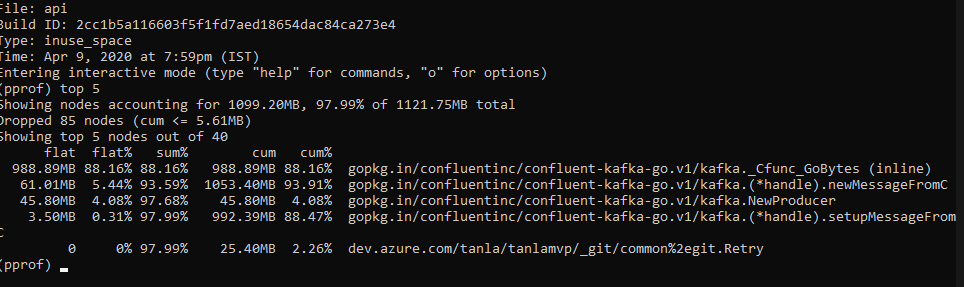
@maeglindeveloper @groyee Were you able to find the root cause, I have same problem
 rajeshmag
on 9 Apr 2020
rajeshmag
on 9 Apr 2020
@rajeshmag Are you reading delivery report Message's from the Events() channel?
edenhill
on 9 Apr 2020
Could this be an issue with slow scheduling, namely that the Events channel writer go-routine does not get scheduled often enough?
What is the CPU load for the application and system load?
Is GOMAXPROCS limited?
How many cores/vcpu does the instance/machine have?
Or is it perhaps the GC that is not running fast enough?
Can you try forcing a GC every now and then to see if it sorts out the issue?
edenhill
on 14 Apr 2020
eh-steve: you removed your comment, did you find the issue?
edenhill
on 14 Apr 2020
It turned out I had something else downstream slowing down the event channel loop - when I removed it and kept the loop tight/unblocked, the performance shot back up - this was my mistake
 eh-steve
on 14 Apr 2020
eh-steve
on 14 Apr 2020
@liubin The problem with these simple sync interfaces is that it tricks new developers into not thinking about what happens when the network starts acting up, broker becoming slow, etc.
A sync interface will work okay as long as the latency is low and there are no problems, but as soon as a produce request can't be immediately served the application will hang, possibly backpressuring its input source. This might be okay in some situations, and it is easy enough to wrap the async produce interface to make it sync (temporary delivery channel + blocking read on that channel after Produce()), but for most situations it is more important to maintain some degree of throughput and not stall the calling application.There's some more information here:
https://github.com/edenhill/librdkafka/wiki/FAQ#why-is-there-no-sync-produce-interfaceAnd here's an example how to make a sync produce call:
  drChan := make(chan Event, 1)

  err := p.Produce(&Message{
      TopicPartition: TopicPartition{Topic: &topic, Partition: -1},
      Value:            []byte(value),
      drChan)

  if err != nil {
      Fatalf("Produce: %v", err)
  }

  // Wait for delivery
  ev := <-drChan
  m := ev.(*Message)
  if m.TopicPartition.Error != nil {
      fmt.Printf("Delivery failed: %v", m.TopicPartition)
  }
  fmt.Printf("Produced message to %v", m.TopicPartition)
@edenhill Using channel actually solved the problem. Thank you for the explanation.
rajeshmag
on 16 Apr 2020
Related issues
 rogaha
·
9Comments
rogaha
·
9Comments
 vanipolnedi
·
10Comments
vanipolnedi
·
10Comments
 holgerw
·
9Comments
holgerw
·
9Comments
 MikeSchlosser16
·
6Comments
MikeSchlosser16
·
6Comments
 QuanVan95
·
4Comments
QuanVan95
·
4Comments
Most helpful comment
In your first example you are effectively implementing a sync producer, it will send one message and wait for an ack (reply) from the broker.
This is a complete performance killer since the thruput is limited by the network round-trip-time plus broker processing.
It is also made worse by the default batching behaviour of the client, it will buffer messages for up to queue.buffering.max.ms before sending to the broker. This value defaults to 1000ms which seems in-line with what you are seeing.
What you typically do is Produce() and then move on to producing new messages, and you check the delivery results on your deliveryChan(s) through Go-routines or similar. This way thruput is not limited by broker round-trip-time.
In your second example you've cut out the return path / delivery chan completely, so this will work at full speed up until the default delivery channel gets full, and that is also the reason why you are seeing a "memory leak". There is no actual memory leak, but the client is expecting you to read off the default producer.Events channel to serve delivery reports.
If you are completely uninterested in delivery state (which you might want to reconsider) you need to disable the default delivery reports too by setting
go.delivery.reportstofalse.See the documentation here for more info: http://docs.confluent.io/3.1.2/clients/confluent-kafka-go/index.html#hdr-Producer