Command-line-api: CommandResult missing ValueForOption<T>
CommandResult used to contain a ValueForOption
Example code:
var command = new Command("someCommand", "Does something interesting")
{
    new Option<bool>(
        new [] {"--boolOption"},
        getDefaultValue: () => false,
        "Some bool option"),
    new Option<int>(
        new [] {"--intOption"},
        getDefaultValue: () => 1,
        "Some int option")
};

command.AddValidator(result =>
{
    try
    {
        var boolOptionValue= result.ValueForOption<bool>("boolOption");
        var intOptionValue = result.ValueForOption<int>("intOption");
        // This code ^ no longer compiles :-(

        if (!boolOptionValue && intOptionValue == 42)
        { return "You can't do that."; }
    }
#pragma warning disable RCS1075, CS0168
    catch (Exception e)
    {
        // Ignore exceptions here, any type issues will be caught elsewhere
    }
#pragma warning disable RCS1075, CS0168

    return null;
});
Is there a better way to achieve this or was the removal of the ValueForOption method an accident?
 divinebovine
All 3 comments
I see the commit message stating:
Remove methods for getting values directly from a
CommandResult. They should be accessed from theParseResult, meaning code consuming the values isn't coupled to the structure of the CLI. This is important when a given option or argument might be added at multiple positions in the tree.
I'm using the CommandLineBuilder and I'm not sure how command validators are expected to be added in a way that they can validate multiple options against one another. In my example above the only invalid option is if both boolOption is true and intOption is 42.
divinebovine
on 8 Dec 2020
Same problem. I'm using this approach for mutually inclusive / exclusive operations (as this approach was a workaround for this feature not being supported natively)
```C#
setCmd.AddValidator(commandResult =>
{
DirectoryInfo workspace = commandResult.ValueForOption
DirectoryInfo publish = commandResult.ValueForOption
string username = commandResult.ValueForOption
string key = commandResult.ValueForOption
string value = commandResult.ValueForOption
  if (workspace == null && publish == null && username == null && key == null && value == null)
  {
      return "Please specify at least one option.";
  }

  if ((key != null && value == null) || (key == null && value != null))
  {
      return "--key & --value are mutually inclusive. Please specify a value for --key AND --value";
  }

  return null;
});
```
Is there a better way of achieving this now?
 HowardvanRooijen
on 28 Dec 2020
HowardvanRooijen
on 28 Dec 2020
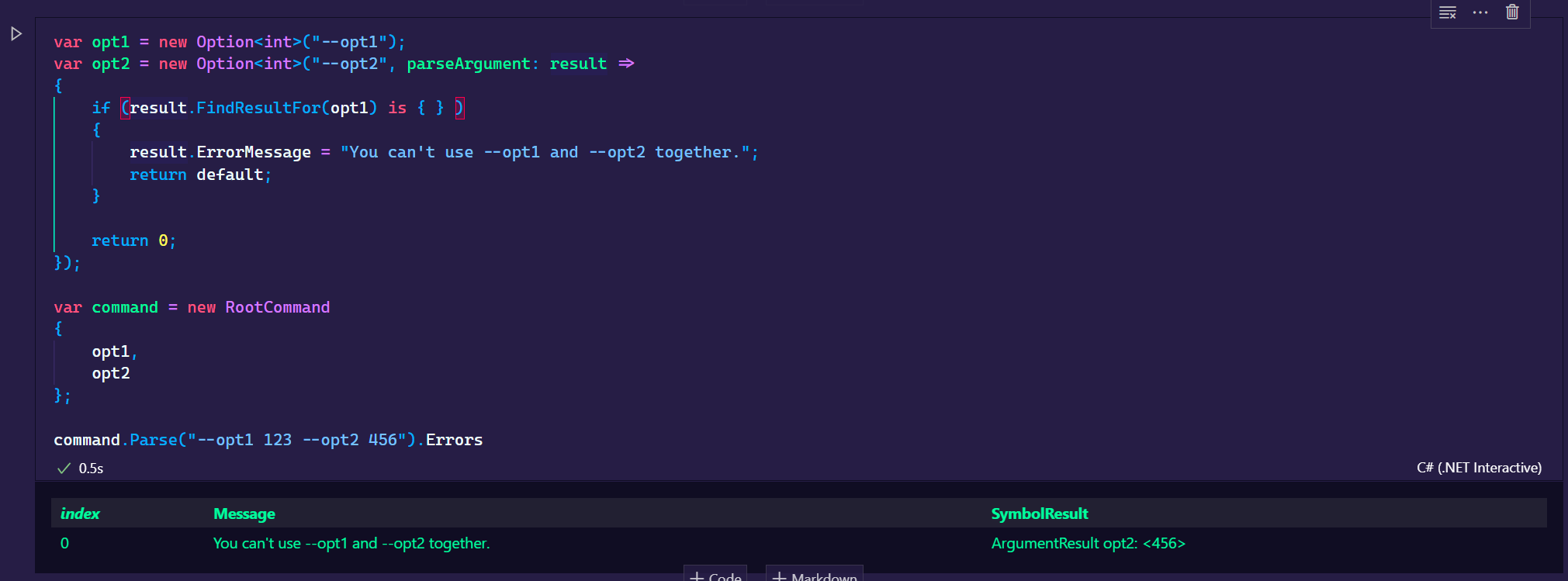
You can do this using the ParseArgument<T> delegate accepted by the Argument<T> and Option<T> constructors.
 jonsequitur
on 4 Jan 2021
jonsequitur
on 4 Jan 2021
Related issues
 jnm2
·
6Comments
jnm2
·
6Comments
 urig
·
6Comments
jonsequitur
·
4Comments
urig
·
6Comments
jonsequitur
·
4Comments
 oising
·
7Comments
oising
·
7Comments
 pjmagee
·
7Comments
pjmagee
·
7Comments