Codeception: dataProvider enhancement
PhpUnit has useful option - named data in dataprovider.
Example:
https://phpunit.de/manual/current/en/textui.html#textui.examples.filter-shortcuts
Is it possible to run tests with particular data from dataprovider with codeception?
It's needed to make parallel run tests with dataprovider.
 fffilimonov
All 7 comments
I made some changes to support running tests with particular data set index from dataset.
Example:
codecept run tests/acceptance/FirstCest.php:frontpageWorks#0
codecept run tests/acceptance/FirstCest.php:frontpageWorks#1
So, it will be possible to split tests by groups with dataproviders.
There is another one PR for this issue:
https://github.com/Codeception/phpunit-wrapper/pull/3
fffilimonov
on 28 Feb 2018
It would be also great to print name of dataset in console output.
 KacerCZ
on 19 Apr 2018
KacerCZ
on 19 Apr 2018
@fffilimonov I believe that using #0 is for unamed dataproviders, what should we do with named dataproviders? Just replace the 0 witht he name ?
 marabesi
on 21 Sep 2018
marabesi
on 21 Sep 2018
@KacerCZ values are printed in console output.
@marabesi we are using named dataproviders and run tests by index (it's enough for us).
There is some problem with name of dataset - codeception replace it with "example".
https://github.com/Codeception/Codeception/blob/1d4bb38d1a5ac852ddb8a35f7aa88c18180176df/src/Codeception/Test/Loader/Cest.php#L90
So dataset name not passed to phpunit (it's always "example").
If you need it - you can submit PR
fffilimonov
on 21 Sep 2018
It would be also great to print name of dataset in console output.
@KacerCZ I found a solution that worked for me to name the console output. Here's what the output originally looked like:
public function objectTypeProvider() {
    return [
        ['item'],
        ['term'],
        ['user'],
    ];
}

/**
* @dataProvider objectTypeProvider
*/
public function test_someTest($objectType) {
    // ...
}
Output:
✔ ComponentTest: some test | #0
✔ ComponentTest: some test | #1
✔ ComponentTest: some test | #2
The output was more useful when the data provider function used an associative array with a name:
public function objectTypeProvider() {
    return [
        'item' => ['item'],
        'term' => ['term'],
        'user' => ['user'],
    ];
}

/**
* @dataProvider objectTypeProvider
*/
public function test_someTest($objectType) {
    // ...
}
Output:
✔ ComponentTest: some test | "item"
✔ ComponentTest: some test | "term"
✔ ComponentTest: some test | "user"
 alecgeatches
on 21 Jan 2019
alecgeatches
on 21 Jan 2019
@alecgeatches Can it be that this so-called named dataset approach (cf. https://phpunit.readthedocs.io/en/8.0/writing-tests-for-phpunit.html#writing-tests-for-phpunit-data-providers-examples-datatest1-php) is only supported by non-acceptance tests?
I think the "name" of the dataset is https://github.com/Codeception/Codeception/blob/367de4ffde960d8be98d710e4a9f849cfd17e28f/src/Codeception/Test/Loader/Cest.php#L81-L95 $k in, but is lost (not used any further)?
Update/Correction: No, I think this is wrong (or not so easy) -- I mixed up @dataProvider and @example :-(
Let's say support for named datasets in @dataProvider AND @example would be really great to have...
 reinholdfuereder
on 13 Mar 2019
reinholdfuereder
on 13 Mar 2019
A possible workaround is returning instances of classes with overridden __toString() method in @dataProvider, e.g.:
class ParameterizedCest {

  /**
   * @dataProvider provider4
   *
   * @param \Codeception\Example $example
   */
  public function testTaxRate4(\Codeception\Example $example) {
    /** @var Provider4TestCase $testCase */
    $testCase = $example[0];
    Assert::assertEquals(20, $testCase->getData()[0]);
  }

  /**
   * Returns array of array entries with: int $taxRate, bool $nettoPrice, bool $asCompany, string $ustId, string $countryCode, int $postCode
   */
  protected function provider4() {
    return [
      [
        (new Provider4TestCase('PrivateUserInAustria'))->setData([ 20, false, false, "", 'AT', 4120 ])
      ],
      [
        (new Provider4TestCase('BusinessUserInAustria'))->setData([ 20, false, true, 'ATU56712338', 'AT', 4120 ])
      ]
    ];
  }

}

class Provider4TestCase {

  private $name;
  private $data;

  public function __construct(string $name) {
    $this->name = $name;
  }

  public function __toString() {
    return $this->name;
  }

  public function setData(array $data) {
    $this->data = $data;
    return $this;
  }

  public function getData() {
    return $this->data;
  }
}
Screenshot from PhpStorm:
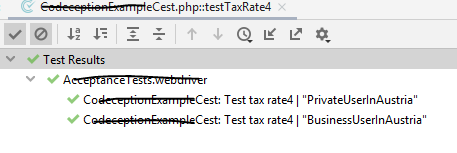
- (Note: Testcode was not in
ParameterizedCest)
reinholdfuereder
on 24 Sep 2019
Related issues
 rogoit
·
3Comments
rogoit
·
3Comments
 marcelodeandrade
·
3Comments
marcelodeandrade
·
3Comments
 schmunk42
·
3Comments
schmunk42
·
3Comments
 Breadleyg
·
3Comments
Breadleyg
·
3Comments
 Renkas
·
3Comments
Renkas
·
3Comments
Most helpful comment
It would be also great to print name of dataset in console output.