Class-validator: feat: @IsOptional should works only for undefined values
This code:
import { IsNotEmpty, IsOptional, IsString, validate } from 'class-validator';
import { plainToClass } from 'class-transformer';

const PATCH = 'patch';
const POST = 'post';

export class Test {
  @IsOptional({ groups: [PATCH] })
  @IsNotEmpty({ always: true })
  @IsString()
  name: string;
}

async function getValidationErrors(obj, group) {
  return await validate(plainToClass(Test, obj), { groups: [group] });
}

describe('Test', () => {
  it('should fail on post without name', async () => {
    const errors = await getValidationErrors({}, POST);
    expect(errors).not.toEqual([]);
  });
  it('should fail on post when name is undefined', async () => {
    const errors = await getValidationErrors({ name: undefined }, POST);
    expect(errors).not.toEqual([]);
  });
  it('should fail on post when name is null', async () => {
    const errors = await getValidationErrors({ name: null }, POST);
    expect(errors).not.toEqual([]);
  });
  it('should fail on post when name is empty', async () => {
    const errors = await getValidationErrors({ name: '' }, POST);
    expect(errors).not.toEqual([]);
  });
  it('should succeed on patch without name property', async () => {
    const errors = await getValidationErrors({}, PATCH);
    expect(errors).toEqual([]);
  });
  it('should fail on patch when name is undefined', async () => {
    const errors = await getValidationErrors({ name: undefined }, PATCH);
    expect(errors).not.toEqual([]);
  });
  it('should fail on patch when name is null', async () => {
    const errors = await getValidationErrors({ name: null }, PATCH);
    expect(errors).not.toEqual([]);
  });
  it('should fail on patch when name is empty', async () => {
    const errors = await getValidationErrors({ name: '' }, PATCH);
    expect(errors).not.toEqual([]);
  });
});
gives the following results:
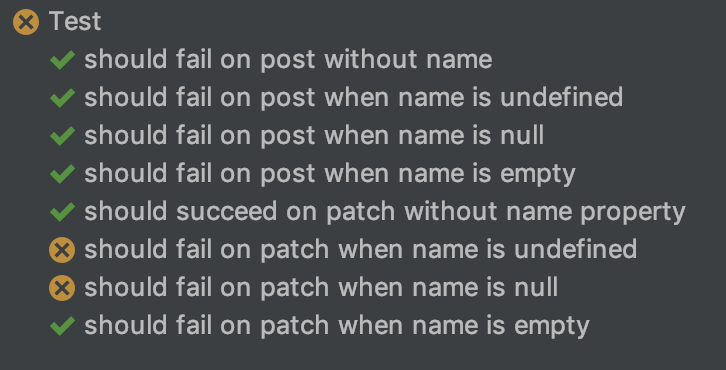
Am I missing something here?
Looking at the code of @IsOptional I see that it checks that the property is not undefined or null, that's why the test for empty string is not failing, but in theory shouldn't it check that this property exists on the object?
 vsternbach
All 12 comments
I do not understand your problem. I think your test cases are not good. You define property name as optional in case PATCH is in groups.
it('should fail on patch when name is undefined', async () => {
const errors = await getValidationErrors({ name: undefined }, PATCH);
expect(errors).not.toEqual([]);
});
it('should fail on patch when name is null', async () => {
const errors = await getValidationErrors({ name: null }, PATCH);
expect(errors).not.toEqual([]);
});
So Test should succeed on patch when name is undefined/null.
From docs:
@IsOptional() | Checks if given value is empty (=== null, === undefined) and if so, ignores all the validators on the property.
-- | --
 vlapo
on 10 Jan 2020
vlapo
on 10 Jan 2020
I use nestjs to validate a DTO from my controller
I have this
class MyDTO {
@IsOptional()
@IsNotEmpty()
locale?: string
}
I send this body json
{
"locale": null
}
The expected behaviour:
- ERROR 400, locale should not be empty
The actual behaviour:
- CODE 200, locale
nullis ignored.
If I have this DTO
class MyDTO {
@IsNotEmpty()
locale?: string
}
Then null value throws CODE 400 which is expected.
@IsOptional() should ignores only when the key is not passed in the request (aka. undefined) or an option to not ignores null value.
 Kiyozz
on 26 Mar 2020
Kiyozz
on 26 Mar 2020
I understand now. But as it is a breaking change I want to have more feedback from community.
vlapo
on 26 Mar 2020
I don't know if is the same issue, but i need to validate if a variable is notEmpty, notNull and notUndefined. Is that possible?
 jrafaels
on 28 Apr 2020
jrafaels
on 28 Apr 2020
@vlapo How about something like an extra config option? The implementation I've got in my fork doesn't break backwards compatibility (as the option defaults to true, which is the default behaviour):
@isOptional({ nullable: false }) // object.hasOwnProperty(property);
@isOptional({ nullable: true }) // value !== undefined && value !== null
@isOptional() // value !== undefined && value !== null
The commit on the fork that adds this behaviour: https://github.com/se-internal/class-validator/commit/5ac9fa0c17ad43ecb0e8642675447b380a54139e
 sam3d
on 5 May 2020
sam3d
on 5 May 2020
We would love this as well, ether with a nullable flag, or as a separate set of decorators (although naming them can be difficult).
@sam3d, your fork looks good to me, would you mind creating a PR?
 fhp
on 27 May 2020
fhp
on 27 May 2020
Thanks @fhp! Yeah we had originally tried to create a new decorator and must've spent over an hour trying to come up with a good name. Eventually, we decided it made more sense to borrow the design pattern from typeorm's @ManyToOne() decorator (a nullable property that defaults to true).
I'll definitely put it into a PR at some point in the next couple of days! Just waiting until I have a moment to add tests. Confirmation from @vlapo or another maintainer that at least the design proposal is accepted would be amazing so I know I'm not doing it for nothing 😄
sam3d
on 28 May 2020
Any update for this? really want to see this feature in next release
@sam3d
 omidh28
on 7 Jul 2020
omidh28
on 7 Jul 2020
I agree about the strange behavior of this.
I like the API proposed by @sam3d. We can use the current behavior as default and add a warning in the changelog about eventually being flipped.
I will take a crack at this at the weekend.
 NoNameProvided
on 4 Aug 2020
NoNameProvided
on 4 Aug 2020
@NoNameProvided Any update? 10 days has been passed
omidh28
on 14 Aug 2020
How about keeping @IsOptional as-is and adding new decorators @IsNullable and @IsUndefinable.
Any support for this?
 NickKelly1
on 16 Aug 2020
NickKelly1
on 16 Aug 2020
/**
 * Skips validation if the target is null
 *
 * @example
 * ```typescript
 * class TestModel {
 *     @IsNullable({ always: true })
 *     big: string | null;
 * }
 * ```
 */
export function IsNullable(options?: ValidationOptions): PropertyDecorator {
    return function IsNullableDecorator(prototype: object, propertyKey: string | symbol): void {
        ValidateIf((obj): boolean => null !== obj[propertyKey], options)(prototype, propertyKey);
    };
}
/**
 * Skips validation if the target is undefined
 *
 * @example
 * ```typescript
 * class TestModel {
 *     @IsUndefinable({ always: true })
 *     big?: string;
 * }
 * ```
 */
export function IsUndefinable(options?: ValidationOptions): PropertyDecorator {
    return function IsUndefinableDecorator(prototype: object, propertyKey: string | symbol): void {
        ValidateIf((obj): boolean => undefined !== obj[propertyKey], options)(prototype, propertyKey);
    };
}
 ruscon
on 16 Sep 2020
ruscon
on 16 Sep 2020
Related issues
 MistyKuu
·
3Comments
MistyKuu
·
3Comments
 jerradpatch
·
5Comments
jerradpatch
·
5Comments
 yantrab
·
3Comments
yantrab
·
3Comments
 ibox4real
·
4Comments
ibox4real
·
4Comments
 st-clair-clarke
·
3Comments
st-clair-clarke
·
3Comments
Most helpful comment
@vlapo How about something like an extra config option? The implementation I've got in my fork doesn't break backwards compatibility (as the option defaults to
true, which is the default behaviour):The commit on the fork that adds this behaviour: https://github.com/se-internal/class-validator/commit/5ac9fa0c17ad43ecb0e8642675447b380a54139e