Ckeditor5: Write ESLint rule for CKEditorError's
📝 Provide a description of the improvement
- https://github.com/ckeditor/ckeditor5/issues/5643
- Missing
@error.
- This one is tricky as the error definition may be in a different file. We may need to have some
/** @error other-file-path... */to reference them.
- This one is tricky as the error definition may be in a different file. We may need to have some
If you'd like to see this improvement implemented, add a 👍 reaction to this post.
 Reinmar
All 19 comments
I wanted to add this at the beginning of CKEditorError() but it fails in too many places (tests, most likely) for me to finish this:
if ( !message.match( /[^:]+: [^.]+\./ ) ) {
throw new Error( 'Wrong CKEditorError message format.' );
}
Optionally this could be a part of the documentation validator. But IMO the faster an error appears the better.
 ma2ciek
on 13 Aug 2020
ma2ciek
on 13 Aug 2020
We could also use https://eslint.org/docs/rules/valid-jsdoc for the default set of JSDoc tags.
ma2ciek
on 13 Aug 2020
Oh, I saw it's deprecated.
ma2ciek
on 13 Aug 2020
However, there's also a community plugin - https://github.com/gajus/eslint-plugin-jsdoc
ma2ciek
on 13 Aug 2020
I wonder if the part of the error after the colon is needed. I think I wanted it to be there so if you're having an error in the dev version of CKE5, you get the full title. But perhaps it's not needed anymore? Although, if an error is described only by its id and has no definition in @error (because someone forgot to write it), then figuring out what it means may be tricky.
So, having @errors for all errors would be more important in this case.
Reinmar
on 13 Aug 2020
In the past, I wrote that the message description in the error itself is necessary (https://github.com/ckeditor/ckeditor5/issues/5643#issuecomment-547411083) but now I think that it's overhead. I think that we could remove that bit from all errors and improve their error codes and error doc strings.
It'd be like:
/**
 * The {@link module:utils/collection~Collection#add `Collection#add()`} method was called without
 * an item. This method always needs to be executed with an item. And so on...
 *
 * @error collection-add-called-without-an-item
 */
throw new CKEditorError( 'collection-add-called-without-an-item', this );
Instead of:
/**
 * Missing item.
 *
 * @error collection-add-invalid-call
 */
throw new CKEditorError( 'collection-add-invalid-call: Missing item.', this );
The latter example looks like many errors that we have. The id (`collection-add-invalid-call`) does not help you understand what happened. The message that follows is often poor as well. And the documentation does not extend the error.
We can remove the message if we'll focus on making the ids clearer. And the documentation should clearly explain what was wrong and how to do that right (if possible).
Reinmar
on 18 Aug 2020
cc @AnnaTomanek @oleq :point_up:
Reinmar
on 18 Aug 2020
cc @jodator :point_up:
Reinmar
on 18 Aug 2020
Should be fairly ease - since I've implemented other custom rule I might check for this.
 jodator
on 19 Aug 2020
jodator
on 19 Aug 2020
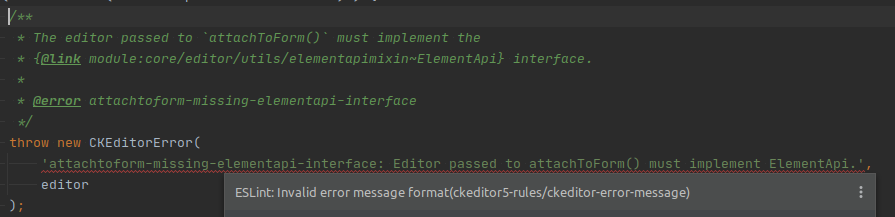
@Reinmar It would be good to agree on the requirements. Below is an example error in IDE using POC (ckeditor/ckeditor5-dev@3473815) of this rule:
jodator
on 19 Aug 2020
To sum up what we need to have is:
- Message format:
'error-id: Error message'vs'error-id' - Do we want validate other arguments as well (I assume that to much hassle).
- What's the rule for detached
@errordefinition with multiple throws (ie case formarker-destroyed). If it is in the context of the same file it might be easy to find defintion - however cumbersome. Having a rule that for everyCKEditorwe must have@errorannotation in comment might be easier to implement.
jodator
on 19 Aug 2020
We can remove the message if we'll focus on making the ids clearer. And the documentation should clearly explain what was wrong and how to do that right (if possible).
I second this: minimal code, verbose docs. I've been wondering why we duplicate these for a while but I couldn't figure it out.
 oleq
on 20 Aug 2020
oleq
on 20 Aug 2020
I was debugging my inspection why it produces an error and just found out this:
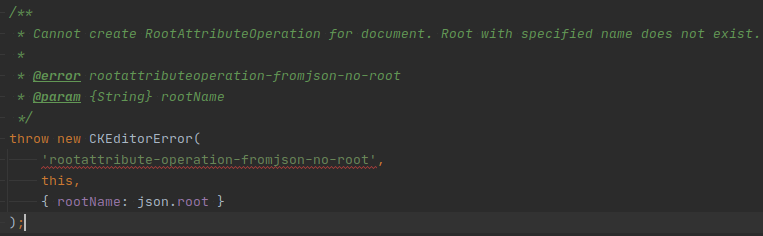
It took me 5 debug sessions to spot why there's an error - it proves IMO that this check would be useful.
jodator
on 20 Aug 2020
Example changes executed with a fixer: f729c2f
jodator
on 20 Aug 2020
At this moment I can detect existing @error in the same file. However errors are defined in different files but also I've found many error mismatches (total 63 errors for both cases):
jodator
on 20 Aug 2020
And the only thing to cover is external errors (IE those thrown by editor implementation) like here: https://github.com/ckeditor/ckeditor5/blob/57188cb96671ea02939c3cf5e811e4ebebeb9fef/packages/ckeditor5-editor-decoupled/src/decouplededitor.js#L227-L231
What doesn't work is adding empty /** @error editor-wrong-element */ jsdoc - it will be detected as a duplicated error.
I think that we could mark it as "private @error "
if ( isHTMLElement && sourceElementOrData.tagName === 'TEXTAREA' ) {
    // @error editor-wrong-element - documented in core/editor/editor.js
    throw new CKEditorError( 'editor-wrong-element', null );
}
Another format would work as well but I think that this would be easiest to parse.
jodator
on 21 Aug 2020
Bonus question: what to do with errors that have one upper case like model-selection-setTo-not-selectable?
I'd go for enforcing lower case as this looks odd.
jodator
on 21 Aug 2020
To sum up again:
- [x] Error id format
error-fooBar-bazvserror-foobar-baz. (probably error message need to be refactored to errorId or name). - ~external errors annotation (~~proposition~~)~ agreed that we can supress the error for now.
- [x] Optional - invalidate also empty jsdoc comment with
@erroronly - also doable in minimal time.
I'd ditch params validation - to much work.
The change is read-ish to apply but would require adding missing annotations in the code base.
jodator
on 21 Aug 2020
Related issues
 MansoorJafari
·
3Comments
MansoorJafari
·
3Comments
 pomek
·
3Comments
pomek
·
3Comments
 metalelf0
·
3Comments
Reinmar
·
3Comments
metalelf0
·
3Comments
Reinmar
·
3Comments
 wwalc
·
3Comments
wwalc
·
3Comments
Most helpful comment
In the past, I wrote that the message description in the error itself is necessary (https://github.com/ckeditor/ckeditor5/issues/5643#issuecomment-547411083) but now I think that it's overhead. I think that we could remove that bit from all errors and improve their error codes and error doc strings.
It'd be like:
Instead of:
The latter example looks like many errors that we have. The id (`collection-add-invalid-call`) does not help you understand what happened. The message that follows is often poor as well. And the documentation does not extend the error.
We can remove the message if we'll focus on making the ids clearer. And the documentation should clearly explain what was wrong and how to do that right (if possible).