Chapel: Enhance user experience by providing a linter for Chapel
I believe that a linter should be provided for at least one text editor. A linter makes it significantly easier to program for both newcomers and experienced veterans in that it saves time by showing compiler errors and warnings on-demand without needing to manually compile (I.E Lint-On-Save). Although I am inexperienced with the actual creation of linters, after doing some digging around I believe I have discovered a simple example that can serve as the base for development. Using the Atom text editor as an example, providing an extension to the core AtomLinter package may not be too difficult as it seems to boil down to parsing the compiler output into a JSON Object that AtomLinter can process. Besides for other boilerplate code, I believe that this can be done and I do volunteer to create a simple prototype as I am very interested in having it myself.
There are some other issues that I believe would need to be addressed eventually, such as any internal errors that can arise... how should they be represented? Normal errors have the format "$FILE_PATH:$LINE_NUMBER: $ERROR_TYPE: $ERROR_MESSAGE", but would this be enough to catch all such errors and issues? Are there an other formats you'd need to look out for?
Screenshot of Progress:
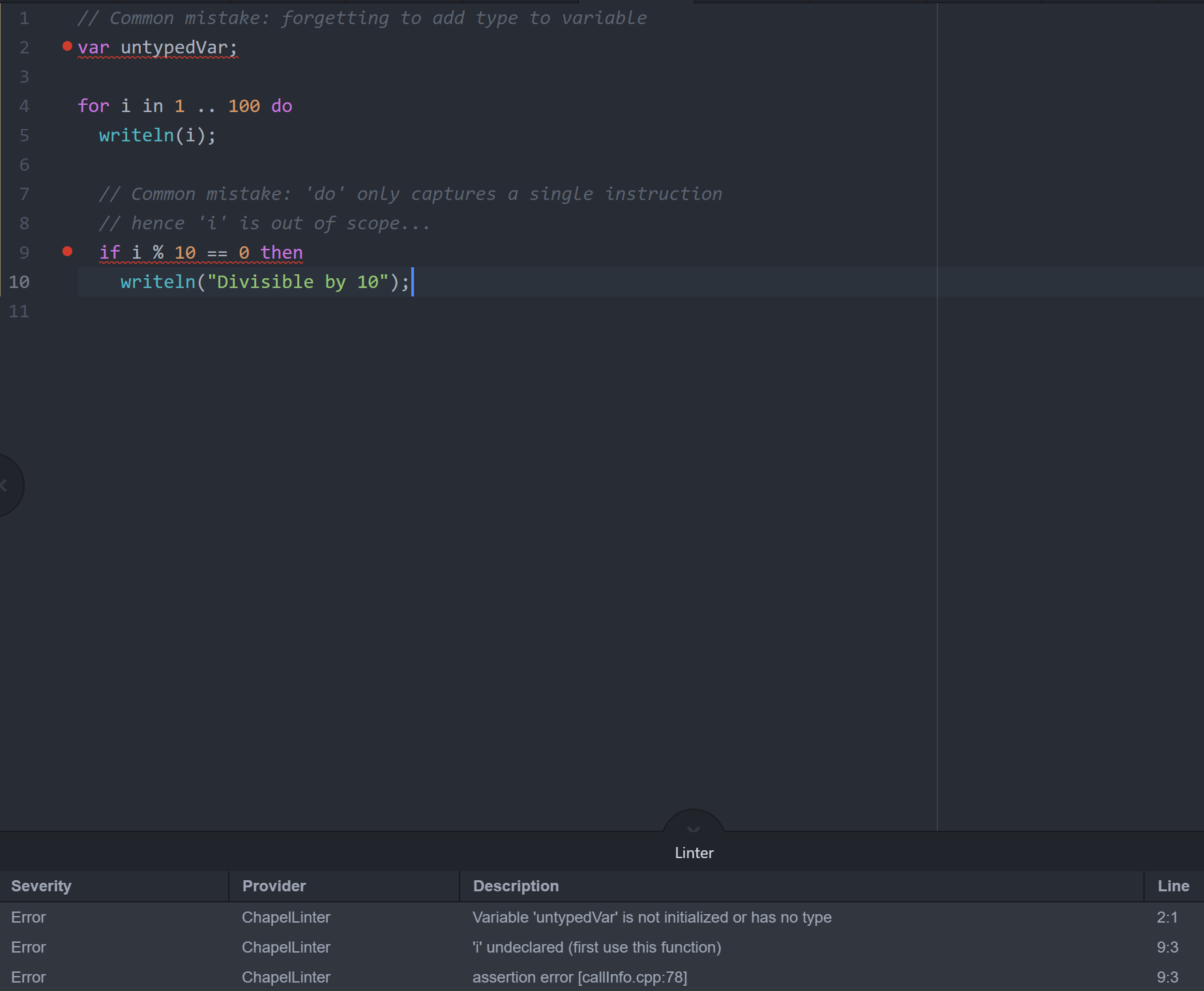
Repository (WIP):
Available here: https://github.com/LouisJenkinsCS/Chapel-Linter
 LouisJenkinsCS
All 18 comments
There is a Chapel plugin for both Vim and Atom Is that what you mean?
 buddha314
on 28 Mar 2018
buddha314
on 28 Mar 2018
That's for syntax highlighting, I mean something like this but for Chapel where it shows both warnings and errors that could only be caught via compilation.
LouisJenkinsCS
on 28 Mar 2018
Oh, yeah. I've used jsonlint quite a bit. Thanks for explaining it.
buddha314
on 28 Mar 2018
While developing this, I realize that a few additions are needed to improve this further...
- The compiler errors should output the start of the column, as currently I need to set the error position to be the start of the line; if there are two or more errors on a single line, how can the user differentiate?
- Is there an easy way to obtain potential 'compiler warning' output that shows dangerous behavior but does not constitute an actual error?
- Is there a way to force the compiler to evaluate all code paths including what gets removed during DeadCodeElimination, and perhaps have it continue to output all errors despite encountering an error early on.
LouisJenkinsCS
on 29 Mar 2018
I have a good screenshot of the current progress...
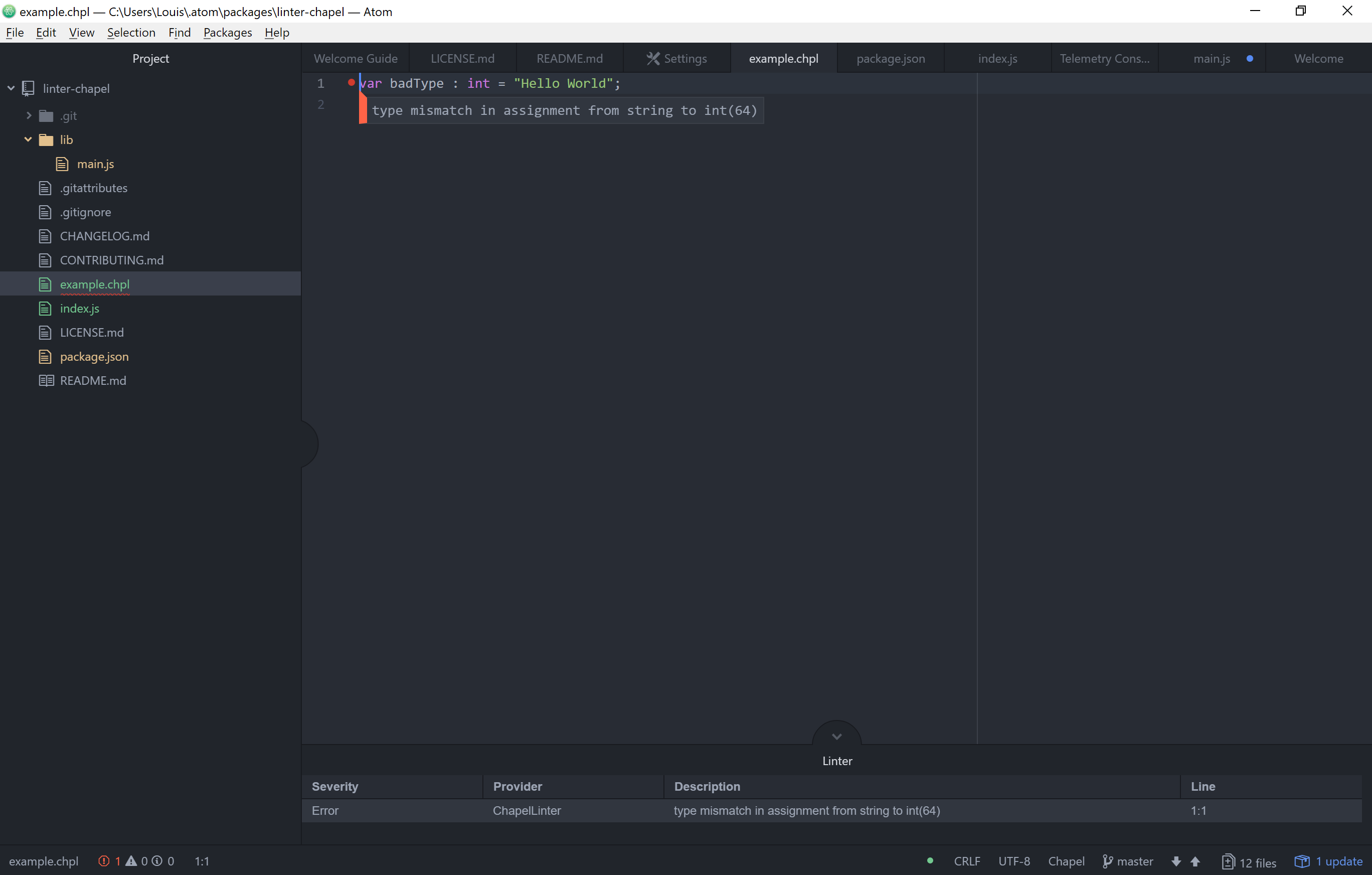
So far I can have it show compiler errors but again, it only shows a single error so its usefulness is limited although it has a lot of potential. Any thoughts?
LouisJenkinsCS
on 29 Mar 2018
@mppf
Since you're the only one I'm comfortable calling on, do you have any idea on how to make it so that the Chapel compiler can optionally continue showing errors past the first it comes across? I know I can disable DeadCodeElimination through compiler flags to ensure the linter will show errors in 'dead' code, but if it requires changes to the Chapel compiler to make it show all errors do you have any pointers of where I should start.
LouisJenkinsCS
on 29 Mar 2018
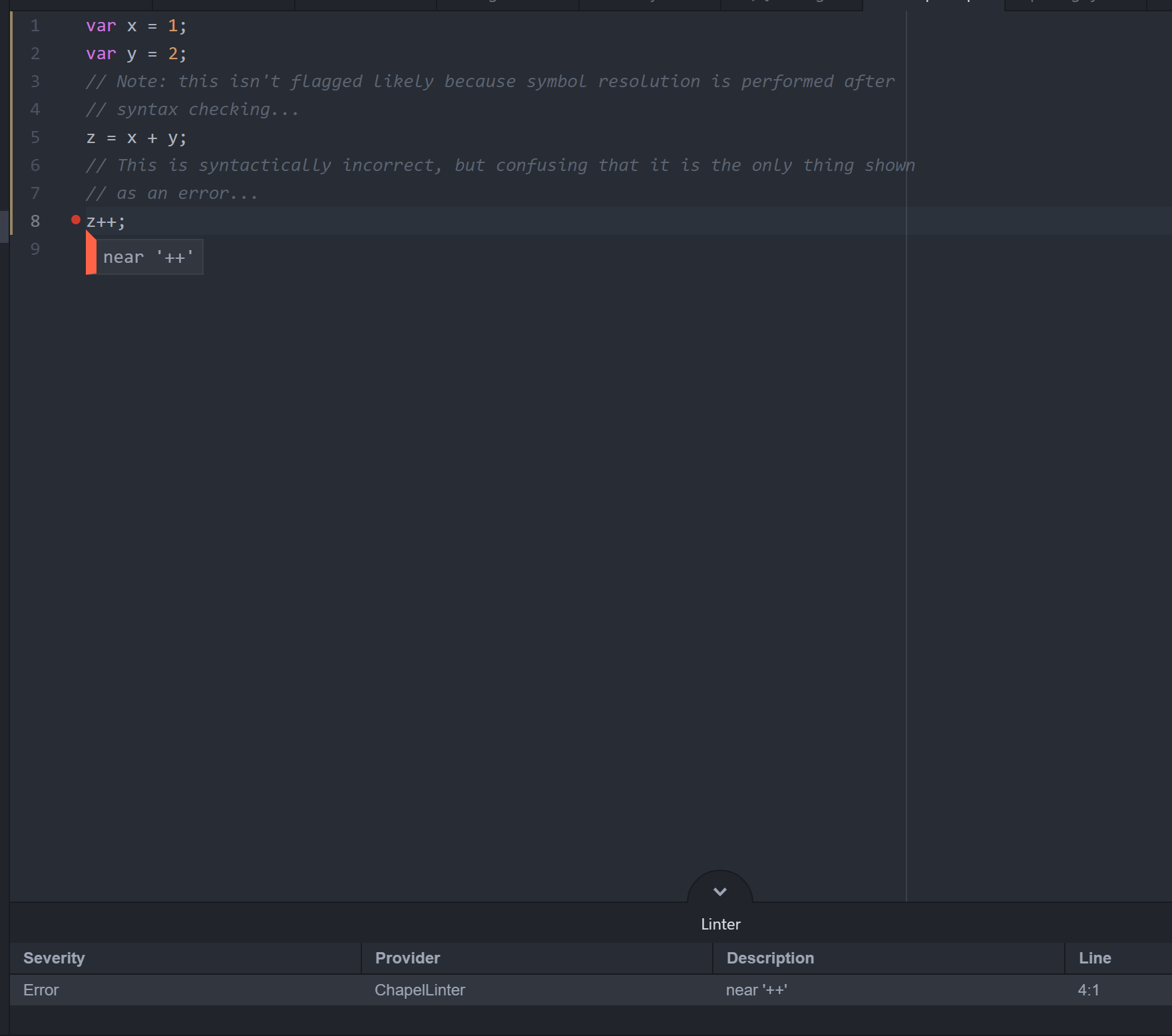
To show what I mean by it "not continuing to show errors beyond the first it comes across"...
LouisJenkinsCS
on 29 Mar 2018
You could try using the --ignore-errors flag which tells the compiler to try and push past any errors it encounters and continue. Of course, depending on what the error is, continuing on may cause weird things to happen in the compiler. But for a case like this where the user isn't directly interacting with the compiler, it may give you more of what you need.
I'll mention that, generally speaking, we're trying to not "halt compiler on first error" as much as we traditionally have, but that this has been a lazy and incremental change. That said, I think it's unlikely that we'd ever be comfortable, by default, listing multiple errors across multiple passes. I.e., if there are parse errors, I wouldn't expect future versions of the compiler to continue past parsing without an "I'm brave and can take what you throw at me" flag like --ignore-errors.
 bradcray
on 29 Mar 2018
bradcray
on 29 Mar 2018
Unfortunate --ignore-errors is a bit too 'strong' as it will repeatedly return from the segfault handler, attempt to continue execution, and then segfault again (example), I believe any internal errors it comes across should result in it halting but it should continue on user errors. Thanks for the suggestion though, could come in handy with some improvements.
LouisJenkinsCS
on 29 Mar 2018
This might simply be considered a bug to fix in --ignore-errors. Since it wasn't designed to be user-facing (and, I suspect, doesn't get much use), it could just be that nobody's ever bothered to address it. Alternatively, we could have multiple levels of --ignore-errors where one would only continue on user errors, the other on any errors.
bradcray
on 29 Mar 2018
To clarify, I understand why it will halt on parse errors and not continue on to static analysis, but even if a program is syntactically correct, if there is an error in pass A and another error in pass B, only the errors discovered in A will be emitted by the compiler which may catch users by surprise when after they fix it they see emission when the compiler halts on B. Although with the use of --baseline and --no-codegen at least it will be a lot cheaper to rerun the linter multiple times.
LouisJenkinsCS
on 29 Mar 2018
I agree on the need for a variant of --ignore-errors such as --ignore-user-errors, etc. I can report the issue with --ignore-errors where a special case should be added for segfaults.
LouisJenkinsCS
on 29 Mar 2018
I didn't know about --ignore-errors and I suspect nobody would object to simple modifications of it, if you have some adjustments that make it more useful for this purpose.
 mppf
on 30 Mar 2018
mppf
on 30 Mar 2018
Okay then, current goal to implement the following flags...
- [x]
--ignore-user-errors - [x]
--stop-after-pass - [ ]
--show-columns&&--show-columm-range - [ ]
--ignore-errorssegfault patch
LouisJenkinsCS
on 30 Mar 2018
It would be nice for a linter to catch when user code uses an auto-used module, e.g. use Math.
 ben-albrecht
on 11 Oct 2018
ben-albrecht
on 11 Oct 2018
I think I would need the ability to query more information from the compiler to support something like this. For example: "Given a specific module X, what are the imports of X?" I could grep for the pattern myself too, but having such support from the compiler would be more resilient to language changes.
LouisJenkinsCS
on 11 Oct 2018
I think I would need the ability to query more information from the compiler to support something like this.
Agreed. I just wanted to document the desire for that feature.
ben-albrecht
on 11 Oct 2018
I think of this as related to #7295.
mppf
on 3 Feb 2020
Related issues
buddha314
·
3Comments
 BryantLam
·
3Comments
BryantLam
·
3Comments
 vasslitvinov
·
3Comments
bradcray
·
3Comments
vasslitvinov
·
3Comments
bradcray
·
3Comments
 npadmana
·
3Comments
npadmana
·
3Comments