Bpftrace: Reading pointers off stack broken
bpftrace --info
System
  OS: Linux 5.6.4-arch1-1 #1 SMP PREEMPT Mon, 13 Apr 2020 12:21:19 +0000
  Arch: x86_64

Build
  version: v0.10.0-63-g4b37
  LLVM: 10
  foreach_sym: yes
  unsafe uprobe: no
  btf: no
  bfd: yes
  bpf_attach_kfunc: yes

Kernel helpers
  probe_read: yes
  probe_read_str: yes
  probe_read_user: yes
  probe_read_user_str: yes
  probe_read_kernel: yes
  probe_read_kernel_str: yes
  get_current_cgroup_id: yes
  send_signal: yes
  override_return: yes

Kernel features
  Instruction limit: 1000000
  Loop support: yes

Map types
  hash: yes
  percpu hash: yes
  array: yes
  percpu array: yes
  stack_trace: yes
  perf_event_array: yes

Probe types
  kprobe: yes
  tracepoint: yes
  perf_event: yes
  kfunc: no
What reproduces the bug?
This works:
#include <linux/fs.h>
#include <linux/blk_types.h>
#include <linux/blkdev.h>
#include <linux/blk-cgroup.h>
#include <linux/cgroup-defs.h>
#include <linux/sched.h>

kprobe:blk_update_request
{
        $req = (struct request *)arg0;
        printf("cgroup name: %p\n", $req->bio->bi_blkg->blkcg->css.cgroup->kn->parent);
}
with output like this:
cgroup name: 0xffffa02fdd173480
cgroup name: 0xffffa02fdd173480
cgroup name: (nil)
cgroup name: (nil)
But this script does not work:
#include <linux/fs.h>
#include <linux/blk_types.h>
#include <linux/blkdev.h>
#include <linux/blk-cgroup.h>
#include <linux/cgroup-defs.h>
#include <linux/sched.h>

kprobe:blk_update_request
{
        $req = (struct request *)arg0;
        $kn = $req->bio->bi_blkg->blkcg->css.cgroup->kn;
        printf("cgroup name: %p\n", $kn->parent);
}
with output like:
cgroup name: (nil)
cgroup name: (nil)
cgroup name: (nil)
cgroup name: (nil)
cgroup name: (nil)
cgroup name: (nil)
cgroup name: (nil)
cgroup name: (nil)
cgroup name: (nil)
cgroup name: (nil)
There are no non-nils.
I think there might have been some change w/ handling pointers already on the stack. Maybe it's eliding a bpf_probe_read()? Could make sense cuz then kernel will fail the dereference and give you 0x0.
cc @mmisono
 danobi
All 16 comments
It's strange. When I try
#include <linux/fs.h>
#include <linux/blk_types.h>
#include <linux/blkdev.h>
#include <linux/blk-cgroup.h>
#include <linux/cgroup-defs.h>
#include <linux/sched.h>

kprobe:blk_update_request
{
        $req = (struct request *)arg0;
        $parent = $req->bio->bi_blkg->blkcg->css.cgroup->kn->parent;

        $kn = $req->bio->bi_blkg->blkcg->css.cgroup->kn;
        $parent2 = $kn->parent;

        printf("cgroup name: %p, %p\n", $parent, $parent2);
}
then it seems to work.
Attaching 1 probe...
cgroup name: (nil), (nil)
cgroup name: 0xffff8c32d9e1a300, 0xffff8c32d9e1a300
but surely
kprobe:blk_update_request
{
        $req = (struct request *)arg0;
        $kn = $req->bio->bi_blkg->blkcg->css.cgroup->kn;
        printf("cgroup name: %p\n", $kn->parent);
}
does not.
 mmisono
on 24 Apr 2020
mmisono
on 24 Apr 2020
Apparently generated code is wrong.
kprobe:blk_update_request
{
        $req = (struct request *)arg0;
        $kn = $req->bio->bi_blkg->blkcg->css.cgroup->kn;
        printf("cgroup name: %p, %p\n", (uint64)$kn, $kn->parent);
}
The program store zero *(u64 *)(r10 -32) = r1 at the location where $kn is stored.
24: (79) r3 = *(u64 *)(r10 -32)
25: (07) r3 += 288
26: (bf) r1 = r10
27: (07) r1 += -32
28: (b7) r2 = 8
29: (85) call bpf_probe_read#4
last_idx 29 first_idx 24
regs=4 stack=0 before 28: (b7) r2 = 8
30: (b7) r1 = 0
31: (7b) *(u64 *)(r10 -32) = r1
last_idx 31 first_idx 24
regs=2 stack=0 before 30: (b7) r1 = 0
32: (79) r3 = *(u64 *)(r10 -32)
33: (7b) *(u64 *)(r10 -24) = r3
34: (07) r3 += 8
35: (bf) r1 = r10
36: (07) r1 += -8
37: (b7) r2 = 8
38: (85) call bpf_probe_read#4
all generated code
Attaching 1 probe...

Program ID: 361369

Bytecode:
0: (bf) r6 = r1
1: (79) r3 = *(u64 *)(r6 +112)
2: (07) r3 += 56
3: (bf) r1 = r10
4: (07) r1 += -32
5: (b7) r2 = 8
6: (85) call bpf_probe_read#4
last_idx 6 first_idx 0
regs=4 stack=0 before 5: (b7) r2 = 8
7: (79) r3 = *(u64 *)(r10 -32)
8: (07) r3 += 72
9: (bf) r1 = r10
10: (07) r1 += -32
11: (b7) r2 = 8
12: (85) call bpf_probe_read#4
last_idx 12 first_idx 0
regs=4 stack=0 before 11: (b7) r2 = 8
13: (79) r3 = *(u64 *)(r10 -32)
14: (07) r3 += 40
15: (bf) r1 = r10
16: (07) r1 += -32
17: (b7) r2 = 8
18: (85) call bpf_probe_read#4
last_idx 18 first_idx 13
regs=4 stack=0 before 17: (b7) r2 = 8
19: (79) r3 = *(u64 *)(r10 -32)
20: (bf) r1 = r10
21: (07) r1 += -32
22: (b7) r2 = 8
23: (85) call bpf_probe_read#4
last_idx 23 first_idx 13
regs=4 stack=0 before 22: (b7) r2 = 8
24: (79) r3 = *(u64 *)(r10 -32)
25: (07) r3 += 288
26: (bf) r1 = r10
27: (07) r1 += -32
28: (b7) r2 = 8
29: (85) call bpf_probe_read#4
last_idx 29 first_idx 24
regs=4 stack=0 before 28: (b7) r2 = 8
30: (b7) r1 = 0
31: (7b) *(u64 *)(r10 -32) = r1
last_idx 31 first_idx 24
regs=2 stack=0 before 30: (b7) r1 = 0
32: (79) r3 = *(u64 *)(r10 -32)
33: (7b) *(u64 *)(r10 -24) = r3
34: (07) r3 += 8
35: (bf) r1 = r10
36: (07) r1 += -8
37: (b7) r2 = 8
38: (85) call bpf_probe_read#4
last_idx 38 first_idx 24
regs=4 stack=0 before 37: (b7) r2 = 8
39: (79) r1 = *(u64 *)(r10 -8)
40: (7b) *(u64 *)(r10 -16) = r1
41: (18) r7 = 0xffff8c32cad79400
43: (85) call bpf_get_smp_processor_id#8
44: (bf) r4 = r10
45: (07) r4 += -32
46: (bf) r1 = r6
47: (bf) r2 = r7
48: (bf) r3 = r0
49: (b7) r5 = 24
50: (85) call bpf_perf_event_output#25
last_idx 50 first_idx 39
regs=20 stack=0 before 49: (b7) r5 = 24
51: (b7) r0 = 0
52: (95) exit
processed 52 insns (limit 1000000) max_states_per_insn 0 total_states 4 peak_states 4 mark_read 3
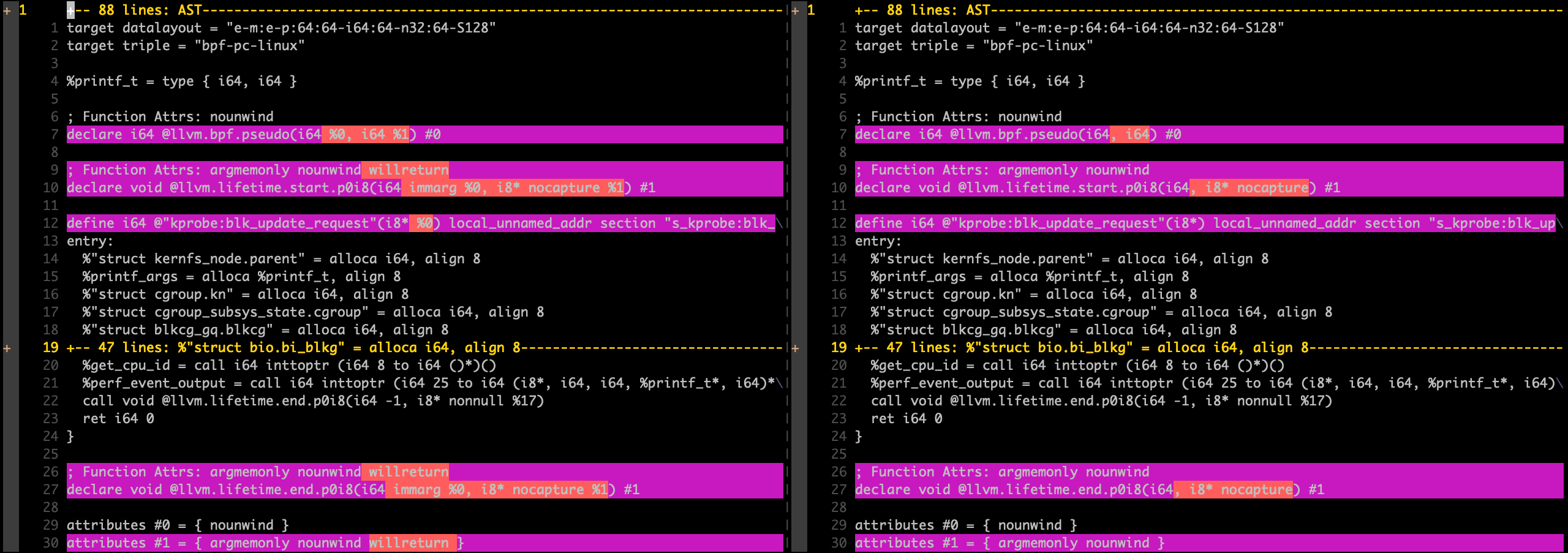
I found llvm 8 does not have the problem, but llvm9 and 10 has.
left: llvm10, right: llvm8

I don't see any LLVM IR differences other than attributes (left: llvm10, right: llvm8).
mmisono
on 24 Apr 2020
IR:
define i64 @"kprobe:blk_update_request"(i8* %0) local_unnamed_addr section "s_kprobe:blk_update_request_1" {
entry:
  %"struct kernfs_node.parent" = alloca i64, align 8
  %printf_args = alloca %printf_t, align 8
  %"struct cgroup.kn" = alloca i64, align 8
  %"struct cgroup_subsys_state.cgroup" = alloca i64, align 8
  %"struct blkcg_gq.blkcg" = alloca i64, align 8
  %"struct bio.bi_blkg" = alloca i64, align 8
  %"struct request.bio" = alloca i64, align 8
  %1 = getelementptr i8, i8* %0, i64 112
  %2 = bitcast i8* %1 to i64*
  %arg0 = load volatile i64, i64* %2, align 8
  %3 = add i64 %arg0, 56
  %4 = bitcast i64* %"struct request.bio" to i8*
  call void @llvm.lifetime.start.p0i8(i64 -1, i8* nonnull %4)
  %probe_read = call i64 inttoptr (i64 4 to i64 (i64*, i32, i64)*)(i64* nonnull %"struct request.bio", i32 8, i64 %3)
  %5 = load i64, i64* %"struct request.bio", align 8
  call void @llvm.lifetime.end.p0i8(i64 -1, i8* nonnull %4)
  %6 = add i64 %5, 72
  %7 = bitcast i64* %"struct bio.bi_blkg" to i8*
  call void @llvm.lifetime.start.p0i8(i64 -1, i8* nonnull %7)
  %probe_read1 = call i64 inttoptr (i64 4 to i64 (i64*, i32, i64)*)(i64* nonnull %"struct bio.bi_blkg", i32 8, i64 %6)
  %8 = load i64, i64* %"struct bio.bi_blkg", align 8
  call void @llvm.lifetime.end.p0i8(i64 -1, i8* nonnull %7)
  %9 = add i64 %8, 40
  %10 = bitcast i64* %"struct blkcg_gq.blkcg" to i8*
  call void @llvm.lifetime.start.p0i8(i64 -1, i8* nonnull %10)
  %probe_read2 = call i64 inttoptr (i64 4 to i64 (i64*, i32, i64)*)(i64* nonnull %"struct blkcg_gq.blkcg", i32 8, i64 %9)
  %11 = load i64, i64* %"struct blkcg_gq.blkcg", align 8
  call void @llvm.lifetime.end.p0i8(i64 -1, i8* nonnull %10)
  %12 = bitcast i64* %"struct cgroup_subsys_state.cgroup" to i8*
  call void @llvm.lifetime.start.p0i8(i64 -1, i8* nonnull %12)
  %probe_read3 = call i64 inttoptr (i64 4 to i64 (i64*, i32, i64)*)(i64* nonnull %"struct cgroup_subsys_state.cgroup", i32 8, i64 %11)
  %13 = load i64, i64* %"struct cgroup_subsys_state.cgroup", align 8
  call void @llvm.lifetime.end.p0i8(i64 -1, i8* nonnull %12)
  %14 = add i64 %13, 288
  %15 = bitcast i64* %"struct cgroup.kn" to i8*
  call void @llvm.lifetime.start.p0i8(i64 -1, i8* nonnull %15)
  %probe_read4 = call i64 inttoptr (i64 4 to i64 (i64*, i32, i64)*)(i64* nonnull %"struct cgroup.kn", i32 8, i64 %14)
  %16 = load i64, i64* %"struct cgroup.kn", align 8
  call void @llvm.lifetime.end.p0i8(i64 -1, i8* nonnull %15)
  %17 = bitcast %printf_t* %printf_args to i8*
  call void @llvm.lifetime.start.p0i8(i64 -1, i8* nonnull %17)
  %18 = add i64 %16, 8
  %19 = bitcast i64* %"struct kernfs_node.parent" to i8*
  %20 = getelementptr inbounds %printf_t, %printf_t* %printf_args, i64 0, i32 0
  store i64 0, i64* %20, align 8
  call void @llvm.lifetime.start.p0i8(i64 -1, i8* nonnull %19)
  %probe_read5 = call i64 inttoptr (i64 4 to i64 (i64*, i32, i64)*)(i64* nonnull %"struct kernfs_node.parent", i32 8, i64 %18)
  %21 = load i64, i64* %"struct kernfs_node.parent", align 8
  call void @llvm.lifetime.end.p0i8(i64 -1, i8* nonnull %19)
  %22 = getelementptr inbounds %printf_t, %printf_t* %printf_args, i64 0, i32 1
  store i64 %21, i64* %22, align 8
  %pseudo = call i64 @llvm.bpf.pseudo(i64 1, i64 1)
  %get_cpu_id = call i64 inttoptr (i64 8 to i64 ()*)()
  %perf_event_output = call i64 inttoptr (i64 25 to i64 (i8*, i64, i64, %printf_t*, i64)*)(i8* %0, i64 %pseudo, i64 %get_cpu_id, %printf_t* nonnull %printf_args, i64 16)
  call void @llvm.lifetime.end.p0i8(i64 -1, i8* nonnull %17)
  ret i64 0
}
llvm10
23: (85) call bpf_probe_read_compat#-53648
  24: (79) r3 = *(u64 *)(r10 -24)
  25: (07) r3 += 288
  26: (bf) r1 = r10
  27: (07) r1 += -24
  28: (b7) r2 = 8
  29: (85) call bpf_probe_read_compat#-53648
  30: (b7) r1 = 0
  31: (7b) *(u64 *)(r10 -24) = r1
  32: (79) r3 = *(u64 *)(r10 -24)
  33: (07) r3 += 8
  34: (bf) r1 = r10
  35: (07) r1 += -8
  36: (b7) r2 = 8
  37: (85) call bpf_probe_read_compat#-53648
  38: (79) r1 = *(u64 *)(r10 -8)
  39: (7b) *(u64 *)(r10 -16) = r1
  40: (18) r7 = map[id:413]
  42: (85) call bpf_get_smp_processor_id#109888
  43: (bf) r4 = r10
  44: (07) r4 += -24
  45: (bf) r1 = r6
  46: (bf) r2 = r7
  47: (bf) r3 = r0
  48: (b7) r5 = 16
  49: (85) call bpf_perf_event_output#-51984
llvm7
  23: (85) call bpf_probe_read#-52672
  24: (79) r3 = *(u64 *)(r10 -24)
  25: (bf) r1 = r10
  26: (07) r1 += -24
  27: (b7) r2 = 8
  28: (85) call bpf_probe_read#-52672
  29: (79) r3 = *(u64 *)(r10 -24)
  30: (b7) r1 = 0
  31: (7b) *(u64 *)(r10 -24) = r1
  32: (07) r3 += 8
  33: (bf) r1 = r10
  34: (07) r1 += -8
  35: (b7) r2 = 8
  36: (85) call bpf_probe_read#-52672
  37: (79) r1 = *(u64 *)(r10 -8)
  38: (7b) *(u64 *)(r10 -16) = r1
  39: (18) r7 = map[id:11601]
  41: (85) call bpf_get_smp_processor_id#98192
  42: (bf) r4 = r10
  43: (07) r4 += -24
  44: (bf) r1 = r6
  45: (bf) r2 = r7
  46: (bf) r3 = r0
  47: (b7) r5 = 16
  48: (85) call bpf_perf_event_output#-51120
Looking at the IR lifetime seem to be ok. Not sure what else could trigger this, I'm looking into it.
 fbs
on 14 Sep 2020
fbs
on 14 Sep 2020
Using:
sudo bpftrace llvm9_issue.bt -d | sed -n '/ModuleID/,$p' | llc-7 --print-after-all --print-before-all 2>&1 | sed -n '/Before BPF DAG->DAG Pattern/,/IR Dump Before/p'
On llvm7:
  LIFETIME_START %stack.2.struct cgroup.kn
  ADJCALLSTACKDOWN 0, 0, implicit-def dead $r11, implicit $r11
  %18:gpr = MOV_rr %stack.2.struct cgroup.kn
  $r1 = COPY %18:gpr
  $r2 = COPY %4:gpr
  $r3 = COPY %17:gpr
  JAL 4, implicit-def $r0, implicit-def dead $r1, implicit-def dead $r2, implicit-def dead $r3, implicit-def dead $r4, implicit-def dead $r5, implicit $r11, implicit $r1, implicit $r2, implicit $r3
  ADJCALLSTACKUP 0, 0, implicit-def dead $r11, implicit $r11
  %19:gpr = COPY $r0
  %20:gpr = LDD %stack.2.struct cgroup.kn, 0 :: (dereferenceable load 8 from %ir."struct cgroup.kn")
  LIFETIME_END %stack.2.struct cgroup.kn
  LIFETIME_START %stack.1.printf_args
  %21:gpr = MOV_ri 0
  STD %21:gpr, %stack.1.printf_args, 0 :: (store 8 into %ir.19)
  LIFETIME_START %stack.0.struct kernfs_node.parent
  ADJCALLSTACKDOWN 0, 0, implicit-def dead $r11, implicit $r11
  %22:gpr = ADD_ri %20:gpr, 8
  %23:gpr = MOV_rr %stack.0.struct kernfs_node.parent
  $r1 = COPY %23:gpr
  $r2 = COPY %4:gpr
  $r3 = COPY %22:gpr
  JAL 4, implicit-def $r0, implicit-def dead $r1, implicit-def dead $r2, implicit-def dead $r3, implicit-def dead $r4, implicit-def dead $r5, implicit $r11, implicit $r1, implicit $r2, implicit $r3
  ADJCALLSTACKUP 0, 0, implicit-def dead $r11, implicit $r11
  %24:gpr = COPY $r0
  %25:gpr = LDD %stack.0.struct kernfs_node.parent, 0 :: (dereferenceable load 8 from %ir."struct kernfs_node.parent")
  LIFETIME_END %stack.0.struct kernfs_node.parent
llvm9
  LIFETIME_START %stack.2.struct cgroup.kn
  ADJCALLSTACKDOWN 0, 0, implicit-def dead $r11, implicit $r11
  %18:gpr = MOV_rr %stack.2.struct cgroup.kn
  $r1 = COPY %18:gpr
  $r2 = COPY %4:gpr
  $r3 = COPY %17:gpr
  JAL 4, implicit-def $r0, implicit-def dead $r1, implicit-def dead $r2, implicit-def dead $r3, implicit-def dead $r4, implicit-def dead $r5, implicit $r11, implicit $r1, implicit $r2, implicit $r3
  ADJCALLSTACKUP 0, 0, implicit-def dead $r11, implicit $r11
  %19:gpr = COPY $r0
  %20:gpr = MOV_ri 0
  STD %20:gpr, %stack.1.printf_args, 0 :: (store 8 into %ir.19)
  %21:gpr = LDD %stack.2.struct cgroup.kn, 0 :: (dereferenceable load 8 from %ir."struct cgroup.kn")
  LIFETIME_END %stack.2.struct cgroup.kn
  LIFETIME_START %stack.1.printf_args
  LIFETIME_START %stack.0.struct kernfs_node.parent
  ADJCALLSTACKDOWN 0, 0, implicit-def dead $r11, implicit $r11
  %22:gpr = ADD_ri %21:gpr(tied-def 0), 8
  %23:gpr = MOV_rr %stack.0.struct kernfs_node.parent
  $r1 = COPY %23:gpr
  $r2 = COPY %4:gpr
  $r3 = COPY %22:gpr
  JAL 4, implicit-def $r0, implicit-def dead $r1, implicit-def dead $r2, implicit-def dead $r3, implicit-def dead $r4, implicit-def dead $r5, implicit $r11, implicit $r1, implicit $r2, implicit $r3
  ADJCALLSTACKUP 0, 0, implicit-def dead $r11, implicit $r11
  %24:gpr = COPY $r0
  %25:gpr = LDD %stack.0.struct kernfs_node.parent, 0 :: (dereferenceable load 8 from %ir."struct kernfs_node.parent")
  STD killed %25:gpr, %stack.1.printf_args, 8 :: (store 8 into %ir.21)
  LIFETIME_END %stack.0.struct kernfs_node.parent
and the diff:
--- llvm7   2020-09-14 18:33:17.000000000 +0200
+++ llvm9   2020-09-14 18:33:09.000000000 +0200
@@ -7,14 +7,14 @@
   JAL 4, implicit-def $r0, implicit-def dead $r1, implicit-def dead $r2, implicit-def dead $r3, implicit-def dead $r4, implicit-def dead $r5, implicit $r11, implicit $r1, implicit $r2, implicit $r3
   ADJCALLSTACKUP 0, 0, implicit-def dead $r11, implicit $r11
   %19:gpr = COPY $r0
-  %20:gpr = LDD %stack.2.struct cgroup.kn, 0 :: (dereferenceable load 8 from %ir."struct cgroup.kn")
+  %20:gpr = MOV_ri 0
+  STD %20:gpr, %stack.1.printf_args, 0 :: (store 8 into %ir.19)
+  %21:gpr = LDD %stack.2.struct cgroup.kn, 0 :: (dereferenceable load 8 from %ir."struct cgroup.kn")
   LIFETIME_END %stack.2.struct cgroup.kn
   LIFETIME_START %stack.1.printf_args
-  %21:gpr = MOV_ri 0
-  STD %21:gpr, %stack.1.printf_args, 0 :: (store 8 into %ir.19)
   LIFETIME_START %stack.0.struct kernfs_node.parent
   ADJCALLSTACKDOWN 0, 0, implicit-def dead $r11, implicit $r11
-  %22:gpr = ADD_ri %20:gpr, 8
+  %22:gpr = ADD_ri %21:gpr(tied-def 0), 8
   %23:gpr = MOV_rr %stack.0.struct kernfs_node.parent
   $r1 = COPY %23:gpr
   $r2 = COPY %4:gpr
@@ -23,5 +23,6 @@
   ADJCALLSTACKUP 0, 0, implicit-def dead $r11, implicit $r11
   %24:gpr = COPY $r0
   %25:gpr = LDD %stack.0.struct kernfs_node.parent, 0 :: (dereferenceable load 8 from %ir."struct kernfs_node.parent")
+  STD killed %25:gpr, %stack.1.printf_args, 8 :: (store 8 into %ir.21)
   LIFETIME_END %stack.0.struct kernfs_node.parent
The IR after the last pass (IR Dump After Module Verifier) is identical between 7 and 9, so it looks like its in the BPF DAG->DAG Pattern Instruction Selection phase, which for ebpf looks mostly standard.
fbs
on 14 Sep 2020
Removing the lifetime end fixes it:
--- llvm9-issue.ll  2020-09-15 09:46:45.062129782 +0000
+++ llvm9-issue-hack.ll 2020-09-15 09:58:51.975020340 +0000
@@ -48,7 +48,6 @@
   call void @llvm.lifetime.start.p0i8(i64 -1, i8* nonnull %15)
   %probe_read4 = call i64 inttoptr (i64 4 to i64 (i64*, i32, i64)*)(i64* nonnull %"struct cgroup.kn", i32 8, i64 %14)
   %16 = load i64, i64* %"struct cgroup.kn", align 8
-  call void @llvm.lifetime.end.p0i8(i64 -1, i8* nonnull %15)
   %17 = bitcast %printf_t* %printf_args to i8*
   call void @llvm.lifetime.start.p0i8(i64 -1, i8* nonnull %17)
   %18 = add i64 %16, 8
$ diff -u <(llc llvm9-issue.ll -o -) <(llc llvm9-issue-hack.ll -o -)
--- /dev/fd/63  2020-09-15 10:00:40.536629484 +0000
+++ /dev/fd/62  2020-09-15 10:00:40.536629484 +0000
@@ -34,12 +34,12 @@
    r3 = *(u64 *)(r10 - 24)
    r3 += 288
    r1 = r10
-   r1 += -24
+   r1 += -32
    r2 = 8
    call 4
    r1 = 0
    *(u64 *)(r10 - 24) = r1
-   r3 = *(u64 *)(r10 - 24)
+   r3 = *(u64 *)(r10 - 32)
    r3 += 8
    r1 = r10
    r1 += -8
But that doesn't explain why it reorders the load/store this way.
fbs
on 15 Sep 2020
From https://llvm.org/docs/LangRef.html, llvm.lifetime.{start,end} encloses a region of lifetime of a memory object.
From the above IR, I see
  %"struct cgroup.kn" = alloca i64, align 8
...
  %15 = bitcast i64* %"struct cgroup.kn" to i8*
  call void @llvm.lifetime.start.p0i8(i64 -1, i8* nonnull %15)
  %probe_read4 = call i64 inttoptr (i64 4 to i64 (i64*, i32, i64)*)(i64* nonnull %"struct cgroup.kn", i32 8, i64 %14)
  %16 = load i64, i64* %"struct cgroup.kn", align 8
  call void @llvm.lifetime.end.p0i8(i64 -1, i8* nonnull %15)
  %17 = bitcast %printf_t* %printf_args to i8*
  call void @llvm.lifetime.start.p0i8(i64 -1, i8* nonnull %17)
  %18 = add i64 %16, 8
  %19 = bitcast i64* %"struct kernfs_node.parent" to i8*
  %20 = getelementptr inbounds %printf_t, %printf_t* %printf_args, i64 0, i32 0
  store i64 0, i64* %20, align 8
  call void @llvm.lifetime.start.p0i8(i64 -1, i8* nonnull %19)
  %probe_read5 = call i64 inttoptr (i64 4 to i64 (i64*, i32, i64)*)(i64* nonnull %"struct kernfs_node.parent", i32 8, i64 %18)
After call void @llvm.lifetime.end.p0i8(i64 -1, i8* nonnull %15), the compiler is free to reuse the same stack location, and based on the above, the compiler is supposed to do load first and then reuse the stack. This is exactly llvm7 asm code is doing.
Need to do a little bit study on why llvm did the above reordering. I guess this might be a llvm bug. One comment mentioned it is after BPF DAG->DAG Pattern Instruction Selection. Let me take a further check and then will comment back.
 yonghong-song
on 18 Sep 2020
yonghong-song
on 18 Sep 2020
I tried to build bpftrace from source.
I have locally built llvm10 and its install bin in PATH env variable.
I then build bcc from source following https://github.com/iovisor/bcc/blob/master/INSTALL.md
I then tried to build bpftrace from source with
cmake -DCMAKE_BUILD_TYPE=Release ../, and then
make
I then hit the following error
[ 24%] Building CXX object src/CMakeFiles/bpftrace.dir/utils.cpp.o
[ 24%] Linking CXX executable bpftrace
ast/libast.a(codegen_llvm.cpp.o):(.rodata._ZTIN4llvm3orc22LegacyLookupFnResolverIZN8bpftrace6BpfOrcC4EPNS_13TargetMachineEEUlRKNSt7__cxx1112basic_stringIcSt11char_traitsIcESaIcEEEE_EE[_ZTIN4llvm3orc22LegacyLookupFnResolverIZN8bpftrace6BpfOrcC4EPNS_13TargetMachineEEUlRKNSt7__cxx1112basic_stringIcSt11char_traitsIcESaIcEEEE_EE]+0x10): undefined reference to `typeinfo for llvm::orc::SymbolResolver'
ast/libast.a(codegen_llvm.cpp.o):(.rodata._ZTIN8bpftrace13MemoryManagerE[_ZTIN8bpftrace13MemoryManagerE]+0x10): undefined reference to `typeinfo for llvm::SectionMemoryManager'
ast/libast.a(codegen_llvm.cpp.o):(.rodata._ZTIN4llvm9ErrorInfoINS_9ErrorListENS_13ErrorInfoBaseEEE[_ZTIN4llvm9ErrorInfoINS_9ErrorListENS_13ErrorInfoBaseEEE]+0x10): undefined reference to `typeinfo for llvm::ErrorInfoBase'
collect2: error: ld returned 1 exit status
make[2]: *** [src/CMakeFiles/bpftrace.dir/build.make:504: src/bpftrace] Error 1
make[1]: *** [CMakeFiles/Makefile2:1202: src/CMakeFiles/bpftrace.dir/all] Error 2
make: *** [Makefile:141: all] Error 2
Any particular tip on how to resolve this?
yonghong-song
on 19 Sep 2020
Is llvm built with rtti?
fbs
on 20 Sep 2020
with rtti on for llvm build, the bpftrace build issue is gone. Thanks!
yonghong-song
on 20 Sep 2020
I filed a bug against llvm upstream: https://bugs.llvm.org/show_bug.cgi?id=47591
yonghong-song
on 21 Sep 2020
Thanks @yonghong-song
As nobody has found IR issues this looks like an LLVM bug, how can we best move that forward? I'd like to dig into it but it might take a while.
fbs
on 29 Sep 2020
@fbs This is a BPF backend fix. https://reviews.llvm.org/D88525 I need to resolve bpf selftest failures before merging. Also, I am wondering whether there is an issue selection dag optimization process. Please feel free to try the patch and also suggest whether there is a better approach. Thanks!
yonghong-song
on 30 Sep 2020
Ah nice 👍, I'l see if I can get that LLVM version built and tested.
Any idea how we can implement a w/a for this? Ditching all lifetime ends seems to work, but that might blow the stack quickly. Or maybe we can avoid the last lifetime end and hope thats enough. I'll try to experiment a bit
fbs
on 30 Sep 2020
Any idea how we can implement a w/a for this? Ditching all lifetime ends seems to work, but that might blow the stack quickly. Or maybe we can avoid the last lifetime end and hope thats enough. I'll try to experiment a bit
That is a problem. Selection dag seems assuming different stack alloc won't collide with each other in memory access.
I guess bpftrace could generate different IR. For example, do an analysis to find maximum stack requirement considering the access chain and just do one alloc so you will only have one lifetime.
yonghong-song
on 30 Sep 2020
The bug is fixed in llvm12. This LLVM patch https://reviews.llvm.org/D91833 fixed the problem and I added a test case (derived from this issue) in BPF https://reviews.llvm.org/D92451.
yonghong-song
on 3 Dec 2020
Related issues
 brendangregg
·
4Comments
brendangregg
·
4Comments
 Brother-Lal
·
6Comments
Brother-Lal
·
6Comments
 psanford
·
7Comments
psanford
·
7Comments
 tty5
·
3Comments
danobi
·
8Comments
tty5
·
3Comments
danobi
·
8Comments
Most helpful comment
I filed a bug against llvm upstream: https://bugs.llvm.org/show_bug.cgi?id=47591