Botframework-sdk: [Feature Request] Porting to .NET Core
Since .NET Core is now in RTM, any plans of porting BotBuilder SDK to Core? I do not see any platform specific references in SDK that could prevent it from running cross platform. I believe the biggest change would be moving away from System.Runtime.Serialization and to json.net(?). Any thoughts?
 ankitbko
All 68 comments
The lack of BinaryFormatter could create some challenges. https://github.com/dotnet/corefx/issues/6564 has some discussions of the issues. I think the biggest challenge may be finding some substitute for the StoreInstanceByType serialization surrogate:
https://github.com/Microsoft/BotBuilder/blob/master/CSharp/Library/Fibers/Serialization.cs#L89
that allows resolution of singleton instances from the container if they're marked with DoNotSerialize:
https://github.com/Microsoft/BotBuilder/blob/master/CSharp/Library/Fibers/FiberModule.cs#L61
Of course, I'm in favor of more tightly constrained dependencies if possible, and moving to .net core seems like "a good idea" other than this serialization issue.
 willportnoy
on 29 Jun 2016
willportnoy
on 29 Jun 2016
This would be an excellent feature!
Bot building would fit very well within .Net Core's minimalist paradigm, would definitely chose over node.js
+1
 htaunay
on 30 Jun 2016
htaunay
on 30 Jun 2016
@willportnoy While porting to .net core would be tricky, support for ASP.NET Core on full .net 4.6 could be done very easily.
We already use the Bot Builder/Bot Connector with ASP.NET Core for our bots but we had to use some workarounds to get the Bot Connector working. Would be nice if the Bot Connector could support the new configuration model for BotId and AppSecret and the new controller attributes for [BotAuthentication()].
I know there is already a sample for ASP.NET Core but it doesn't address these problems very well.
 berhir
on 6 Jul 2016
berhir
on 6 Jul 2016
@berhir Yes, I agree, we could better support ASP.NET Core.
I assume the BotAuthentication attribute would be replaced with some piece of [authentication] middleware in the new model.
Some of the auth configuration for IConnectorClient could flow through the Autofac container registrations.
willportnoy
on 6 Jul 2016
@berhir can you share how you are doing this? Thanks!!!
 murilocurti
on 9 Jul 2016
murilocurti
on 9 Jul 2016
Closing this issue. Thanks!
 v-thgratMSGit
on 29 Jul 2016
v-thgratMSGit
on 29 Jul 2016
Why this issue was closed @v-thgratMSGit ? Thanks
murilocurti
on 29 Jul 2016
We've been closing some of the older issues that have been without recent activity. In this case, it's not clear how to port the Bot Builder SDK to .Net Core without the presence of BinaryFormatter, on which we have a somewhat strong dependency (in particular for the serialization surrogates).
willportnoy
on 29 Jul 2016
Ok, tks
murilocurti
on 30 Jul 2016
@willportnoy Sure, but supporting ASP.NET Core even with the full 4.6 SDK is still relevant - shall I open a new ticket about it?
I see some that GraphBot sample is using ASP.NET Core but I don't know if it's fully working?
 georgiosd
on 14 Aug 2016
georgiosd
on 14 Aug 2016
I agree with @berhir, if we could get an ASP.NET CORE sample targeting .NET 4.6 (full framework) would be great. In particular it would be great to get a drop in replacement for [BotAuthentication()].
 DamianReeves
on 26 Sep 2016
DamianReeves
on 26 Sep 2016
Hey folks, any plans on this?
georgiosd
on 11 Oct 2016
No specific plans, right now - @georgiosd what form of .net core support are you looking for? asp.net core authentication attribute or the full builder in .net core (harder due to serialization requirements)?
willportnoy
on 12 Oct 2016
The authentication is the first thing I suppose but then what? I'd have to host another internal service and delegate requests there? Kind of defeats the purpose right?
I'd be happy if it supported the ASP.NET Core API with the full 4.6 framework - basically we're starting all new projects in the Core API vs Web API 2 so adding a bot would mean keeping a project in WebAPI 2...
Does that make sense?
georgiosd
on 12 Oct 2016
Yes @georgiosd - we have it filed as an internal backlog item.
willportnoy
on 25 Oct 2016
Thanks @willportnoy - is there an ETA?
georgiosd
on 29 Oct 2016
+1 ETA...
 nothingmn
on 6 Nov 2016
nothingmn
on 6 Nov 2016
Even ASP.NET Core support targeting Full .NET Framework 4.6 would be great. Looking forward to it.
 Deilan
on 14 Nov 2016
Deilan
on 14 Nov 2016
No particular ETA, but I'll leave this issue open since it's pretty active.
willportnoy
on 29 Nov 2016
+1
 immunochomik
on 12 Dec 2016
immunochomik
on 12 Dec 2016
+1 waiting ..
 AmirSasson
on 15 Jan 2017
AmirSasson
on 15 Jan 2017
Any updates for .NET Core?
 prtdomingo
on 6 Feb 2017
prtdomingo
on 6 Feb 2017
We have connector client support for .net core - more details here: https://github.com/Microsoft/BotBuilder/issues/1473#issuecomment-278190706
willportnoy
on 10 Feb 2017
Well, it seems that I have just ported Bot.Builder to .Net Standard with VS 2017, and got some example projects working on ASP.Net Core.
The basic idea is to use JsonSerializer to take over BinaryFormatter, though IMO it is a little bit tricky, and might not reliable enough. Still, I think it's better than nothing.
Anyway, the repository is CXuesong/BotBuilder.Standard, and I have written some notes on it. You may drop by if you want something to play with…
Update: I have uploaded these unofficially ported packages to NuGet. You may take a look at the notes mentioned above to find out the package names.
Update: I have made a rather rudimentary .NET Core 2.0 targeted port using BinaryFormatter. It is now available on NuGet. Still, no stability guarantee. See the notes here.
 CXuesong
on 14 Mar 2017
CXuesong
on 14 Mar 2017
👌
AmirSasson
on 15 Mar 2017
It's a whole year since this was requested... To give you a scenario where this is useful, I have an ASP.Net core site that allows users to create expert systems that can be interrogated as bots. Each user has a separate subdomain. If a user wants to create a Bot, they must also create an intermediate web service in old .Net 4.6 on Azure just to pass through connectivity to my site. If you upgraded to .Net core, I could implement the message controller on my site leaving the user to just register a bot with botframework and pointing it at their subdomain.docandys.com. Could you get round to this please?
 AndyEdmonds
on 8 Jul 2017
AndyEdmonds
on 8 Jul 2017
@AndyEdmonds i agree, even the simple use case of developing using the bot framework on mac is not possible. (rewriting the already built app in nodejs is not possible). I am sure gonna check the forked framework mentioned above that uses json serialization rather than binary serialization...
AmirSasson
on 10 Jul 2017
@CXuesong Thank you 👍
 Natinux
on 11 Jul 2017
Natinux
on 11 Jul 2017
+1
Natinux
on 11 Jul 2017
I've started a port to NET Standard 2.0 (preview-2) and it seems to work for very simple bots locally. I haven't done nearly as much testing as it looks like @CXuesong has done (I didn't find his work until today).
This port needed relatively few changes with NET Standard 2.0. The BinaryFormatter still didn't work due to exceptions thrown about primitive types not being serializable, so I used Newtonsoft as well. Frankly, I tend to believe that persisting state as JSON (compressed) is probably a better long-term approach anyway for compatibility across platforms anyway (NodeJS has to do JSON, right?).
I done enough with authentication to get the libraries to compile and but it doesn't actually work yet. I need to learn more about how AspNetCore authentication is supposed to work.
You can find my repo here: jefflill/BotBuilder.
I've also published some Nuget packages:
Neon.Bot.Builder
Neon.Bot.Builder.Autofac
Neon.Bot.Builder.Calling
Neon.Bot.Builder.FormFlow.Json
Neon.Bot.Builder.History
Neon.Bot.Connector
The package versions imply that these are stable, but they're really not. Authentication doesn't work and I've only done hello world testing so far. You'll also need Visual Studio 15.3 preview 3 or greater to play with this,
PS: Although it would have been nice for Microsoft to have already done this port (and I'm sure they will someday soon), you really need to give MSFT credit for making this open source, so we can have a crack at it! Back in the day we'd be totally screwed.
 jefflill
on 25 Jul 2017
jefflill
on 25 Jul 2017
@jefflill Well I used to believe that with the resurrection of BinaryFormatter in .NET Standard 2.0 / .NET Core 2.0, the original library will just work. But now it seems that there is still a long way to go.
On the other hand, I support the idea that using some other explict data persistence approach with JSON or XML or even protobuf because it will force the bot developer to think carefully about the state they want to save, and to separate the state data (e.g. in POCOs) from the injected services at first (currently they are serialized together, even with some delegates). This will not only save the day for the bot framework developers, but also suit MS's original intention on serialization. In the Bot Framework they used heavily customized ISurrogateProvider implementation with BinaryFormatter, which, I thought when porting the library, is the root of all evil 🌚
However, such shift might lead to some big changes on the C# implementation…
CXuesong
on 26 Jul 2017
@CXuesong: Oh you're right. I had just munged the source enough so it could compile, simply by using JsonConvert.SerializeObject and DeserializeObject and ignoring the ISurrogateProvider. I just tried actually using conversation state and my port failed because the framework is trying to deserialize an interface and JSON.NET needs a concrete type.
Now, I understand what all of that ISurrogateProvider provider code was for (I've really just started looking at this).
jefflill
on 26 Jul 2017
@CXuesong: So I just spent a few minutes poking around the ISurrogateProvider code. Seems overly complex to me. I'm guessing the MSFT team is passing interfaces as the type parameters so they can mock the interfaces in their unit tests. Seems like a bad decision to trade off run-time simplicity for test-ability if true.
I've got to get back to my real work right now, but I'll try to take a crack at some deeper surgery on serialization over the weekend. Perhaps it's going to require a transplant :)
jefflill
on 26 Jul 2017
+1
 ghost
on 3 Aug 2017
ghost
on 3 Aug 2017
+1
 nwhitmont
on 11 Aug 2017
nwhitmont
on 11 Aug 2017
relates to WIP by @jefflill - https://github.com/jefflill/BotBuilder
_"Ports the Microsoft Bot Framework to NETStandard 2.0 to support Linux and Mac/OSX deployments in addition to Windows."_
nwhitmont
on 11 Aug 2017
@willportnoy Considering .Net Core 2.0 with support for BinaryFormatter will be launched during DEVIntersection (19 to 20 of September) is .Net core support something we can expect in the near future?
This is currently blocking us as we are aiming to start any new projects with cross-platform compatibility.
 Symbianx
on 11 Aug 2017
nwhitmont
on 14 Aug 2017
Symbianx
on 11 Aug 2017
nwhitmont
on 14 Aug 2017
From 7:31 in the video :)
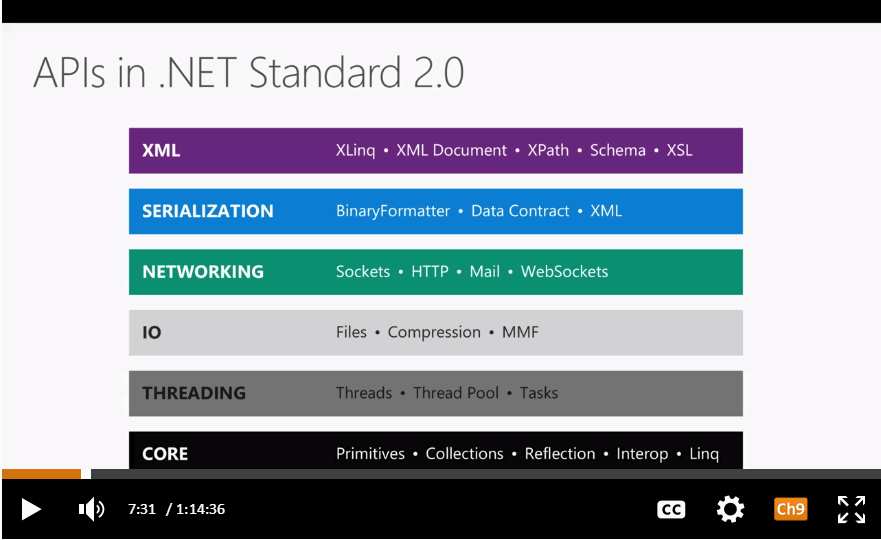
 daltskin
on 16 Aug 2017
daltskin
on 16 Aug 2017
Just tried it with .NET Standard 2.0. Ran into this issue. Reason is that DialogTask and Wait classes use Delegate and Type objects as properties respectively.
Here is the stacktrace
System.Runtime.Serialization.SerializationException: Type 'System.RuntimeType' in Assembly 'System.Private.CoreLib, Version=4.0.0.0, Culture=neutral, PublicKeyToken=7cec85d7bea7798e' is not marked as serializable.
   at System.Runtime.Serialization.Formatters.Binary.WriteObjectInfo.InitSerialize(Object obj, ISurrogateSelector surrogateSelector, StreamingContext context, SerObjectInfoInit serObjectInfoInit, IFormatterConverter converter, ObjectWriter objectWriter, SerializationBinder binder)
   at System.Runtime.Serialization.Formatters.Binary.ObjectWriter.Write(WriteObjectInfo objectInfo, NameInfo memberNameInfo, NameInfo typeNameInfo)
   at System.Runtime.Serialization.Formatters.Binary.ObjectWriter.Serialize(Object graph, BinaryFormatterWriter serWriter, Boolean fCheck)
   at System.Runtime.Serialization.Formatters.Binary.BinaryFormatter.Serialize(Stream serializationStream, Object graph, Boolean check)
   at System.Runtime.Serialization.Formatters.Binary.BinaryFormatter.Serialize(Stream serializationStream, Object graph)
   at Microsoft.Bot.Builder.Internals.Fibers.FormatterStore`1.Microsoft.Bot.Builder.Internals.Fibers.IStore<T>.Save(T item)
   at Microsoft.Bot.Builder.Dialogs.Internals.DialogTask.<Microsoft-Bot-Builder-Base-IEventLoop-PollAsync>d__23.MoveNext()
 syedhassaanahmed
on 17 Aug 2017
syedhassaanahmed
on 17 Aug 2017
I ran into the same thing when I tried this a month or so ago on the
preview NET Core 2.0.
On Thu, Aug 17, 2017 at 1:59 PM, Syed Hassaan Ahmed <
[email protected]> wrote:
Just tried it with .NET Standard 2.0. Ran into this issue
https://github.com/dotnet/corefx/issues/23213. Here is the stacktraceSystem.Runtime.Serialization.SerializationException: Type 'System.RuntimeType' in Assembly 'System.Private.CoreLib, Version=4.0.0.0, Culture=neutral, PublicKeyToken=7cec85d7bea7798e' is not marked as serializable.
at System.Runtime.Serialization.Formatters.Binary.WriteObjectInfo.InitSerialize(Object obj, ISurrogateSelector surrogateSelector, StreamingContext context, SerObjectInfoInit serObjectInfoInit, IFormatterConverter converter, ObjectWriter objectWriter, SerializationBinder binder)
at System.Runtime.Serialization.Formatters.Binary.ObjectWriter.Write(WriteObjectInfo objectInfo, NameInfo memberNameInfo, NameInfo typeNameInfo)
at System.Runtime.Serialization.Formatters.Binary.ObjectWriter.Serialize(Object graph, BinaryFormatterWriter serWriter, Boolean fCheck)
at System.Runtime.Serialization.Formatters.Binary.BinaryFormatter.Serialize(Stream serializationStream, Object graph, Boolean check)
at System.Runtime.Serialization.Formatters.Binary.BinaryFormatter.Serialize(Stream serializationStream, Object graph)
at Microsoft.Bot.Builder.Internals.Fibers.FormatterStore`1.Microsoft.Bot.Builder.Internals.Fibers.IStore.Save(T item)
at Microsoft.Bot.Builder.Dialogs.Internals.DialogTask.d__23.MoveNext() —
You are receiving this because you were mentioned.
Reply to this email directly, view it on GitHub
https://github.com/Microsoft/BotBuilder/issues/572#issuecomment-323192487,
or mute the thread
https://github.com/notifications/unsubscribe-auth/AErlj7gj4xMzGCPEr2p4-z8bvutawtOvks5sZKmvgaJpZM4JBcJw
.
jefflill
on 17 Aug 2017
@jefflill In this case, I'm thinking about using IObjectReference in combination with ISerializationSurrogate to delegate the serialization of Type, MethodInfo, etc. Actually knowing the full-qualified name of the Type is enough to deserialize it.
CXuesong
on 18 Aug 2017
@CXuesong: I've been looking at this some more for the past couple of days. My approach is to extract the BinaryFormatter source from the coreclr repo and munge it to create a specialized version of the class UnsafeBinaryFormatter that works pretty much as you describe.
I got this to the point where I could serialize the runtime types but then ran into a SerializationException complaining that delegates can't be serialized.
I'm guessing the BotBuilder is serializing the delegate that handles the next step in a dialog and perhaps for other things. What a mess. This may need major surgery to get this working.
I see this coreclr commit from 5-23-2017 where MSFT removed all of the [Serializable] attributes for types they didn't want to support and also the DelegateSerializationHolder class. I'm going to try restoring this last class to my hack and see how far this gets us.
I can't believe MSFT used binary serialization for this. This is probably going to be a big rewrite for them to get this to work on NET Standard/Core.
EDIT: The commit actually happened in the coreclr repo (not corefx)
jefflill
on 2 Sep 2017
@CXuesong: I'm giving up. The DelegateSerializationHolder relies on internal corecrl stuff that I don't understand and really don't want to get into right now. I'm going to have to switch to using the old .NET Framework on Windows which will be a bit of a pain because I'm currently hosted only on Ubuntu.
jefflill
on 2 Sep 2017
@jefflill Just saw your repos, and that's... really a lot of code :see_no_evil: And by hosting on Ubuntu, are you talking about something like Wine?
I tried BinaryFormatter yesterday. At least I am still on my way writing some "polyfill"s to get it work with BotFramework on .NET Core. But yes, there are some nasty things like I cannot, in any way without explicitly putting every property into SerializationInfo, serialize Regex and many, many other classes though they "implement" ISerializable, and I still have some trouble using ISerializationSurrogate to surrogate the serialization of RuntimeType. During de-serialization, BinaryFormatter tells me the object to be deserialized is some type of TypeLoadExceptionHolder, which is supposed to be RuntimeType!
Still, BinaryFormatter provides better support for surrogates than JsonSerializer. JsonConverter.CanConvert(Type type) has different semantics for type parameter from ISurrogateSelector.GetSurrogate(Type type, StreamingContext context, out ISurrogateSelector selector)
. During deserialization, it means the declared value type of the property or field, rather than the actual type of the object instance to be deserialized, so I had to use some more nasty hacks(the $resolve thing, rather than $type) into JsonObjectCovnerter.
A little digression here
Recently I am working on some home-made sandbox and surprisingly found out Task cannot be remoted across AppDomain. I thought it should derive from MarshalByRefObject or something... Perhaps they are more or less still going to deprecate those AppDomains, (System.Runtime.Remoting) Remoting, Binary Serialization, etc. Interestingly, they have removed BinaryFormatter from "Unsupported Technologies" section in a later version, but in dotnet/corefx#19119, they observed
But it comes with some serious implications, and it's becoming clear we took things too far. Doing this makes it very easy for code to take dependencies on private implementation details and will end up binding our hands for improvements/optimizations/refactorings/etc. in the future.
Taking in to account the limited set of Exception-derived class that is marked as [Serializable], it's clear they brought back BinaryFormatter only for compatibility purpose, which I think is okay, because we have Newtonsoft.Json now, which is still better than DataContractSerializer.
To make a summary, the current situation is caused by
- It the Fiber they introduced the need for serialization of deleages, and
BinaryFormatteris really a handy approach for that. (Though we can do the same withJsonConverter)
- Then they decide to customize
BinaryFormatterusing surrogates to automatically restore the injected dependencies during deserialization. (Though we can do the same with someObjectFactory, I mean, inject the services via constructors, and populates the properties)
- Then they decide to customize
- The freedom provided by
BinaryFormattermakes it difficult to be replaced.
- Users won't need to care the serialization details (e.g.
[JsonConstructor]), as long as their classes are[Serializable]. - There are many BCL types in .NET Framework marked as
[Serializable]but cannot work withJsonSerializer(Though we can resort toJsonCovnerter) - It provides good support for polymorphism (
JsonSerializercan emit$typetag, but as I have stated above, it does not pass$typeinto JsonConverter.CanConvert) - It provides good support for surrogates (e.g.
IObjectReference; while on the other hand you cannot return an instance of different type inJsonConverterfrom$type)
- Users won't need to care the serialization details (e.g.
In fact, in this situation, we prefer the polymorphism & reference (esp. for circular references) transparency rather than portability across the languages (even not across .NET on different platforms), and we want the serialized data independent from the implementation details (name of the private fields, etc.), which would amount to a mixture of BinaryFormatter and JsonSerializer/DataContractSerializer. That's my 2 cents.
CXuesong
on 4 Sep 2017
@CXuesong: Thoughtful post. You definitely know more about serialization than I do but I'm learning as I'm poking around this lower level stuff.
I've been working on enhancing Docker for maybe a year and a half with tools and services that will make it easy to deploy and run a Docker cluster with all (OK, a lot) of the stuff you'll need for a production environment (setup, remote commands, load balancing, logging,...) called neonCLUSTER. This is currently hosted on Ubuntu nodes and I'm running my applications natively using .NET CORE 2.0. I've got a couple months more work before I release neonCLUSTER, probably with an opensource/freemium model.
Eventually, I'll support mixed Docker clusters with both Ubuntu and Windows node but Windows hasn't been a priority for me and I'm hoping that this BotBuilder issue won't force me to do Windows prematurely.
I haven't actually written a real bot yet, but my sense is that I wouldn't really want to code bots to persist very much application state using the built-in BotBuilder state mechanism, especially if the data persisted is going to be an essentially opaque (to external code) byte array. Instead, I'd persist just enough information into the state so that I can explicitly query conversation state from my NoSQL (or whatever) database. This is for future proofing. Over the long-term, the likely hood that you need external processes to access this data and potentially modify this for one reason or another is very high, and I really don't want to make some poor developer to have to crack some crazy binary format some years hence.
My gut feeling (and I could easily be wrong) is that BotBuilder serialization is somewhat over-engineered. I would looked into designing this such that it simply used JSON with concrete types. Internally, BotBuilder would have had their own types that explicitly serialize conversation internal state include the delegates). Then, I would have tried to have the bot developer (somehow) explicitly specify the concrete app state type that itself was implemented only with concrete types. I suspect that for many (most?) applications the app state is going to be just a handful of fields, not a complex object graph. So, simple JSON.NET serialization would just work. Applications with complex graphs would have to serialize these themselves one way or another (and an easy way would be to define the bot state type to include a byte array and then explicitly use BinaryFormatter to serialize the graph into that array.
I decided yesterday morning to have one more go at creating a munged BinaryFormatter called NeonBinaryFormatter. The approach now is to introduce the concept of built-in surrogates for types like System.RuntimeType and Delegate. These surrogates will be implicitly available for backwards compatibility. I believe I have System.RuntimeType and I'm working on Delegate now (hopefully the last problem type required for basic bots). If this works, I'll release NeonBinaryFormatter as an open source Nuget package that allows folks to add additional built-in surrogates.
Your historical comments on .NET Core are interesting. I believe you are probably right about MSFT long-term intentions. I found it interesting that they didn't disable serialization for all of these type in .NET Core 2.0 until just this May (~3 months ago). That was probably very smart move; you don't want to release a shiny new platform that builds in a lot of potential future constraints.
If it had been up to me though, I would have tried to add a BinaryFormatter(bool unsafe = false) constructor (or something) that enabled the old behavior, explicitly telling developers that serialized types may not work cross platform or even across different releases of the same platform. I can see MSFT prioritizing this though. Shipping is a feature, as they say.
I'll let you know if I get this working.
jefflill
on 4 Sep 2017
Finally! I got the example projects compile with my ported library. You may check out this (could-be-rather-unstable) prerelease. See the notes here. You can also update the packages via NuGet with "-Pre" turned on.
CXuesong
on 4 Sep 2017
@jefflill I am still learning about Binary Serialization, and all the Linux stuff. Oh plus Docker now :see_no_evil: You are doing awesome work!
I intended to write a bot but running on Ubuntu. That is when I found out BotBuilder SDK only runs on .NET Framework. Haven't plunged into the Fiber stuff (if I have time, I will try to comprehend it in the future). But I guess if they separate the states from methods, just like MVC controller, the life would be great. Then it will be possible for JsonSerializer to store only the fields, by value, and then we can make some assumption of "no polymorphism" and "no cyclic references" safely. Under current situation, BinaryFormatter introduced too much freedom, and we just cannot make any assumptions… Yes I believe except from the methods, the Dialog would be a trivial combination of fields. Nobody need to store Exception instance in their state, after all.
Yes, we need to support serializing delegates first, and this amounts to the serialization of Type, and MethodInfo. We also need to serialize Regex because its used everywhere.
As for over-engineering… I'm not sure but perhaps we can do nothing more than migrating… Until someone decides to rework it :see_no_evil:
CXuesong
on 5 Sep 2017
@CXuesong: I played around a bit with your BotBuilder port this morning and so far so good: IT WORKS! Very cool. I've abandoned my efforts and pointed folks to your repo and Nuget packages. Great work!
It sure would be nice if MSFT were to take a pull request from you and make this official. It's a bit strange that they've been so quiet about this issue, especially with .NET Core 2.0 being their big shiny new thing.
If I were you, I'd submit a pull request just to see their response, and who knows, perhaps they'd accept it and you'd be famous :)
jefflill
on 9 Sep 2017
@jefflill Oh I'd love to be famous XD After all, who wouldn't?
Though it may take a while to prepare a PR :-P
CXuesong
on 10 Sep 2017
@CXuesong, anxiously waiting for your PR to be approved. You would be famous and we will be happy 😊!
Started to have doubts in our desicion to go with C#..
Any progress with that?
AmirSasson
on 30 Nov 2017
Btw, if anyone wants to try creating chat bot using ASP.NET Core 2.0 (.NET Core 2), I make some simple working sample and blog it. Source code also available and currently I'm adding the project template as BotApplicationNetCore2 for VS2017 15.5 Preview 5.
Check it out: https://www.rizamarhaban.com/2017/11/27/creating-chat-bot-using-asp-net-core-2-web-api-microsoft-bot-framework/
 rizamarhaban
on 30 Nov 2017
rizamarhaban
on 30 Nov 2017
@rizamarhaban thanks for the sample! Is it possible to the same for VS Code in Linux, for example? What are the steps could be? Thanks!
 akontsevich
on 30 Nov 2017
akontsevich
on 30 Nov 2017
@AmirSasson I can only say, if you want to consume Bot.Builder on .NET Core with C#, for now, you may try out my unofficial releases of BotBuilder.
I guess nodejs certainly has no compatibility issue for now…
CXuesong
on 1 Dec 2017
Good news everyone!
New Bot Connector support for ASP.NET Core 2.0 and 1.1
https://blog.botframework.com/2017/11/28/new-bot-connector-support-net-core-2-0/
nwhitmont
on 14 Dec 2017
Hurray!!! :)
akontsevich
on 14 Dec 2017
@nwhitmont yes the Connector is there now but the actual Bot.Builder package is still old and not supported by ASP.NET Core 2.0 will this be upgraded as well?
 Geertvdc
on 15 Dec 2017
Geertvdc
on 15 Dec 2017
@Geertvdc No Bot.Builder Will not support .Net Core. Our next version (v4) of the SDK will fully support it though. At this time we do not have hard dates for a release of it, but it should be in the not too distant future.
 JasonSowers
on 21 Dec 2017
JasonSowers
on 21 Dec 2017
is this V4 being build as open source? can we see it somewhere / contribute?
Geertvdc
on 21 Dec 2017
@Geertvdc Right now we do not have information to release publicly please follow #3891. We will update that issue as we can.
JasonSowers
on 21 Dec 2017
v4 with .Net Core is out, we may close this issue, don't we?
 nrobert
on 14 Mar 2018
nrobert
on 14 Mar 2018
Agreed! Though it may take some time for the next generation SDK to stabilize.
Wait for it.
CXuesong
on 14 Mar 2018
SWEET
 oscarwest
on 15 Mar 2018
oscarwest
on 15 Mar 2018
Update?
 hitaspdotnet
on 13 Jun 2018
hitaspdotnet
on 13 Jun 2018
See my answer below, it's already out for weeks, what do you mean by "update?"?
nrobert
on 13 Jun 2018
@hitaspdotnet the new version of the API that supports .net core is located here: https://github.com/Microsoft/botbuilder-dotnet
they moved it to a separate repo
Geertvdc
on 13 Jun 2018
@nrobert issue still open
hitaspdotnet
on 13 Jun 2018
Bot Builder V4 SDK available in preview here will fully support dotnet core. There are no plans to add any additional support for dotnet core to the V3 SDK.
 vishwacsena
on 26 Jun 2018
vishwacsena
on 26 Jun 2018
Related issues
 bluekite2000
·
4Comments
bluekite2000
·
4Comments
 arpan14
·
3Comments
arpan14
·
3Comments
 verdysh
·
3Comments
verdysh
·
3Comments
 maba4891
·
3Comments
maba4891
·
3Comments
 jschristophe
·
3Comments
jschristophe
·
3Comments
Most helpful comment
Well, it seems that I have just ported
Bot.Builderto .Net Standard with VS 2017, and got some example projects working on ASP.Net Core.The basic idea is to use
JsonSerializerto take overBinaryFormatter, though IMO it is a little bit tricky, and might not reliable enough. Still, I think it's better than nothing.Anyway, the repository is CXuesong/BotBuilder.Standard, and I have written
some notes on it.You may drop by if you want something to play with…Update: I have uploaded these unofficially ported packages to NuGet. You may take a look at the notes mentioned above to find out the package names.
Update: I have made a rather rudimentary .NET Core 2.0 targeted port using
BinaryFormatter. It is now available on NuGet. Still, no stability guarantee. See the notes here.