Bat: feature request: detect filetype based on vim/emacs comments
Vim and Emacs can detect the file type base on comments placed at the top of the file.
For emacs:
# -*- mode: ruby -*-
For vim:
# vi: set ft=ruby :
This is useful for vagrant configuration files which are written in Ruby but are named Vagrantfile for example.
 little-dude
All 7 comments
Thank you for the feedback. bat (or rather syntect) can do the same, but it has to be specified in the respective syntax file. The C.sublime-syntax file, for example, has this header (see first_line_match):
name: C
file_extensions:
  - c
  - h
first_line_match: "-[*]-( Mode:)? C -[*]-"
scope: source.c
which bat correctly detects:
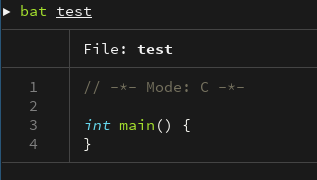
Unfortunately, only a few syntax definitions include this feature. The Ruby syntax includes this:
first_line_match: ^#!\s*/.*\bj?ruby\b
which means that it only detects shebangs:
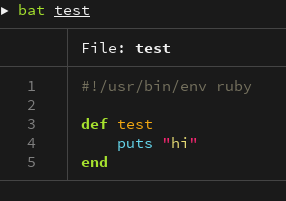
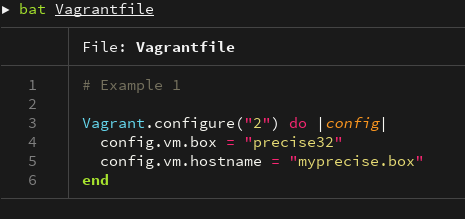
However, note that Vagrantfile is correctly detected and displayed with Ruby syntax highlighting:
 sharkdp
on 31 May 2018
sharkdp
on 31 May 2018
Actually, I guess correct highlighting of files such as Vagrantfile is only supported on master and not in the latest release. It has been integrated in syntect with my pull request here: https://github.com/trishume/syntect/pull/163.
sharkdp
on 31 May 2018
Ah awesome! I'll wait for next release then. I'll look at syntect to ask if it's worth adding support for -*- mode: ruby -*-. Thanks for the answer!
little-dude
on 31 May 2018
I'll look at syntect to ask if it's worth adding support for -- mode: ruby --.
This would have to be done here: https://github.com/sublimehq/Packages
sharkdp
on 31 May 2018
New release is out.
sharkdp
on 1 Jun 2018
Just updated, and I can now see my Vagrantfiles with colors \o/
Thanks for this nice crate!
little-dude
on 3 Jun 2018
Thank you for the feedback!
sharkdp
on 3 Jun 2018
Related issues
 mjlbach
·
3Comments
mjlbach
·
3Comments
 gwpl
·
3Comments
gwpl
·
3Comments
 issmirnov
·
3Comments
issmirnov
·
3Comments
 tbsvttr
·
3Comments
tbsvttr
·
3Comments
 rien333
·
3Comments
rien333
·
3Comments