Azure-functions-host: Proxy merges multiple cookie headers into one
This makes all modern browsers only capture the first cookie.
Investigative information
- Timestamp: Wed, 22 May 2019 14:48:15 GMT
- Function App version (1.0 or 2.0): 2.0
- Region: Westeurope
Repro steps
Create function proxy to and endpoint that returns multiple cookies in one response.
Expected behavior
The multiple "Set-Cookie" headers should be transported as they are, one-by-one, into the response. example:
Set-Cookie: idsrv.session=21bxxxxxxxxxxxxxxxxxxxxx93b1; path=/; secure
Set-Cookie: .AspNetCore.Identity.Application=CfDJ8EXV_uoT8urq1HrndD5I; expires=Wed, 05 Jun 2019 14:48:15 GMT; path=/; secure; httponly
Actual behavior
However, the function proxy meges the two returned cookies into one comma separated value:
Set-Cookie: idsrv.session=21bxxxxxxxxxxxxxxxxxxxxx93b1; path=/; secure, .AspNetCore.Identity.Application=CfDJ8EXV_uoT8urq1HrndD5I; expires=Wed, 05 Jun 2019 14:40:59 GMT; path=/; secure; httponly
This makes it impossible to authenticate via this function proxy.
 macgyver2k
All 16 comments
I am also experiencing this problem:
Original (link w/o proxy):
Set-Cookie: ...value.. ,
Set-Cookie: ..value... ,
Set-....
Proxy link :
Set-Cookie: ...value..., ...value..., ...value..., ...
We looked into possibly intercepting the request and splitting the cookie headers ourselves, but doesn't look like its possible. If there is a hot fix to use in the mean time, we would love to know.
 AllisonBolen
on 10 Jun 2019
AllisonBolen
on 10 Jun 2019
I have experienced this same issue as well, as documented above. It would be nice to see a resolution for this.
 mikeking27
on 13 Jun 2019
mikeking27
on 13 Jun 2019
I once encountered an error page for the proxy. It looked pretty much like a Jetty error page. So the problem may not be fixable inside Azure Functions implementation. I also could not find any line of code beeing accountable for this issue inside Azure Functions.
macgyver2k
on 14 Jun 2019
@AllisonBolen we're running into the same issue. You mentioned looking at splitting the cookie headers yourselves and was going to try something similar. I was wondering if you were doing that within the function and trying to override the response headers?
 mgfink
on 1 Jul 2019
mgfink
on 1 Jul 2019
@vfedonkin would you please investigate this?
 safihamid
on 16 Jul 2019
safihamid
on 16 Jul 2019
Looking...
 vfedonkin
on 16 Jul 2019
vfedonkin
on 16 Jul 2019
We decided to use Nginx as a proxy, but would love to see a fix for this soon so we can utilize this in the future.
AllisonBolen
on 16 Jul 2019
According to http://www.w3.org/Protocols/rfc2616/rfc2616-sec4.html#sec4.2 :
Multiple message-header fields with the same field-name MAY bepresent in a message if and only if the entire field-value for thatheader field is defined as a comma-separated list [i.e., #(values)].It MUST be possible to combine the multiple header fields into one"field-name: field-value" pair, without changing the semantics of themessage, by appending each subsequent field-value to the first, eachseparated by a comma. The order in which header fields with the samefield-name are received is therefore significant to theinterpretation of the combined field value, and thus a proxy MUST NOTchange the order of these field values when a message is forwarded.
.Net framework combines headers automatically when getting HttpWebResponse.
Anyway, the task for Api Management team was created to pass backend provided headers as is, so backend should be responsible for that logic.
After the task is done and tested we will apply same changes to the functions proxy.
vfedonkin
on 16 Jul 2019
Would it be possible to tweak the proxy somehow to alter the back-end response headers as follows?
Before:
Set-Cookie: ...value..., ...value..., ...value..., ...
After:
Set-Cookie: ...value.. ,
Set-Cookie: ..value... ,
I'm wondering if this is something that could be done on the user side since we have the ability to alter response headers.
mgfink
on 19 Jul 2019
@vfedonkin is this something that has been done in APIM? Are you still thinking about backporting this to Proxies?
 fabiocav
on 24 Sep 2019
fabiocav
on 24 Sep 2019
@fabiocav , yes, we fixed this in APIM. Will fix it in Functions Proxies soon.
vfedonkin
on 27 Sep 2019
Thank you. Flagging this as triaged for now as it is still on the radar.
fabiocav
on 27 Sep 2019
@vfedonkin Do you have some estimation when it will be fixed in Functions Proxies, please?
 ZivotJeKrasny
on 7 Jan 2020
ZivotJeKrasny
on 7 Jan 2020
Having issues with accessing original headers in .net core. Trying to solve but didn't find solution yet. No ETA.
vfedonkin
on 7 Jan 2020
There is a bug in .net core implementation, need to wait till this issue is resolved: https://github.com/dotnet/corefx/issues/39527
vfedonkin
on 10 Jan 2020
Is there any work-around for this? Would switching runtime work?
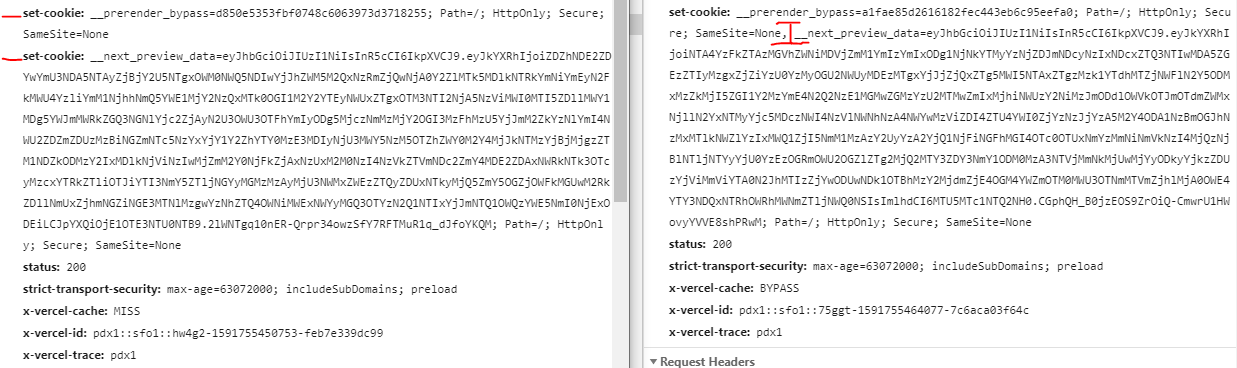
I experienced the same issue while trying to proxy against a Vercel (prev. Zeit) serverless function. In the screenshot, left is original response. Right is proxied response.
 chuanqisun
on 10 Jun 2020
chuanqisun
on 10 Jun 2020
Related issues
 mathewc
·
4Comments
mathewc
·
4Comments
 krillehbg
·
3Comments
krillehbg
·
3Comments
 paulbatum
·
4Comments
paulbatum
·
4Comments
 alaatm
·
4Comments
alaatm
·
4Comments
 ladeak
·
3Comments
ladeak
·
3Comments
Most helpful comment
I am also experiencing this problem:
Original (link w/o proxy):
Set-Cookie: ...value.. ,Set-Cookie: ..value... ,Set-....Proxy link :
Set-Cookie: ...value..., ...value..., ...value..., ...We looked into possibly intercepting the request and splitting the cookie headers ourselves, but doesn't look like its possible. If there is a hot fix to use in the mean time, we would love to know.