Aws-load-balancer-controller: Support Advanced Request Routing
The Advanced Request Routing for ALB was just announced: https://aws.amazon.com/fr/blogs/aws/new-advanced-request-routing-for-aws-application-load-balancers/
Do you have an ETA for implementing this ?
One of our use case would be to have the same path defined in our ingress but with different "backend" that would be routed by HTTP method request (POST or GET).
This would be especially useful for people working with Lambdas.
I have no idea if the ingress spec allow for defining twice the same path, if it does not maybe a specific annotation could work.
 Rowern
All 29 comments
Hi, How would you like it be implemented?
Alternative 1 - Use Ingress Group: the routing.condition on ingress will affect all rules inside that ingress, and all ingress belongs to same group(mysvc-group) will be aggragted on same ALB/Listener.
apiVersion: extensions/v1beta1
kind: Ingress
metadata:
name: mysvc-get
annotations:
kubernetes.io/ingress.class: alb
alb.ingress.kubernetes.io/group: mysvc-group
alb.ingress.kubernetes.io/routing.condition.header:header1=b,header2=d
alb.ingress.kubernetes.io/routing.condition.verb:GET,HEAD
spec:
rules:
- host: www.example.com
http:
paths:
- path: /api
backend:
serviceName: service-blue
servicePort: 8080
---
apiVersion: extensions/v1beta1
kind: Ingress
metadata:
name: mysvc-post
annotations:
kubernetes.io/ingress.class: alb
alb.ingress.kubernetes.io/group: mysvc-group
alb.ingress.kubernetes.io/routing.condition.header:header1=b,header2=d
alb.ingress.kubernetes.io/routing.condition.verb:POST,PATCH
spec:
rules:
- host: www.example.com
http:
paths:
- path: /api
backend:
serviceName: service-green
servicePort: 8080
Alternative 2 - Extend the use-annotation:
apiVersion: extensions/v1beta1
kind: Ingress
metadata:
name: ingress-foo
annotations:
kubernetes.io/ingress.class: alb
alb.ingress.kubernetes.io/actions.api-rule-cfg-get: '{"conditions":["verb": ["get", "head"]]:, "backend": [{"serviceName:service1", "servicePort":80, "weight":80}, {"serviceName:service2", "servicePort":80, "weight":20}]}'
alb.ingress.kubernetes.io/actions.api-rule-cfg-post: '{"conditions":["verb": ["get", "head"]]:, "backend": [{"serviceName:service1", "servicePort":80, "weight":80}, {"serviceName:service2", "servicePort":80, "weight":20}]}'
spec:
rules:
- host: www.example.com
http:
paths:
- path: /api
backend:
serviceName: api-rule-cfg-get
servicePort: use-annotation
- path: /api
backend:
serviceName: api-rule-cfg-post
servicePort: use-annotation
Alternative 3 - Similar to Alternative 2 but use CRD instead of annotation:
apiVersion: extensions/v1beta1
kind: Ingress
metadata:
name: ingress-foo
annotations:
kubernetes.io/ingress.class: alb
spec:
rules:
- host: www.example.com
http:
paths:
- path: /api
backend:
serviceName: api-rule-cfg-get
servicePort: use-crd
- path: /api
backend:
serviceName: api-rule-cfg-post
servicePort: use-crd
---
apiVersion: ingress.k8s.io/v1alpha1
kind: RouteConfig
metadata:
name: api-rule-cfg-get
spec:
# can also embed other rule level settings.
verb: GET
query: header1=a
port: 443
backend:
- serviceName: service1
servicePort: 80
weight: 80
- serviceName: service2
servicePort: 80
weight: 20
---
apiVersion: ingress.k8s.io/v1alpha1
kind: RouteConfig
metadata:
name: api-rule-cfg-post
spec:
# can also embed other rule level settings.
verb: POST
query: header1=b
port: 443
backend:
- serviceName: service1
servicePort: 80
weight: 80
- serviceName: service2
servicePort: 80
weight: 20
Alternative 4? If you have preferences 😄
 M00nF1sh
on 2 Apr 2019
M00nF1sh
on 2 Apr 2019
Alternative 3 is maybe the cleanest but doesn't it means you have to "implement" a new object inside kubernetes ?
If you go this way doesn't it means you will have to maintain 2 ways of specifying routing (one by annotation "actions" and one with objects "RouteConfig").
Alternative 2 is the closest to what this controller provides and might be easier to understand for anyone (maybe even easier to implement?).
Maybe the actions annotation could be re-used by adding some more infos:
{
"Type": "AdvancedRouting",
"AdvancedRoutingConfig": {
"Conditions": {
"Verbs": ["get", "post"]
},
"Backend": {
"Type": "forward",
"TargetGroupArn": "arn:123:blabha..."
}
}
}
With Alternative 2 my use case might look like this (two rules on the /api route to two target groups):
apiVersion: extensions/v1beta1
kind: Ingress
metadata:
name: ingress-foo
annotations:
kubernetes.io/ingress.class: alb
alb.ingress.kubernetes.io/actions.api-rule-cfg-get: '{"Type": "AdvancedRouting","AdvancedRoutingConfig": {"Conditions": {"Verbs": ["get"]},"Backend": {"Type": "forward","TargetGroupArn": "arn:123:blabha..."}}}'
alb.ingress.kubernetes.io/actions.api-rule-cfg-post: '{"Type": "AdvancedRouting","AdvancedRoutingConfig": {"Conditions": {"Verbs": ["post"]},"Backend": {"Type": "forward","TargetGroupArn": "arn:456:blabha..."}}}'
spec:
rules:
- host: www.example.com
http:
paths:
- path: /api
backend:
serviceName: api-rule-cfg-get
servicePort: use-annotation
- path: /api
backend:
serviceName: api-rule-cfg-post
servicePort: use-annotation
I would prefer alternative 1 as it seems most ci friendly. Also thinking of a blue-green deployment we can safely add new ingress, do canary analysis and drop the previous ingress. Also, I believe alternative one would require a lesser extension so we can expect faster implementation and lesser bugs.
 rverma-nikiai
on 4 Apr 2019
rverma-nikiai
on 4 Apr 2019
Including it in the current actions (Alternative 2) would be a great addition for me. Making separate alb files seems confusing when it is the same alb (Alternative 1).
 VincentCouzij
on 5 Apr 2019
VincentCouzij
on 5 Apr 2019
Thanks to @M00nF1sh and @Rowern
Ref: https://github.com/kubernetes-sigs/aws-alb-ingress-controller/issues/916
Second alternative seemed to be the easiest with minimal effort.
Combined the suggestions from both and it worked fine
alb.ingress.kubernetes.io/actions.api-rule-cfg-get: '{"Type": "AdvancedRouting","AdvancedRoutingConfig": {"Conditions": {"Verbs": ["get"]},"Backend": {"serviceName:app1", "servicePort":80}}}'
alb.ingress.kubernetes.io/actions.api-rule-cfg-post: '{"Type": "AdvancedRouting","AdvancedRoutingConfig": {"Conditions": {"Verbs": ["post"]},"Backend": {"serviceName:app2", "servicePort":80}}}'
- path: /api/*
backend:
serviceName: api-rule-cfg-post
servicePort: use-annotation
- path: /api/*
backend:
serviceName: api-rule-cfg-get
servicePort: use-annotation
One additional step was to manually add the GET and POST methods as additional rules on the AWS side after deploying the Ingress file
 kannananandan
on 10 Apr 2019
kannananandan
on 10 Apr 2019
all three option are easy to implement 😄.
Personally i favor alternative2(can add weight based routing later based on it). And we can evolve to use CRD based solution if it works well 😄 .
M00nF1sh
on 10 Apr 2019
Not sure which would be my preference, but as long as I can express that I want OPTION to go to the service and GET,POST to be authenticated and then go to the service I'm fine with either..
 marcust
on 10 Apr 2019
marcust
on 10 Apr 2019
One thing that is nice about alternative 1 (ingress groups) is that we'd also be able to have more granular authentication rules. For example, I could have the path /foo under an ingress with auth configured, and /bar under another ingress that doesn't require authentication, for the same host. I believe that's not supported right now.
What's not so nice is that as the number of ingresses grow (e.g. if I need a new ingress for each service because I want different source ips conditions), I imagine I'd need to keep all the other config annotations (scheme, subnets, target-type, etc.) in sync manually, as they all refer to the same ALB.
As I believe this use case will already be covered after the Ingress Group Feature is released, the alternative 2 seems easier to maintain.
Here's an example using both the ingress grouping and annotations for advanced routing conditions:
apiVersion: extensions/v1beta1
kind: Ingress
metadata:
  name: auth-ingress
  annotations:
    kubernetes.io/ingress.class: alb
    alb.ingress.kubernetes.io/group: mysvc-group
    alb.ingress.kubernetes.io/auth-type: 'oidc'
    alb.ingress.kubernetes.io/auth-on-unauthenticated-request: 'authenticate'
    alb.ingress.kubernetes.io/auth-scope: 'openid'
    alb.ingress.kubernetes.io/auth-session-cookie: 'AWSELBAuthSessionCookie'
    alb.ingress.kubernetes.io/auth-session-timeout: '604800'
    alb.ingress.kubernetes.io/auth-idp-oidc: '{
        "Issuer": "https://accounts.google.com",
        "AuthorizationEndpoint": "https://accounts.google.com/o/oauth2/v2/auth",
        "TokenEndpoint": "https://www.googleapis.com/oauth2/v4/token",
        "UserInfoEndpoint": "https://www.googleapis.com/oauth2/v3/userinfo",
        "SecretName": "alb-oidc-secret"
      }'

spec:
  rules:
    - host: example.com
      http:
        paths:
          - path: /foo/*
            backend:
              serviceName: service1
              servicePort: 80

---

apiVersion: extensions/v1beta1
kind: Ingress
metadata:
  name: no-auth-ingress
  annotations:
    kubernetes.io/ingress.class: alb
    alb.ingress.kubernetes.io/group: mysvc-group
    alb.ingress.kubernetes.io/actions.from-authorized-sources: '{
      "conditions":[
        "sourceIps": ["177.40.126.35/32", "177.40.126.36/32"]],
        "backend": [
          { "serviceName": "service1", "servicePort": "80" }
        ]
    }'

spec:
  rules:
    - host: example.com
      http:
        paths:
          - path: /bar/*
            backend:
              serviceName: from-authorized-sources
              servicePort: use-annotation

          - path: /*
            backend:
              serviceName: service1
              servicePort: 80
This would configure a single ALB where:
example.com/foo/* would require google auth
example.com/bar/* would only allow requests from the whitelisted source IPs
Any other request to example.com/* would be routed to service1
 brianstorti
on 1 May 2019
brianstorti
on 1 May 2019
@M00nF1sh any idea when this is going to land?
 AdeOpe
on 31 May 2019
AdeOpe
on 31 May 2019
Hello @M00nF1sh , do we have any update with this issue ? If you need help, it would be my pleasure to help you!!
 nestoras
on 21 Jun 2019
nestoras
on 21 Jun 2019
Is there any planned timeline for the support of advanced routing? This will be very usefull in our multitenant scenario
 ashish4github
on 25 Jun 2019
ashish4github
on 25 Jun 2019
Hi any update on this issue and when it will be implemented?
 akash0710
on 8 Jul 2019
akash0710
on 8 Jul 2019
+1 waiting on the same. Any timelines? :D
Thanks
 mr-karan
on 11 Jul 2019
mr-karan
on 11 Jul 2019
I assume this project has been abandoned in favor of aws own app-mesh to use routing using envoy. There are no updates on either on shared ingress nor on advanced routing.
rverma-nikiai
on 11 Jul 2019
@rverma-nikiai Hi, it's not true. app-mesh is targeting different area than Ingress. I'll be actively back to contribute to this project soon. (was doing other internal tasks)
M00nF1sh
on 11 Jul 2019
Good to hear that :)
rverma-nikiai
on 12 Jul 2019
+1
 clhlc
on 20 Aug 2019
clhlc
on 20 Aug 2019
+1
 tspycher
on 19 Sep 2019
tspycher
on 19 Sep 2019
I'd also need to have the features mentioned #925, specifically "Host header" and "Path" rule. I am running an alb-ingress-controller image from July it keeps deleting rules I manually added to the ALB listener. It is only keeping the rules it created itself.
 garyfritz
on 1 Oct 2019
garyfritz
on 1 Oct 2019
+1
 esg-dlelis
on 3 Oct 2019
esg-dlelis
on 3 Oct 2019
Is there any way currently to restrict access from a specific IP?
I'm using aws-alb-ingress-controller:v1.1.3
esg-dlelis
on 3 Oct 2019
How many IPs?
Could Network ACL handle it?
 Vadim-Zenin
on 4 Oct 2019
Vadim-Zenin
on 4 Oct 2019
+1
 chendanshuang
on 30 Oct 2019
chendanshuang
on 30 Oct 2019
+1
 gxjluck
on 13 Nov 2019
gxjluck
on 13 Nov 2019
Alternative 3 looks like the best, but I can live with alternative 2. If it's significantly easier to implement, alternative 2 sounds better and then we can try alternative 3 in the future.
 alFReD-NSH
on 14 Nov 2019
alFReD-NSH
on 14 Nov 2019
I'm trying to use path-based routing using ALB ingress as following:
[root@ip-10-0-60-180 test-lb]# cat ingresstestlb.yaml
apiVersion: extensions/v1beta1
kind: Ingress
metadata:
name: test-ingress
namespace: "default"
annotations:
kubernetes.io/ingress.class: "alb"
alb.ingress.kubernetes.io/certificate-arn: xxxxx
alb.ingress.kubernetes.io/listen-ports: '[{"HTTP": 80}, {"HTTPS":443}]'
alb.ingress.kubernetes.io/scheme: internal
alb.ingress.kubernetes.io/subnets: subnet-1,subnet-2
alb.ingress.kubernetes.io/security-groups: sg-xxxxx
alb.ingress.kubernetes.io/actions.test123: >
{"Type":"forward","TargetGroupArn": "xxxxx"}
spec:
rules:
- host: abcdef.com
http:
paths:
- path: /abcservices/*
backend:
serviceName: test123
servicePort: use-annotation
I'm not able to browse the service in any browser but I'm getting response from curl.
On the other hand, If I simply configure host without any path configured, I am able to browse the services.
My requirement is to use path based routing.
Please advise what I'm missing here.
Thanks
 gsharm2020
on 18 Mar 2020
gsharm2020
on 18 Mar 2020
One thing that is nice about alternative 1 (ingress groups) is that we'd also be able to have more granular authentication rules. For example, I could have the path
/foounder an ingress with auth configured, and/barunder another ingress that doesn't require authentication, for the same host. I believe that's not supported right now.What's not so nice is that as the number of ingresses grow (e.g. if I need a new ingress for each service because I want different
source ipsconditions), I imagine I'd need to keep all the other config annotations (scheme, subnets, target-type, etc.) in sync manually, as they all refer to the same ALB.As I believe this use case will already be covered after the Ingress Group Feature is released, the alternative 2 seems easier to maintain.
Here's an example using both the ingress grouping and annotations for advanced routing conditions:
apiVersion: extensions/v1beta1
kind: Ingress
metadata:
  name: auth-ingress
  annotations:
    kubernetes.io/ingress.class: alb
    alb.ingress.kubernetes.io/group: mysvc-group
    alb.ingress.kubernetes.io/auth-type: 'oidc'
    alb.ingress.kubernetes.io/auth-on-unauthenticated-request: 'authenticate'
    alb.ingress.kubernetes.io/auth-scope: 'openid'
    alb.ingress.kubernetes.io/auth-session-cookie: 'AWSELBAuthSessionCookie'
    alb.ingress.kubernetes.io/auth-session-timeout: '604800'
    alb.ingress.kubernetes.io/auth-idp-oidc: '{
        "Issuer": "https://accounts.google.com",
        "AuthorizationEndpoint": "https://accounts.google.com/o/oauth2/v2/auth",
        "TokenEndpoint": "https://www.googleapis.com/oauth2/v4/token",
        "UserInfoEndpoint": "https://www.googleapis.com/oauth2/v3/userinfo",
        "SecretName": "alb-oidc-secret"
      }'

spec:
  rules:
    - host: example.com
      http:
        paths:
          - path: /foo/*
            backend:
              serviceName: service1
              servicePort: 80

---

apiVersion: extensions/v1beta1
kind: Ingress
metadata:
  name: no-auth-ingress
  annotations:
    kubernetes.io/ingress.class: alb
    alb.ingress.kubernetes.io/group: mysvc-group
    alb.ingress.kubernetes.io/actions.from-authorized-sources: '{
      "conditions":[
        "sourceIps": ["177.40.126.35/32", "177.40.126.36/32"]],
        "backend": [
          { "serviceName": "service1", "servicePort": "80" }
        ]
    }'

spec:
  rules:
    - host: example.com
      http:
        paths:
          - path: /bar/*
            backend:
              serviceName: from-authorized-sources
              servicePort: use-annotation

          - path: /*
            backend:
              serviceName: service1
              servicePort: 80
This would configure a single ALB where:
example.com/foo/*would require google auth
example.com/bar/*would only allow requests from the whitelisted source IPs
Any other request toexample.com/*would be routed toservice1
@brianstorti
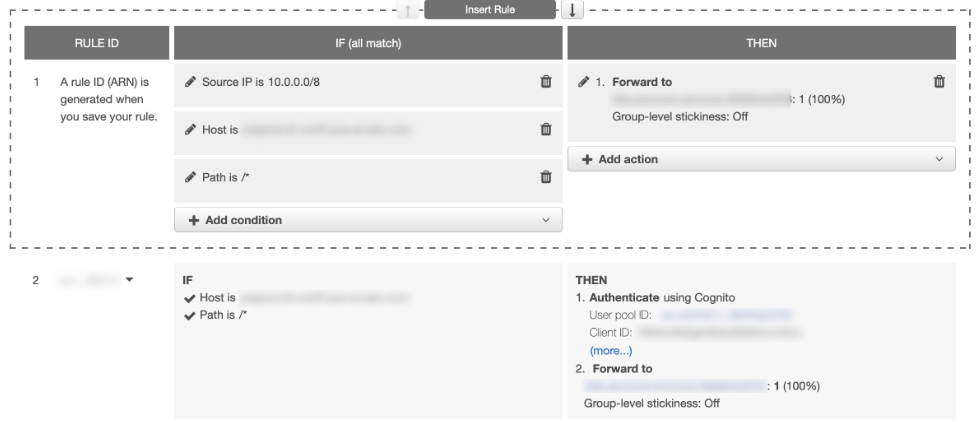
Only concern, It is creating 2 load balancer( auth-ingress & no-auth-ingress) with common target group. Is it possible to have a single ALB with both rule implemented.
Manually, it possible not able to get using Ingress.yaml.
 chandankashyap19
on 8 Jul 2020
chandankashyap19
on 8 Jul 2020
Any update on this issue?
 sebsanchez
on 3 Sep 2020
sebsanchez
on 3 Sep 2020
Issue is closed. But still It is not being resolved. Using ingress.yaml, it is still not possible.
chandankashyap19
on 7 Sep 2020
Related issues
 mgoodness
·
5Comments
mgoodness
·
5Comments
 ghostsquad
·
4Comments
ghostsquad
·
4Comments
 amalagaura
·
4Comments
amalagaura
·
4Comments
 jwickens
·
4Comments
jwickens
·
4Comments
 ishaannarang
·
5Comments
ishaannarang
·
5Comments
Most helpful comment
One thing that is nice about alternative 1 (ingress groups) is that we'd also be able to have more granular authentication rules. For example, I could have the path
/foounder an ingress with auth configured, and/barunder another ingress that doesn't require authentication, for the same host. I believe that's not supported right now.What's not so nice is that as the number of ingresses grow (e.g. if I need a new ingress for each service because I want different
source ipsconditions), I imagine I'd need to keep all the other config annotations (scheme, subnets, target-type, etc.) in sync manually, as they all refer to the same ALB.As I believe this use case will already be covered after the Ingress Group Feature is released, the alternative 2 seems easier to maintain.
Here's an example using both the ingress grouping and annotations for advanced routing conditions:
This would configure a single ALB where:
example.com/foo/*would require google authexample.com/bar/*would only allow requests from the whitelisted source IPsAny other request to
example.com/*would be routed toservice1