Auth0.js: Can’t get google refresh token using auth0.js
Describe the problem
I follow this link https://community.auth0.com/t/cant-get-google-refresh-token-using-auth0-js/11756
When i’m using login with google function, i can't get the refresh token.
This is my code:
var params = Object.assign(
  {
    overrides: {
      __tenant: config.auth0Tenant,
      __token_issuer: config.authorizationServer.issuer,
    },
    domain: config.auth0Domain,
    clientID: config.clientID,
    redirectUri: config.callbackURL,
    responseType: "code",
    scope: 'openid profile offline_access'
  },
  config.internalOptions
);

var webAuth = new auth0.WebAuth(params);

webAuth.authorize({
  connection: 'google-oauth2',
  connection_scope: 'https://www.googleapis.com/auth/calendar,https://www.googleapis.com/auth/calendar.events',
  scope: 'openid profile',
  accessType: 'offline',
  approvalPrompt: 'force'
}, function(err) {
  if (err) displayError(err);
});
This is what i get from api /api/v2/users/{id}:

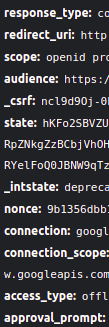
I check param from authorize request and still get access_type
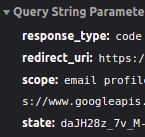
And when i check goolge url redirect from auth0 i don't see the access_type param
 duongmanhhoang
All 3 comments
When i add state:'' to authorize method, it’s work. I wonder if it has any risks cause i’ve read that state is used to prevent attack?
webAuth.authorize({
  connection: 'google-oauth2',
  responseType: "code",
  state:'',
  connection_scope: 'https://www.googleapis.com/auth/calendar,https://www.googleapis.com/auth/calendar.events',
  scope: 'openid profile email offline_access',
  accessType: 'offline',
  approvalPrompt: 'force'
}, function(err) {
  console.log(err);
  if (err) displayError(err);
});
This sounds odd, I'm surprised it works if you set state to ''. You should not do that though as you're correct - the state parameter there is there to help prevent XSRF attacks.
In your second example you are also passing the 'offline_access' scope when compared to the example that does not work - can you confirm if you are able to omit state and have it still work?
 stevehobbsdev
on 17 Sep 2021
stevehobbsdev
on 17 Sep 2021
I'll close this for now. If there is still an issue here, please feel free to reply and I'll do my best to help.
stevehobbsdev
on 15 Oct 2021
Related issues
 danii-nebot
·
4Comments
danii-nebot
·
4Comments
 andreasvirkus
·
7Comments
andreasvirkus
·
7Comments
 jorgeucano
·
6Comments
jorgeucano
·
6Comments
 beno
·
3Comments
beno
·
3Comments
 nmastereal
·
8Comments
nmastereal
·
8Comments