Async-std: Throttle results in 100% cpu
use async_std::stream::StreamExt;
use async_std::sync::channel;
use async_std::task;

use std::thread;
use std::time::Duration;

#[async_std::main]
async fn main() {
    let (requests_tx, requests_rx) = channel::<i32>(10);
    let mut requests_rx = requests_rx.throttle(Duration::from_secs(1));

    thread::spawn(move || {
        task::block_on( async {
            for i in 0..5 {
                requests_tx.send(i).await;
            }
        });

        thread::sleep(Duration::from_secs(100));
    });

    while let Some(item) = requests_rx.next().await {
        println!("{:?}", item);
    }
}

 tekjar
All 11 comments
I was able to reproduce this locally in debug mode, uploaded a repro here: https://github.com/yoshuawuyts/repro-async-std-583.
__edit:__ seems the cause is block_on + the use of thread::*: https://github.com/async-rs/async-std/issues/583#issuecomment-557904492
 yoshuawuyts
on 24 Nov 2019
yoshuawuyts
on 24 Nov 2019
Confirmed that this happens in release mode too.
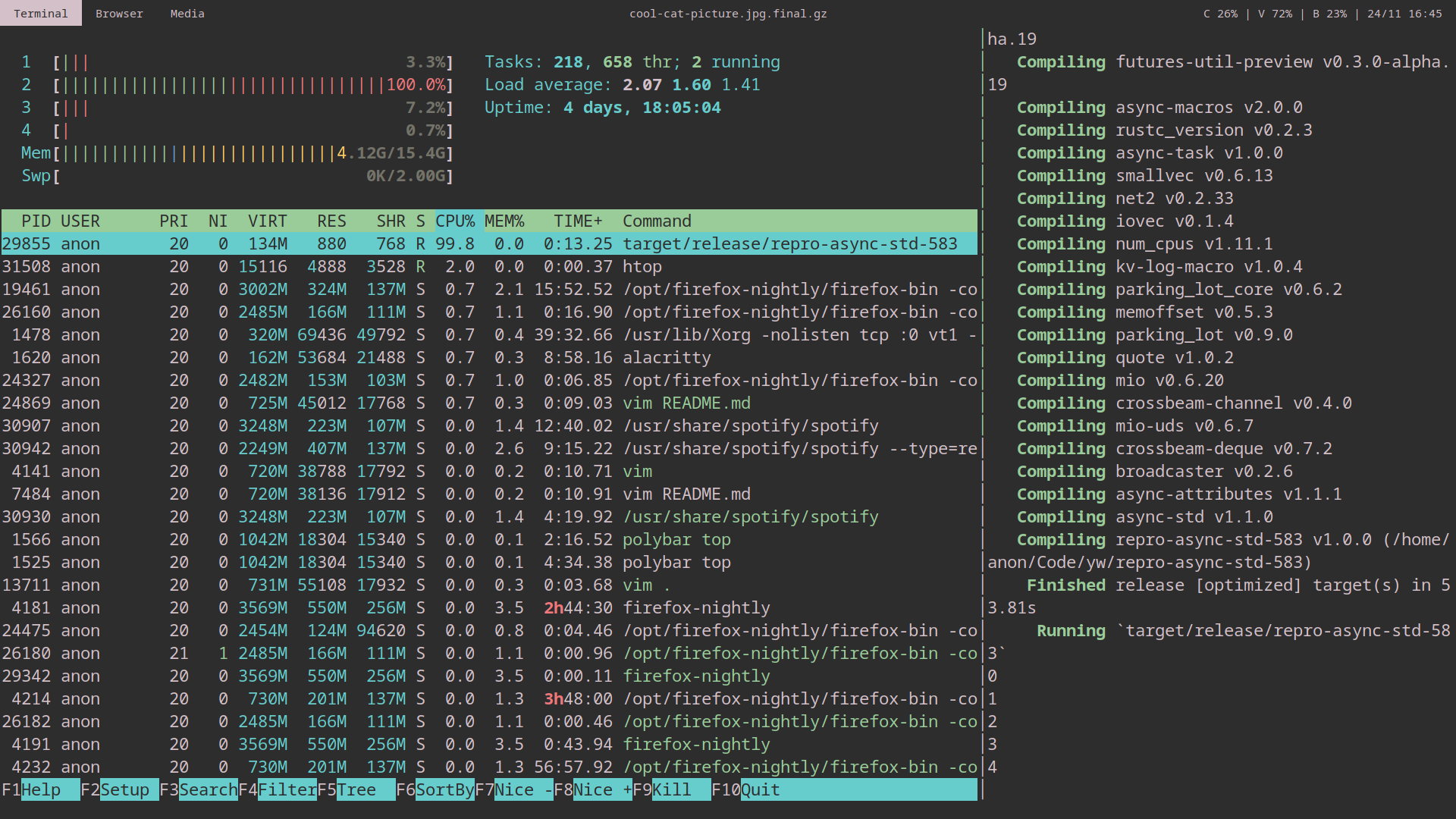
I now suspect this is caused because thread::sleep is called, and our scheduler doesn't know how to handle that so it bounces the task around indefinitely. The spikes seem to be happening only once thread::sleep is hit.
yoshuawuyts
on 24 Nov 2019
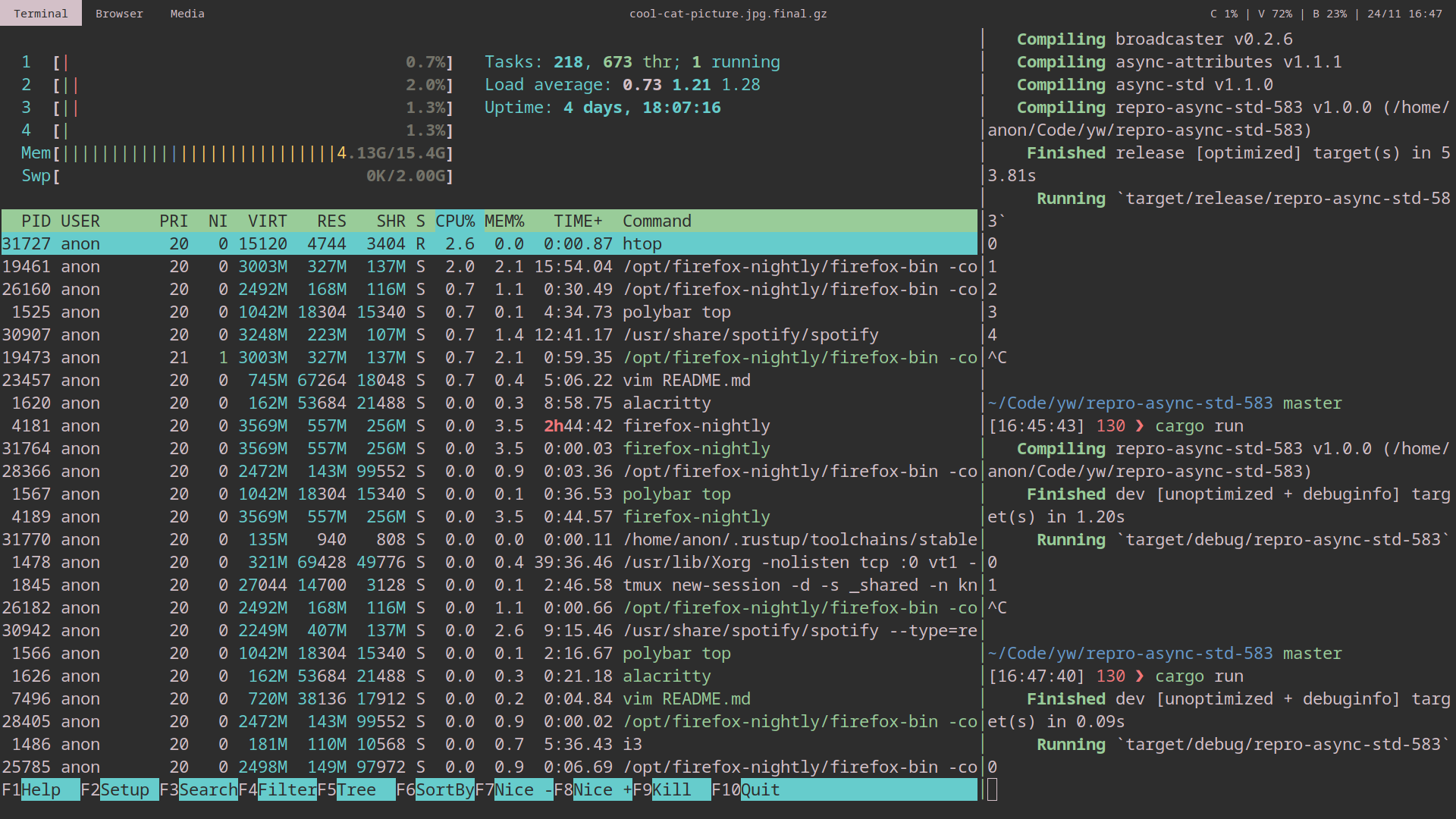
When applying this patch:
diff --git a/src/main.rs b/src/main.rs
index fa8dfed..b2d8e8a 100644
--- a/src/main.rs
+++ b/src/main.rs
@@ -8,7 +8,7 @@ use std::time::Duration;
 #[async_std::main]
 async fn main() {
     let (requests_tx, requests_rx) = channel::<i32>(10);
-    let mut requests_rx = requests_rx.throttle(Duration::from_secs(1));
+    let mut requests_rx = requests_rx.throttle(Duration::from_secs(10));

     thread::spawn(move || {
         task::block_on( async {
The output doesn't seem to spike, further corroborating the theory that this is caused by thread::sleep confusing the scheduler.
yoshuawuyts
on 24 Nov 2019
Okay, no it's not the threads happening. I think you're right and it's indeed something about debounce perhaps? Will run a flame graph next.
Tested it with this patch, and got the same results:
diff --git a/src/main.rs b/src/main.rs
index fa8dfed..7c71e3a 100644
--- a/src/main.rs
+++ b/src/main.rs
@@ -2,7 +2,6 @@ use async_std::stream::StreamExt;
 use async_std::sync::channel;
 use async_std::task;

-use std::thread;
 use std::time::Duration;

 #[async_std::main]
@@ -10,14 +9,14 @@ async fn main() {
     let (requests_tx, requests_rx) = channel::<i32>(10);
     let mut requests_rx = requests_rx.throttle(Duration::from_secs(1));

-    thread::spawn(move || {
+    task::spawn(async move {
         task::block_on( async {
             for i in 0..5 {
                 requests_tx.send(i).await;
             }
         });

-        thread::sleep(Duration::from_secs(100));
+        task::sleep(Duration::from_secs(100)).await;
     });

     while let Some(item) = requests_rx.next().await {

yoshuawuyts
on 24 Nov 2019
Yes okay, if we remove the throttle call the problem indeed goes away. So it seems to be that when throttle is in a suspended mode something is causing it to spin. Maybe we're hitting a waker loop of sorts?
diff --git a/src/main.rs b/src/main.rs
index fa8dfed..4839cc2 100644
--- a/src/main.rs
+++ b/src/main.rs
@@ -8,7 +8,7 @@ use std::time::Duration;
 #[async_std::main]
 async fn main() {
     let (requests_tx, requests_rx) = channel::<i32>(10);
-    let mut requests_rx = requests_rx.throttle(Duration::from_secs(1));
+    let mut requests_rx = requests_rx;

     thread::spawn(move || {
         task::block_on( async {

yoshuawuyts
on 24 Nov 2019
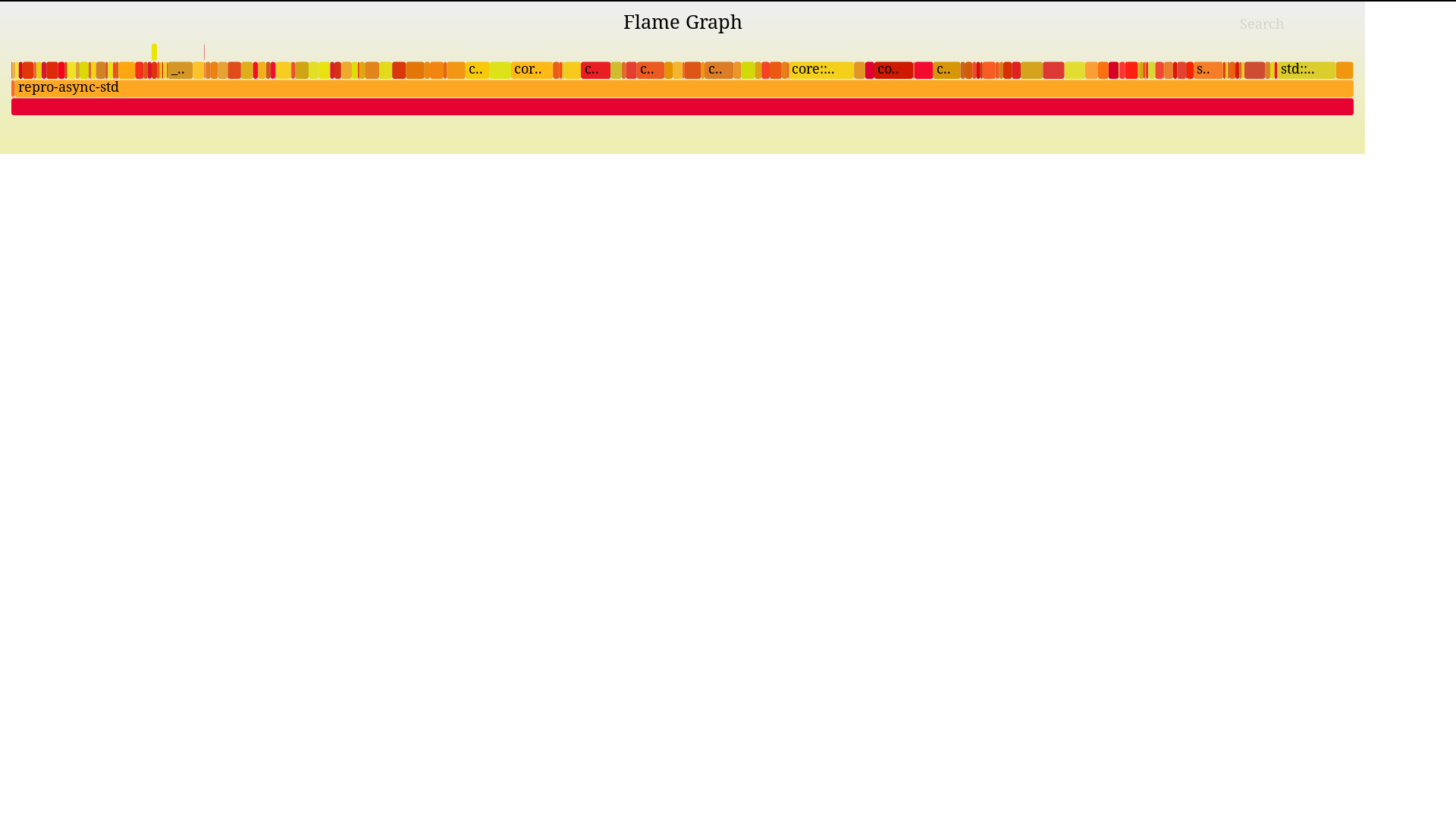
Okay, ran the flame graph locally, but nothing stands out really. It's a flat line it seems :sweat_smile:
yoshuawuyts
on 24 Nov 2019
Okay, it seems that I forgot to remove the task::block_on call from task::spawn when I was testing that out. The CPU spikes go away if we remove it.
diff --git a/src/main.rs b/src/main.rs
index fa8dfed..ff7dae9 100644
--- a/src/main.rs
+++ b/src/main.rs
@@ -2,22 +2,19 @@ use async_std::stream::StreamExt;
 use async_std::sync::channel;
 use async_std::task;

-use std::thread;
 use std::time::Duration;

 #[async_std::main]
 async fn main() {
     let (requests_tx, requests_rx) = channel::<i32>(10);
-    let mut requests_rx = requests_rx.throttle(Duration::from_secs(1));
+    let mut requests_rx = requests_rx.throttle(Duration::from_secs(10));

-    thread::spawn(move || {
-        task::block_on( async {
-            for i in 0..5 {
-                requests_tx.send(i).await;
-            }
-        });
+    task::spawn(async move {
+        for i in 0..5 {
+            requests_tx.send(i).await;
+        }

-        thread::sleep(Duration::from_secs(100));
+        task::sleep(Duration::from_secs(100)).await;
     });

     while let Some(item) = requests_rx.next().await {
Seems like this might still be related to #358?
Either way, this doesn't seem like much of a priority to fix I think; using block_on and thread::* APIs inside of a task should be discouraged, and is definitely not using the APIs the way we intended it to. Even if it takes up more CPU than it should, at least it doesn't deadlock which seems to have been the purpose. I don't think this should be a priority to address. @stjepang what do you think?
@tekjar if you apply the patch above, the performance issues you experienced should go away (:
yoshuawuyts
on 24 Nov 2019
thread::spawn(move || task::block_on(async {
        let requests_tx = requests_tx;
        for i in 0..10 {
            requests_tx.send(i).await;
        }

        task::sleep(Duration::from_secs(100)).await
    }));
Does this look like a legitimate use case? Looks so to me and cpu spikes in this case as well. task::block_on inside thread::spawn is a very similar case to using task::block_on in main.
using
block_onandthread::*APIs inside of a task should be discouraged, and is definitely not using the APIs the way we intended it to
Sure. But in my head, worst case of using synchronous apis inside a cooperative eventloop should cause a block (and hence no progress), not cpu spikes.
tekjar
on 24 Nov 2019
@tekjar if you apply the patch above, the performance issues you experienced should go away (:
It doesn't to me. Maybe your throttle duration is very high (10 secs) and you are not waiting enough time?
I think you should wait for 50 seconds in your case
tekjar
on 24 Nov 2019
thread::spawn(move || {
    task::block_on( async {
            for i in 0..5 {
                requests_tx.send(i).await;
            }
    });

    thread::sleep(Duration::from_secs(100));
});
Is this pattern very weird in async world. To me, all the asynchronous code is encapsulated in task::block_on. I would've used task::sleep inside it. But using thread::sleep outside doesn't look like an anti pattern
tekjar
on 24 Nov 2019
Here is your busy-loop: https://github.com/async-rs/async-std/blob/50cefce803c88f3cd321b3bc181427b2bc4b30ce/src/stream/stream/throttle.rs#L59
Removing the line should fix things. Actually this should lead to a busy loop in every use of throttle where the polled Stream is not immediately ready. I guess @tekjar is just the first one who use it (or noticed the CPU going wild).
The usage pattern of @tekjar looks fine to me. It's doing thread blocking operations in a thread, and not in a task.
 Matthias247
on 25 Nov 2019
Matthias247
on 25 Nov 2019
Related issues
yoshuawuyts
·
6Comments
 imtsuki
·
5Comments
imtsuki
·
5Comments
 95th
·
7Comments
95th
·
7Comments
 Nokel81
·
3Comments
yoshuawuyts
·
8Comments
Nokel81
·
3Comments
yoshuawuyts
·
8Comments
Most helpful comment
Here is your busy-loop: https://github.com/async-rs/async-std/blob/50cefce803c88f3cd321b3bc181427b2bc4b30ce/src/stream/stream/throttle.rs#L59
Removing the line should fix things. Actually this should lead to a busy loop in every use of
throttlewhere the polledStreamis not immediately ready. I guess @tekjar is just the first one who use it (or noticed the CPU going wild).The usage pattern of @tekjar looks fine to me. It's doing thread blocking operations in a thread, and not in a task.